
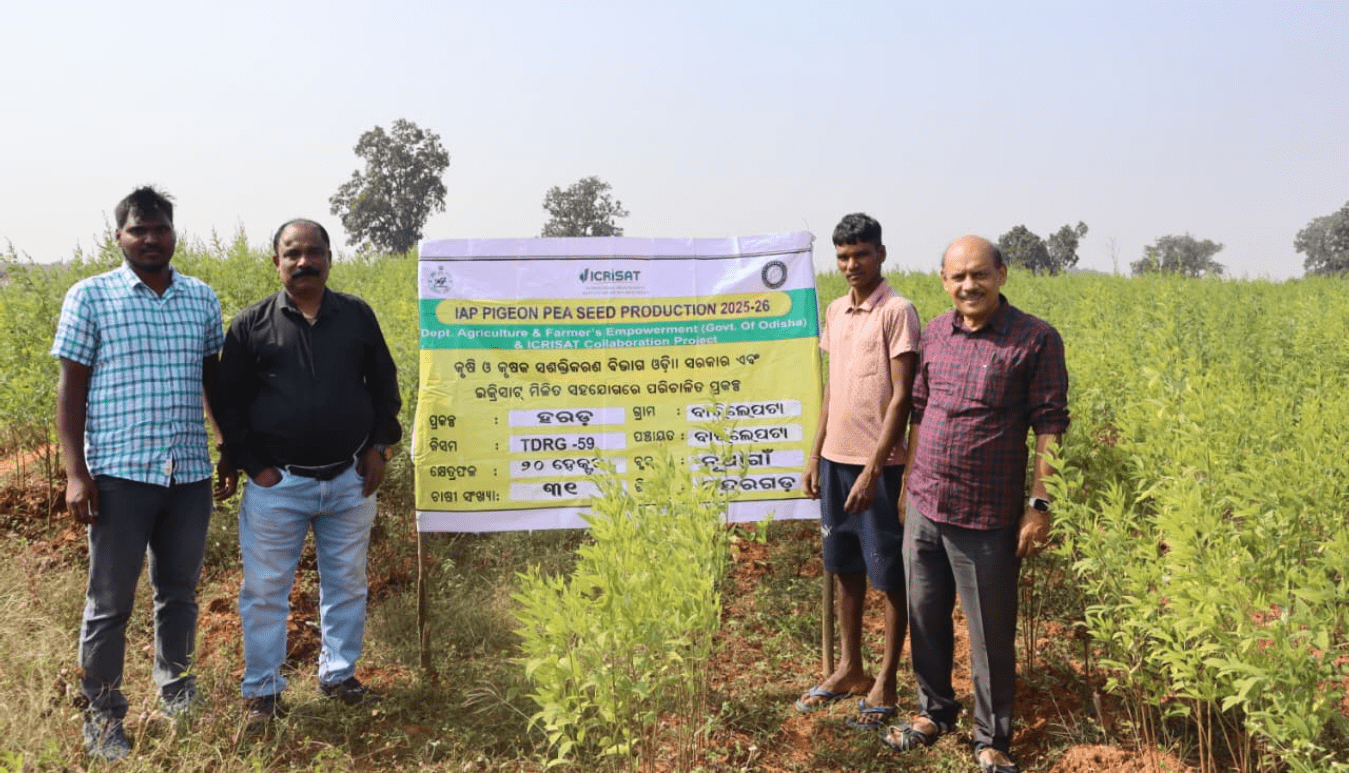
ICRISAT and the provincial government of Odisha have worked together over this rabi season to produce pigeon pea and other seed crops. Photo: ICRISAT
FAVOURABLE early-season weather conditions, adequate soil-moisture reserves, and high water reservoir levels may have boosted India’s winter crop planting program, but the climate cycle has flipped, with the forecast now pointing to warmer, drier conditions this month after an unusually warm January.
According to the Indian Agriculture Ministry’s crop update as of January 30, planting of the primary winter crops, commonly known as rabi crops on the Indian subcontinent, had been completed. The data shows that the nation’s seeded area has risen 2.2 percent from 66 million hectares (Mha) in 2024-25 to 67.4Mha this season. This compares to the long-term rabi crop average of 63.8Mha.
Wheat accounts for 49.6pc of that total, with a record 33.4Mha sown down to the critically important cereal crop in 2025-26. This is up 1.9pc from 32.8Mha last season, and 7 percent above the long-term average of 31.2Mha.
The coarse-grain area increased 1.6pc season on season from 6Mha to 6.9Mha, 10.1pc above the long-term average of 5.5Mha. The corn and barley areas of 2.9Mha and 700,000ha are 4.9pc and 21.2pc higher respectively, while sorghum plantings decreased 8.1pc to 2.3Mha.
Oilseeds are a vital winter crop in India each season, with the final 2025-26 area reported to be 9.7Mha, 3.8pc higher than the 9.4Mha seeded in 2024-25. Rapeseed and mustard seed collectively account for 91.9pc of the oilseed area with 8.9Mha, up from 8.7Mha a season earlier.
Outside of wheat, pulses occupy the second-largest rabi crop area in India each season. The nation’s farmers have committed 13.7Mha to a range of pulse crops in 2025-26, an increase of 2.9pc from 13.3Mha last season, but 2.4pc below the long-term average of 14Mha. Gram, or chickpeas, accounts for 70.2pc of that total with 9.6Mha, up from 9.1Mha in 2024-25. Lentils are the other pulse crop of note, with 1.8Mha planted in 2025-26, 2.6pc higher than last season and 13.2pc of the total pulse area.
Crop off to good start
Field reports indicate good establishment of early sown crops, with most regions experiencing very few seeding delays. The ideal planting conditions reportedly resulted in better seedbed preparation this season, and the relatively advanced planting pace can be attributed to the heightened adoption of zero-tillage farming systems and the rapidly increasing use of precision planters. Cooler nighttime temperatures post sowing also aided crop growth.
Establishment of later-planted crops has been good, aided by some timely late January rain that partially restored soil-moisture reserves. Nonetheless, January rainfall across the country as a whole was only 68.5pc of the long-term average. Had that rainfall not eventuated, water scarcity would have been a serious problem for rabi crops, with evapotranspiration rates far higher throughout the month due to the higher-than-average temperatures. The late January rainfall also played a crucial role in advancing root development.
However, the forecast for a warm and dry February, and a short spring, particularly across the north-western and central regions, does not bode well for the development of key winter crops such as wheat, barley, sorghum, rapeseed and chickpeas. According to an early February update from the India Meteorological Department, the country’s north-western wheat-growing region is likely to receive less than 78pc of its long-term rainfall average.
The forecast for fewer, less intense western disturbances means that daily maximum and minimum temperatures are also expected to be above average across most of the country in February. Western disturbances are non-monsoonal, low-pressure extratropical storms originating in the Mediterranean region that bring essential winter rain, locally called Mahawat, and snow to north-west India between December and March. These eastward migrating systems are crucial for rabi crop production in India.
Crops such as wheat and barley, which have shallower root systems, could suffer yield losses if it remains warm and dry, as the above-average temperatures may accelerate crop growth and shorten the critical reproductive growth phase. The unseasonal weather may also push crops such as rapeseed, mustard, chickpeas and lentils to mature prematurely in some areas, leading to poor pod development, reduced seed size and lower yields.
The sudden change in the Indian weather outlook is likely to jeopardise the government’s lofty 2025-26 winter-crop production forecast of 171.14 million tonnes (Mt) of foodgrains. This includes a record wheat output projection of 119Mt, making it the eighth such record in the past nine years: an extraordinary run of good seasons. The Agriculture Ministry is also forecasting pulse production of 16.57Mt, nutri-cereal output of 3.17Mt, primarily sorghum, corn production of 14.5Mt, record barley output of 2.05Mt, and 15.07Mt of oilseeds.
Fertiliser demand unprecedented
Fertiliser demand suggests that early-season grower confidence was extremely high, with sales of urea reaching unprecedented levels late in 2025. November sales reached 3.75Mt, the second-highest monthly consumption on record and an increase of 4.7pc over November 2024 levels. December sales reached an all-time high of 5.76Mt, a year-on-year increase of 9.6pc, and surpassing India’s previous all-month record of 5.4Mt set in July 2025.
India has a fertiliser subsidy system that provides direct government support, enabling farmers to purchase urea at controlled prices significantly below international market rates. This policy framework creates demand that exceeds what would occur under open-market conditions, essentially establishing an inelastic demand curve during critical agricultural seasons. The effectiveness of this subsidy mechanism is demonstrated by the rapid inventory depletion in December, where the higher sales outweighed production of 2.69Mt and imports of 826,000t, resulting in a 2.24Mt reduction in urea stocks, the highest monthly drawdown since July 2020.
HAVE YOUR SAY