
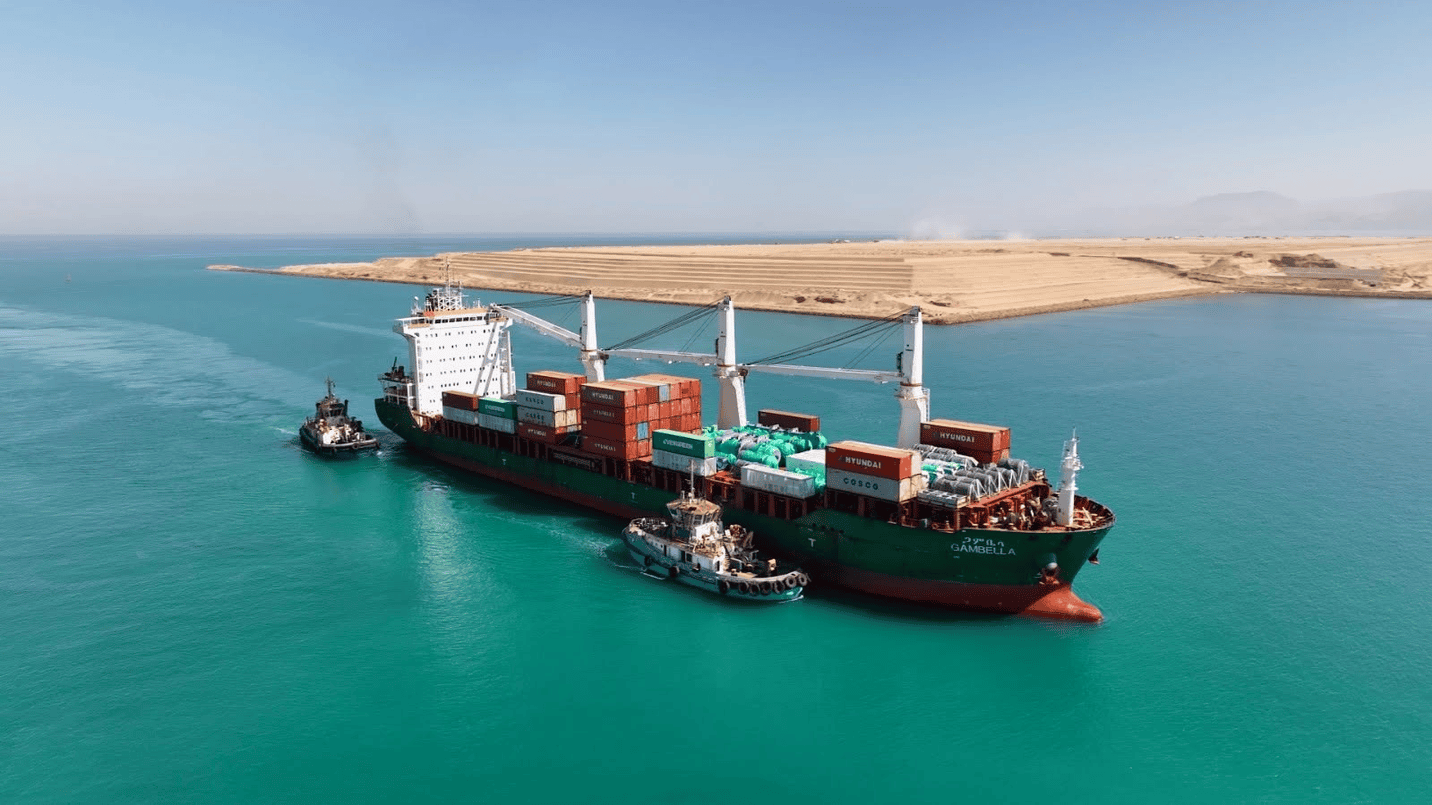
The Gambella departed the Egyptian port of Sokhna last week and is awaiting orders as its international traffic on the Red Sea quietens due to Houthi activity. Photo: Maritime Transport and Logistics Sector, Egyptian Government
AS THE war between the United States and Iran enters its eighth month, and the Strait of Hormuz remains closed, another global trade chokepoint is re-emerging. With the Iran-backed Houthi rebels now controlling almost all of Yemen’s Red Sea coastline, the conflict has an unimpeded extension into the Bab el-Mandeb Strait, disrupting trade, energy flows and threatening freedom of navigation in the crucial international seaway.
Located between Yemen on the Arabian Peninsula and Djibouti and Eritrea in the Horn of Africa, the narrow strait connects the southern end of the Red Sea to the Gulf of Aden and the Indian Ocean. A sea-trade hub between East Africa, Arabia, and India for centuries, the strait gained global significance after the opening of the Suez Canal in 1869, allowing sea trade between Asia and Europe to avoid the long transit around the southern tip of Africa.
The waterway is divided by Mayyun Island, known as Perim Island in English, into a 26km-wide western channel, the deeper option traditionally used for international shipping, and a 3km-wide eastern channel, which is quite shallow and generally used for smaller local vessels.
However, the Bab el-Mandeb Strait, whose Arabic name means “Gate of Tears” or “Gate of Grief” because of the dangerous crosscurrents, hidden reefs and shoals, and wild winds that can make navigation extremely perilous, has rarely lived up to its name more than it does at present.
Seized in a weekend
Over September 11-13, Houthi forces seized the port city of Mocha and the island of Mayyun, giving them control of Yemen’s entire western coastline save for one district near the Saudi Arabian border. While the rebel militia does not command the strait itself, it is no longer necessary. Control of the coastal territory, the range of their missile arsenal, and their maritime disruption capability are enough to significantly increase the risk of passage.
According to reports from Reuters, the Associated Press, and regional wires, Iran’s Islamic Revolutionary Guard Corps (IRGC) directly guided and commanded the Houthi offensive along Yemen’s Red Sea coast. Senior Iranian officials were reportedly on the ground in Yemen overseeing operations rather than just providing logistical and arms support. The Houthis needed less than 48 hours to seize a 115km stretch of coastline from forces aligned with Yemen’s internationally recognised, and Saudi-backed, government.
International impact
The economic consequences are both regional and global, raising fears of even higher oil prices, increased shipping costs, higher food costs and widespread disruption to international trade at a time when inflation is already elevated across much of the world.
The waterway links Asian and Gulf markets to Europe via the Red Sea and Suez Canal and has historically carried some 12 percent of global trade. This includes around 12pc of maritime oil shipments, which equates to 6-7 million barrels per day, and 8pc of LNG trade. More recently, it has been a lifeline to Saudi Arabia’s oil export program, piping product across the peninsula from Arabian Gulf ports to Red Sea ports to avoid the Strait of Hormuz.
Beyond energy traffic, vessels transiting the strait carry bulk commodities such as grain, oilseeds, fertiliser, and raw materials as well as a wide range of manufactured goods moving between Asian production centres and European markets. Around 25pc of global container trade and one-third of international seaborne fertiliser trade transits the strait each year.
Each year, approximately 76 million tonnes (Mt) of grains, oilseeds, and oilseed products move from key exporter regions in the Northern and Southern hemispheres through the Bab el-Mandeb Strait. Collectively, this represents around 17pc of global trade in those food commodities. Wheat is the most heavily impacted grain, with roughly 19pc of annual seaborne wheat trade navigating the passage each season en route to consumers across Africa, Asia and the Middle East.
Although the rebels have stated that navigation is “safe” for all except Saudi Arabian-owned and flagged vessels, it remains uncertain whether Western shipping companies will continue to take on the transit risk. The alternative is to sail around Africa via the Cape of Good Hope, adding thousands of kilometres to a voyage, meaning longer travel times, higher insurance premiums and a costlier journey.
Grain and oilseed supply chains globally will need to reorganise their supply pipelines, bring procurement programs forward, build more storage capacity to reduce the reliance on hand-to-mouth import programs, and look to alternate origins as a means of hedging against potential shipping delays.
Currently, four out of five people globally live in countries that depend on imports to feed their populations. Many countries worldwide depend almost entirely on imports from the world’s breadbasket regions to meet domestic grain demand. Much of that trade relies on safe transit through the Bab el-Mandeb Strait.
For example, Djibouti depends on imports for virtually all of its cereal requirements, and ultimately on the Black Sea region for almost three-quarters of those purchases. Around 75pc of Ethiopia’s imported grain and oilseed requirements come via the Suez Canal to the Port of Djibouti from either EU, US or Black Sea exporters. More than 40pc of Tanzania’s and Uganda’s grain imports, predominantly wheat, come out of the Black Sea region via the Bab el-Mandeb Strait to ports on Africa’s east coast.
For the first time ever, both the Strait of Hormuz and the Bab el-Mandeb Strait are simultaneously under hostile control. Add the Panama Canal’s transit issues due to drought and low water levels, and navigation via three of the world’s key trade chokepoints is under grave threat, seriously jeopardising global energy and food security, and stoking the inflation fire.
HAVE YOUR SAY