
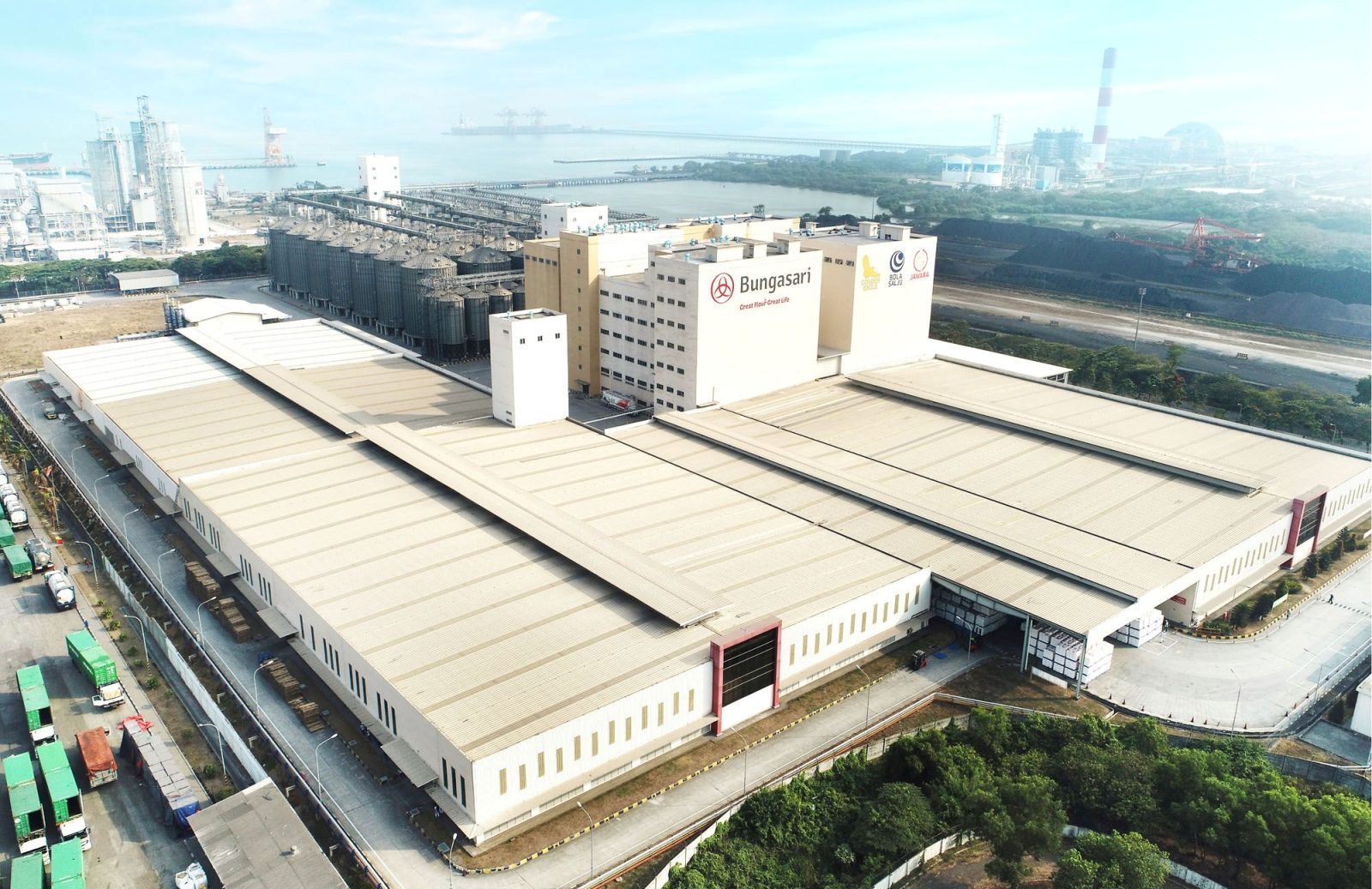
Indonesia’s wheat imports are on the rise thanks to demand from mills including this one in West Java. Photo: PT Bungasari Flour Mills
INDONESIAN wheat imports are forecast to rebound in the 2025-26 marketing year to June, primarily driven by growing optimism, especially among the younger middle class, and by improving economic stability after a prolonged period of inflation and uncertainty.
Indonesia does not produce wheat because its hot, humid tropical environment is unsuitable for the cultivation of the cereal crop, which thrives in more temperate zones further away from the equator. Moreover, high-value alternative crops such as palm oil are better suited to the climate and offer much higher economic returns. Consequently, the world’s largest archipelagic nation is totally reliant on imports to meet domestic wheat obligations.
The United States Department of Agriculture elevated Indonesia to the top of the worldwide wheat importer list for the current season in its latest global supply-and-demand update, released last Friday. By adding 200,000 tonnes to the import task, the US agency raised the estimate to 13.2 million tonnes (Mt), up from 10.5Mt in 2024-25.
This puts Indonesia just ahead of Egypt, unchanged at 13Mt in the April report, with Algeria rounding out the podium, also unchanged at 9.5Mt. Türkiye is next on the list, unchanged month on month at 7.7Mt, followed by Bangladesh, 200,000t higher at 7.6Mt, The Philippines, unchanged at 7.6Mt, Vietnam 700,000t higher at 7.3Mt and Morocco 200,000t lower at 7Mt.
USDA also increased Indonesian wheat consumption for the 2025-26 marketing year, pegging it at 12.3Mt, 100,000t higher than the previous month’s report, and up from 10.8Mt last season. Food, seed, and industrial (FSI) use accounts for 10Mt, or 81.3pc of domestic demand, while the balance of 2.3Mt goes to the stockfeed industry. This compares to FSI and stockfeed demand of 9.4Mt and 1.4Mt respectively in 2024-25.
Changing tastes
According to the Jakarta-based bureau of the USDA’s Foreign Agricultural Service, the Indonesian flour industry continues to expand, currently comprising 31 mills with a total installed capacity of 14.8 Mt annually. In line with population growth, urbanisation rates, new flour-based food trends, and increased consumer demand for food diversity, prospects for continued industry growth remain positive, despite the weakening value of the rupiah relative to the US dollar.
The nation’s middle class is dominated by Generation Z, the oldest of which turned 30 last year. They like to try new products and seek new taste experiences, which is driving growing demand for greater nutritional variety and the cultivation of new flour-based food trends. More high-end restaurants and bakeries are opening across the country, offering new and globally trending flour-based foodstuffs. The Indonesian Food and Beverage Industry Association estimates that the domestic food and beverage industry grew by 6.3 percent in 2025.
Government restrictions on feed
The government permits flour mills to regularly import milling wheat, while severely restricting international purchases by feed mills and traders. Feed wheat imports are delegated to a state-owned enterprise, and the government only sanctions international purchases when deemed critical.
In the second half of 2025, lower corn production led to a spike in domestic corn prices, forcing stockfeed manufacturers to increase the use of wheat as an energy source in ration formulations at the expense of corn. Strong industry lobbying led the government to issue additional feed wheat import permits for both the 2025-26 and 2026-27 seasons to meet the projected increase in demand.
Around 71pc of Indonesia’s wheat flour production is consumed by the myriad small to medium-sized enterprises scattered around the many islands. These tend to be traditionally managed, family-owned businesses, including small-scale wet noodle makers, street food vendors, low and mid-sized bread and bakery businesses, and traditional Indonesian cake-makers. Many of these ventures are modernising equipment and improving production capacity as the economy recovers.
Imports spike
In the seven months to the end of January 2026, Indonesia imported just under 7.8Mt of wheat, a 30.4pc increase from the 6Mt imported over the same period in the 2024-25 marketing year. Australia remains the dominant supplier, accounting for 2.92Mt over that period, enjoying a freight advantage over more distant suppliers, as well as the Indonesian consumer’s preference for yellowish noodles made from Australian wheat.
That constitutes 37.8pc of the total seven-month import program, almost double Ukraine’s 18.3pc share, and more than double Canada’s 16.1pc contribution. With a record wheat crop and a huge export program to execute before the 2026 row-crop harvest chokes the export pathway, Argentina’s share of the Indonesian import market is expected to spike when customs statistics for February, March and April are revealed.
The Memorandum of Understanding that was signed by the Indonesian Flour Mills Association and the US Wheat Associates on July 7 last year, a result of Trump’s tariff tirade, saw the US market share jump from 6.9pc in the first seven months of 2024-25 to 12.5pc in the same period a year later.
While locally produced flour dominates with a 99.9pc market share, wheat flour imports in the 2025-26 marketing year to the end of January did increase by 53.7pc to 87,500t wheat equivalent. Türkiye supplied 96.2pc of the total, with Vietnam the second-biggest seller with 2.3pc market share.
HAVE YOUR SAY