
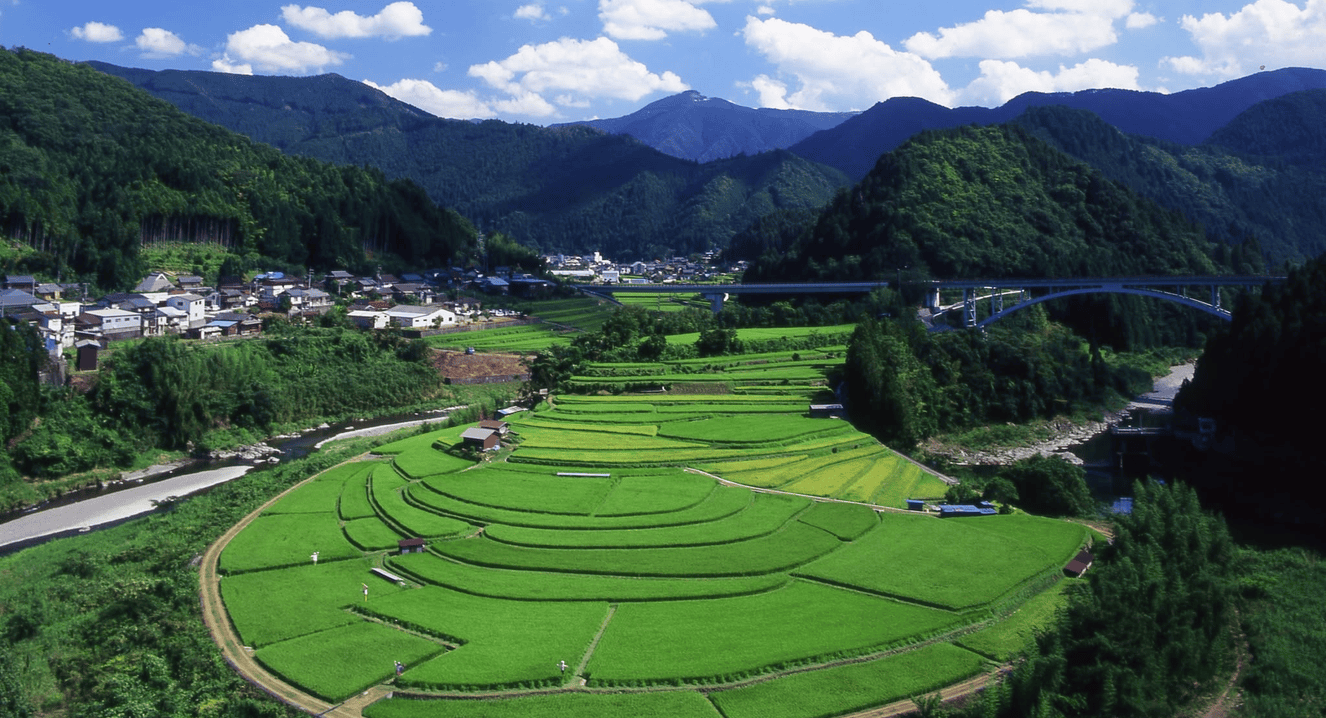
Rice growing last year in the Aragi-jima Island district south of Osaka. Photo: Ministry of Agriculture, Forestry and Fisheries of Japan
RICE production in Japan continues to rebound, with retail distribution of the nation’s newly harvested rice crop now in full swing. This has pushed retail prices lower than old-crop shelf stock, welcome news for shoppers, but a disaster for the nation’s farmers who are now struggling to make ends meet.
Drought and extreme heat severely damaged Japan’s 2023 rice crop, reducing milled output to its lowest level in more than 10 years, just as restaurants filled and demand surged after the pandemic. This led to a national supply shortage so severe in the lead-up to the 2024 harvest that it precipitated a ministerial resignation. Retail prices doubled, and the government was forced to release stocks from its emergency reserves.
However, chasing higher returns, Japan’s farmers ramped up production. By 2026, supply has swung so far in the opposite direction that the nation is sitting on a record surplus, and prices have crashed, forcing the government to buy back old-crop stocks off-market to prevent prices from collapsing further.
Retailers normally discount old-crop rice once the new harvest arrives. But this year, distributors say they cannot cut prices that far because they paid so much for last year’s supply. On top of the production rebound in 2025, official forecasts failed to predict the drop in consumption driven by rising prices, changing eating habits and an aging population. Supply has overshot demand so completely that private stocks climbed from a low of 1.5 million tonnes (Mt) in 2024 to 2.5Mt by mid-2026, well above the government’s preferred stock buffer of 2Mt.
Last month, the Japanese government decided to repurchase some of the emergency reserves it released last year, as well as adding a portion of this year’s harvest to its stockpile. The move aims to support domestic farmers by preventing a further collapse in rice prices.
Rice production in 2026 is estimated at 7.4Mt milled rice equivalent, slightly higher than last year’s harvest of 7.3Mt, according to the United States Department of Agriculture’s Tokyo-based attaché. This comes from a harvested area of 1.49 million hectares, netting a milled rice equivalent yield of 4.96t/ha, compared to 1.47 million hectares and 4.96t/ha in 2025, respectively.
Japan’s 2026-27 marketing year begins at the start of next month with an opening stocks projection of 2.5Mt, up 25 percent year-on-year, according to the USDA’s Foreign Agricultural Service. Imports are forecast at 700,000t, in line with Japan’s World Trade Organization Tariff-Rate Quota obligation. This puts total 2026-27 rice supply at 10.6Mt.
Staple
Rice has long been a dietary staple in Japan, traditionally the population’s primary energy source. However, per capita consumption continues to decline as economic prosperity increases. On average, people consumed 1,106 kilocalories per annum from rice in 1960, but this declined to less than 500 kcal by the early 2020s as Japanese consumers diversified their food choices. However, that decline has reversed slightly in recent years as the depreciating yen forced up the price of imported food items.
The FAS bureau in Tokyo expects 2026-27 rice demand to be 7.9Mt, including exports of 700,000t. Domestic consumption of 7.2Mt includes food and feed sector demand of 6.25Mt and 950,000t, respectively. The feed rice component is up around 200,000t compared to 2025-26, which is likely to affect the volumes of feed corn and feed wheat consumed in the 2026-27 marketing year.
Meanwhile, the FAS expects Japan’s wheat production in 2026-27 to remain just above 1Mt off a slightly lower planted area than last season, as many farmers continued to prioritise rice production on their paddies due to better gross margin expectations at the time of planting.
Wheat
Total wheat consumption is expected to fall from 6.4Mt in the 2025-26 marketing year to June to 6.2Mt in 2026-27. At 5.4Mt, the food, seed and industrial category accounts for more than 84pc of domestic demand but is down slightly from 5.5Mt last season, as the resale price of wheat increases by around 12pc and rice prices decline. Feed sector use is also tipped to drop from 900,000t to 800,000t as stockfeed inclusion rates of feed rice increase at the expense of wheat due to prevailing price relativities.
Like rice, wheat is a state-traded commodity, and Japan relies on imports to satisfy the vast majority of its consumption requirements. The USDA’s attaché projects wheat imports of 5.5Mt (wheat grain equivalent) this season, down from 5.7Mt in 2025-26. The import figure includes almost 300,000t of processed wheat products such as flour, noodles and pasta, couscous and bulgur. Wheat exports are forecast to remain unchanged at around 300,000t, 80pc of which is premium wheat flour into Asian markets for use in boutique bakeries.
Food barley
With domestic production of around 200,000t this season, Japan’s barley demand of 1.34Mt is supported by imports of 1.1Mt in 2026/27. Food, seed and industrial use is forecast to recover slightly to around 360,000t. Food barley is used in a range of Japanese staple foods and beverages, including beer, shochu liquor, barley tea, barley miso, roasted barley “hattai” flour, and granola.
However, food barley use has been progressively declining, driven by factors such as fewer after-work drinking gatherings since the pandemic and reduced alcohol consumption among younger consumers. Feed barley consumption is forecast to decrease a tad to 980,000t, reflecting a decline in Japan’s cattle herd.
Special-use imported barley
Japan generally imports two-row hulled barley for beer malt and shochu from Australia, six-row hulled barley for barley tea and other uses from Canada, and hull-less barley for use as a rice extender from the United States. It uses Australian and Canadian barley, as well as domestic off-grade barley, for stockfeed.
HAVE YOUR SAY