
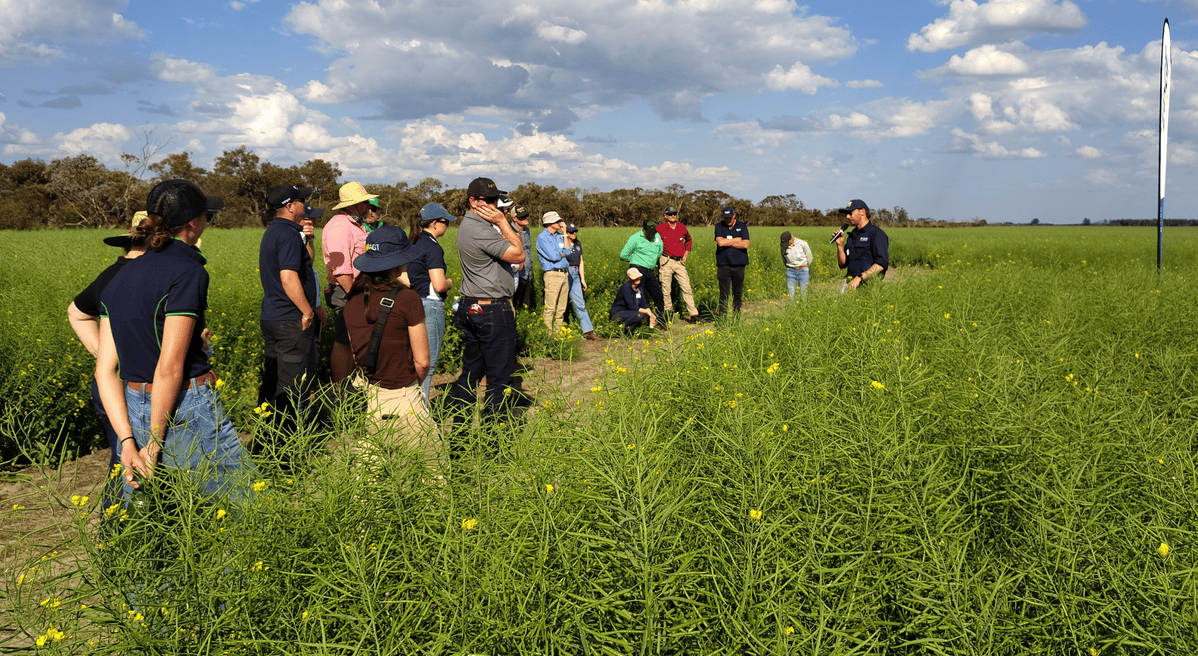
Stirlings to Coast’s Spring Field Day in the South Stirling district last week. Photo: Stirlings to Coast Farmers
AUSTRALIA exported 212,244 tonnes of canola in July, down 28 percent from the 294,291t shipped in June, according to the latest export data from the Australian Bureau of Statistics.
France on 112,904t was the biggest market by far for July-shipped canola, followed by Japan on 87,168t, and Nepal on 7049t, as Australia entered the last quarter of its shipping year.
The July 2026 figure is well above the 154,801t exported in July 2025, part of the 2025-26 (Oct-Sep) export program which saw 5.4 million tonnes (Mt) shipped to all destinations.
In its monthly supply-and-demand report for canola released on Friday, Lachstock Consulting has lifted its forecast for the Australian canola crop about to be harvested to 7.86Mt.
This is above ABARES 7.27Mt, which was revised up on September 1 from 6.19Mt seen June 2, and sits behind only the record production year of 2022-23 which ABARES puts at 8.64Mt.
Record exports on cards: Lachstock
Lachstock forecast Australia’s 2026-27 exports at a record 6.55Mt for the shipping year starting October 1, which includes 2.2Mt to China over its importing year which will end in June.
“China remains the key swing factor, particularly for GM canola, with improved access tightening discounts, although poor Chinese crush margins and heavy soybean buying mean Australian seed will still need to remain competitive,” the Lachstock report said.
“Offshore, the backdrop has become more supportive.”
Lachstock said Canada’s harvest is well behind normal with stocks tight and crush expanding, EU production has disappointed and import requirements are rising, and reduced Ukrainian seed exports and higher domestic processing have tightening nearby European supply.
“Biofuel demand also remains a major pillar, with strong US soybean oil consumption and Indonesian B50 policy supporting the wider vegetable oil complex.
“The key risk is that canola remains heavily tied to energy markets and speculative positioning; any meaningful Middle East de-escalation and fall in crude [oil prices] could remove an important source of support.
“For Australia, the set-up is favourable, but with a huge crop coming, continued Chinese demand will be crucial to preventing harvest pressure from flowing into weaker basis and local values.”
Lachstock said the quality of Australian canola about to be harvested could challenge forecast volume to China.
“If an El Niño develops and the season finishes hotter and drier, there is potential for higher admixture levels.
“Under current Chinese import requirements, non-canola seed material must be below 1pc [and] higher-admixture tonnes may not be eligible for that market.
“If a meaningful volume of GM canola cannot meet the Chinese specification, those tonnes would need to compete into alternative export markets against Canadian seed.
“In that scenario, GM discounts would likely need to widen to make Australian seed competitive and clear the additional volume.”
| CANOLA | May | Jun | Jly | Tonnes |
| Bangladesh | 29280 | 1872 | 834 | 31987 |
| Canada | 0 | 521 | 0 | 521 |
| Belgium | 118419 | 58836 | 0 | 177254 |
| Brazil | 0 | 4 | 0 | 4 |
| China | 60500 | 120274 | 0 | 180774 |
| France | 0 | 0 | 112904 | 112904 |
| Germany | 59479 | 0 | 0 | 59479 |
| Indonesia | 62 | 0 | 70 | 132 |
| Japan | 66942 | 506 | 87168 | 154615 |
| Malaysia | 2731 | 6626 | 3242 | 12599 |
| Nepal | 13068 | 6317 | 7049 | 26434 |
| New Zealand | 0 | 407 | 0 | 407 |
| South Africa | 0 | 93 | 0 | 93 |
| Sri Lanka | 3382 | 2900 | 976 | 7259 |
| UAE | 89992 | 95934 | 0 | 185926 |
| Uruguay | 0 | 2 | 0 | 2 |
| TOTAL | 443856 | 294291 | 212244 | 950391 |
Grain Central: Get our free news straight to your inbox – Click here
HAVE YOUR SAY