
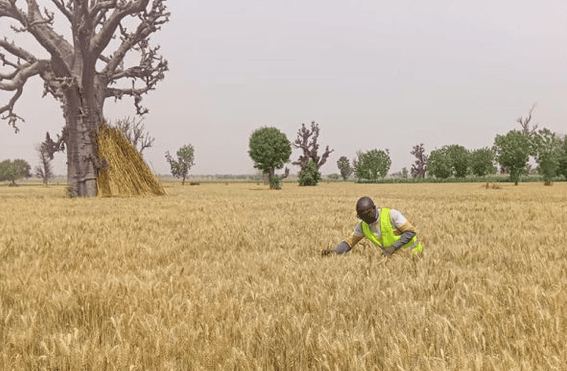
Inspecting wheat growing in north-western Nigeria’s Jega region earlier this year. Photo: Flour Milling Association of Nigeria
NIGERIA remains a major global wheat importer and the largest in sub-Saharan Africa, despite government efforts to increase national production by expanding irrigated wheat area, boosting yields, and building a competitive domestic supply chain.
Wheat, rice and corn all face output declines in 2026-27 driven by increased rural insecurity in key producing regions that has led to lower planted areas, higher input costs, and reduced farmer incentives, while international shipping disruptions and elevated sea freight rates are expected to increase costs for Nigerian grain importers.
Given the low production base, the government’s goal of transforming the nation from a net wheat importer to a self-sufficient producer will be a long journey. Characterised by a series of hits and misses thus far, results from a range of diverse market intervention initiatives, including a blend of subsidies and wheat trade restrictions, have been mixed, with minimal impact on national wheat output.
Agro-Pocket promotes growth
The West African country, with a population of more than 242 million people and annual consumption of more than 22kg of wheat per capita, among the highest in sub-Saharan Africa, has been implementing the National Agricultural Growth Support Scheme – Agro-Pocket (NAGS-AP).
The multi-million-dollar agricultural program, financed by the African Development Bank, aims to increase production of key food grains, with a particular focus on wheat.
Through the program, Nigerian wheat farmers receive 25 percent and 50pc subsidies on seed and fertiliser respectively. They also receive access to extension services, agricultural insurance, credit facilities, climate-smart technologies, and digital platforms for their farming operations.
More recently, the Minister of State for Industry, John Owan Enoh, unveiled Project Wheat-ness, designed to strengthen Nigeria’s wheat-based foods value chain, improve industrial competitiveness, and make food products more affordable for consumers.
Identifying as much as 3.5 million hectares of land with potential for irrigated wheat production, he said the scheme would bring together farmers, millers, food manufacturers, bakers, financial institutions and government agencies to address constraints across the sector.
Regional unrest impacts
Nevertheless, wheat production in Nigeria relies heavily on the northern states, where regional unrest has escalated over the past 12 months. The insecurity issues stem from a mix of Islamist insurgencies that have caused tens of thousands of deaths, armed banditry such as kidnapping for ransom and cattle rustling, farmer-herder clashes exacerbated by climate pressures, and deep economic distress.
The United States Department of Agriculture’s Lagos-based agricultural attaché reports that farmers are likely to face similar or worsening security conditions in wheat-producing regions during the upcoming planting season, which begins in November.
According to the USDA’s Foreign Agricultural Service, Nigeria’s wheat production in 2026-27 is forecast at just 120,000 tonnes, down from 130,000t last season, and well short of domestic consumption requirements. The planted area of 110,000ha was down from 120,000ha in 2025-26, putting the average yield at just 1.1t/ha.
Although USDA data indicates that Nigeria’s wheat output has more than doubled from a low of 55,000t in 2020, the country’s consumption is said to have risen by more than 45pc over the same period, as have wheat imports to meet domestic market requirements.
The FAS forecasts a 500,000t decrease in domestic consumption to 5.4 million tonnes in 2026-27, primarily a reflection of high food inflation and low wage growth. Despite foreign exchange stability, wages and real incomes have not kept pace with rising fuel and transportation costs, leaving consumers with less purchasing power than in the previous marketing year.
Flour accounts for around 70pc of total baking production costs in Nigeria, and prices reportedly declined by about 12pc in the year to May 2026. However, despite the decrease, local bakeries are reducing loaf sizes or altering recipes to maintain the critical sub-1000 Naira (US$0.74) price point for lower-income consumers, a practice that started as other production costs increased, particularly energy and logistics.
With wheat production sitting at a fraction of internal demand, Nigeria will remain structurally dependent on wheat imports in 2026-27. The entrenched gap between local output and ballooning domestic demand keeps Nigerian millers and food processors highly exposed to global wheat prices, freight costs, and local currency exchange-rate volatility.
Inbound wheat shipments are expected to total 5.6Mt, a decrease of 5.6pc from 5.93Mt last season, leaving stocks perilously low at just 250,000t when the current marketing year concludes on July 31.
The decline is attributed to the higher cost of wheat on the international market, with shipping bottlenecks and rising logistics costs restricting shipments from key Black Sea suppliers, Russia, Ukraine and Romania.
Rerouting of vessels to circumvent the Black Sea issues is also increasing freight costs and transit times.
HAVE YOUR SAY