
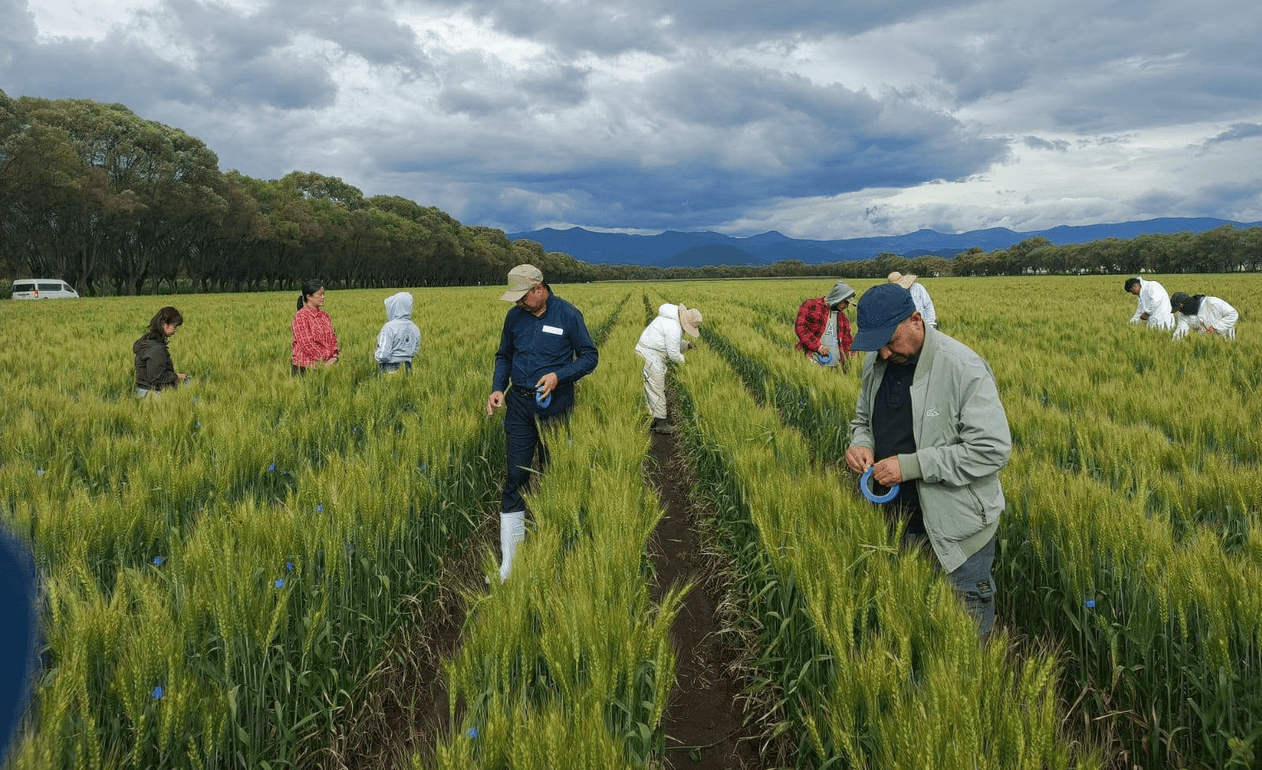
Despite producing its own crop estimated locally at 27.5Mt, Pakistan is calling tenders to import wheat to satisfy domestic demand. Photo: Wheat Research Institute, Faisalabad
PAKISTAN’S strategic wheat reserves have almost been exhausted after the nation’s federal and provincial governments failed to procure sufficient domestic and imported wheat supplies at harvest, despite funding approval from the International Monetary Fund.
The shortage, which has raised concerns among domestic consumers, prompted Food Security Minister Rana Tanveer Hussain to announce on July 24 that the government intended to import wheat from international suppliers to meet domestic demand and stabilise the local market.
The statement, issued by the Ministry of National Food Security and Research, said: “The government will immediately import one million tonne of wheat to meet the provinces’ requirements.” The minister said the state-run Pakistan Agricultural Storage and Services Corporation would also immediately release wheat held in its stores to meet provincial demand, adding that the federal government remained committed to ensuring the availability of affordable, quality wheat.
However, just days later, two of the largest wheat-deficient provinces, Punjab and Sindh, backtracked on an agreement with Pakistan’s Federal Government to buy the imported commodity, ultimately delaying the planned international purchase until the provinces could accurately determine, advise, and finance their requirements.
Crop smaller than expected
Pakistan’s Federal Committee on Agriculture originally expected the 2026 Rabi season wheat harvest to come in at around 29.7 million tonnes (Mt). However, the country’s Space and Upper Atmosphere Research Commission announced in May that it estimated output would be 7.4 percent lower at 27.5Mt, citing a smaller planted area and poorer yields than initially projected. The commission is expecting a harvested area of 8.84 million hectares, almost 600,000ha lower than the estimate championed by the United States Department of Agriculture’s Pakistan-based attaché.
In early May, at the start of Pakistan’s current marketing year, the federal government announced a new wheat-procurement policy, marking a significant transition away from state-dominated buying at harvest to a market-based system that shifted the purchasing responsibility to the private sector.
The intention was to minimise direct government intervention, but the system faltered due to a breakdown in financing arrangements. This was despite incentives for private buyers, including subsidised financing, free storage in food department warehouses, and the deployment of government officials to assist procurement companies. Private purchasing ultimately failed to absorb the harvested grain at the required pace, and the market suffered from speculative buying and concerns over undeclared stocks and hoarding.
According to the Islamabad bureau of the USDA’s Foreign Agricultural Service, domestic demand for wheat will be 30Mt in the current marketing year. This is down from its early-season forecast of 31.3Mt, on the back of price-based rationing, and 700,000t lower than consumption in the previous marketing year. The food, seed and industrial category dominates the balance sheet, accounting for 29Mt, while the stockfeed sector only consumes around 1Mt.
Pakistan’s flour milling industry is well-established, with approximately 1500 flour mills operating across the country. The industry is primarily concentrated in the major wheat-producing provinces of Punjab, Sindh, and Khyber Pakhtunkhwa. The mills produce a variety of products, including wheat flour, refined flour, semolina, and bran. The flour is used to make various traditional breads such as roti, naan, and paratha, as well as other bakery products.
Including the FAS’s projected carry-in of 2.8Mt puts national wheat supply at 30.3Mt. Even allowing for a 1Mt drawdown of stocks across the season, leaving a carry-out of just 1.8Mt, Pakistan’s imports will need to be at least 1.5Mt to satisfy domestic requirements through to the 2027 harvest.
Tender time
Fast-forward to last week, and the Trading Corporation of Pakistan (TCP) finally opened a tender to import up to 750,000t from global wheat suppliers amid persistent shortages in provincial stocks. The tender was open to the latest-crop wheat from any origin that met the required quality standards. The wheat is to be supplied in bulk and priced on a cost and freight (CFR) basis, delivered to the ports of Karachi and Gwadar in November. Once discharged, the wheat will reportedly be distributed according to advised requirements, with Sindh receiving 300,000t, Punjab 250,000t, and Khyber Pakhtunkhwa 200,000t.
Under the tender terms, interested suppliers were required to submit offers for a minimum quantity of 50,000t; 13 parties reportedly participated, nine of which met the technical and financial tender requirements. When the tender closed late in the week, offers totalling 656,000t had reportedly been received with prices ranging from lows of US$348.83/t CFR Karachi, and $352.97/t CFR Gwadar to a high of $369.95/t.
At the time of writing, the Trading Corporation of Pakistan was still actively evaluating the tender offers and had not officially awarded any contracts. However, it is widely expected to trade between $348.83/t and $352.97/t for the full tender volume. The TCP has also floated a subsequent international tender for an additional 185,000t, with offers scheduled to open on September 28.
Domestic traders and millers are mystified as to why authorities failed to buy enough wheat from Pakistani farmers when they had the chance to secure the crop at a much lower cost. Instead of purchasing wheat at harvest for around $316/t, the government let farmers face weak market conditions through harvest and is now buying wheat from international suppliers at a much higher overall cost, especially once it is redelivered to the regions.
High flour prices, driven by the rising wheat cost and escalating fuel prices, are already reported to be rationing flour demand among low and middle-income households. Market participants will watch closely to see whether the additional supplies, once delivered, reach mills and retailers quickly enough to ease pressure on consumers. The import decision is not expected to cause a significant drop in wheat prices in regional markets, but consumers hope that it may provide some resistance to any further price escalation through to the 2027 harvest.
HAVE YOUR SAY