
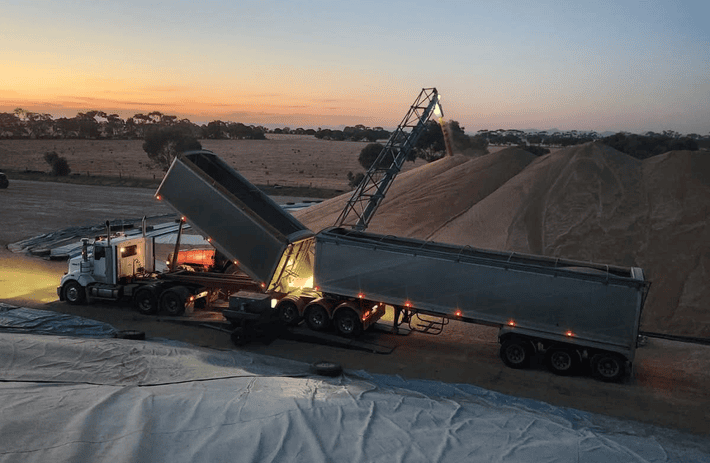
A cereal bunker builds at Willaura in western Victoria in January. Photo: Norph Bulk Storage
WIDE spreads between bid and offer are quashing volume being traded in Australian grain markets.
According to Clear Grain Exchange managing director Nathan Cattle, buyers appear keen to do business based on underlying demand from export and domestic markets, but growers are watchful of risks in their season from here on in.
Mr Cattle said growers were generally well sold on current-crop grain, and those still holding appear to be targeting prices above the highs of last month.

Nathan Cattle.
“Buyers are finding it hard to reach those prices with volume.
Mr Cattle said domestic markets were grappling with the shape of the Australian crop.
“It’s looking decent in southern parts of eastern Australia, but tight in the north.”
Western Australia’s outlook is mixed, and Friday’s Grain Industry Association of WA report will shed some light on conditions by region.
“WA could have a significant production range depending on rains from here.
“That’s seeing price spreads widen between the north and the south in eastern Australia, and buyers seem interested in building cover in the west.”
Offshore influences
Moves in the international wheat market help to explain the gulf between local buying and selling ideas in most of Australia’s regional and port markets.
Internationally, Chicago Board of Trade December 2026 wheat traded sideways last week to sit US60 cents per bushel above the price lows at the end of June, and the same amount below the mid-July price highs, of “right in the middle of a $62/t price range in Australian dollar terms”.
“The market is wrestling with world stock levels expected to diminish this year across wheat and corn, yet the Northern Hemisphere harvest is happening now and grain should be available.
“The US and Europe have suffered drought, and where the excess mostly exists is in the Black Sea, where war is disrupting exports.”
Mr Cattle said nearby global demand for grains has recently shifted from the Black Sea to other origins such as Australia to support prices, but Argentina remains a competitive origin and is capping gains.
“The medium-term perception is that grain is able to move from farms to Black Sea ports; however, it’s not able to be shipped due to the conflict.
“The thought is grain stockpiled at Black Sea ports could flood global markets when/if the conflict improves.”
Meanwhile, large Middle East and North African grain buyers are reportedly comfortable to slow their buying, given their reasonable domestic production, and in the hope they can access Black Sea grain in the future.
This is keeping Australian buyers cautious.
“The longer the conflict disrupts exports from the Black Sea, the tighter things get and the more attractive Australian grain gets; this may well see more price volatility ahead of us.
“There is likely to be demand for volume at prices somewhere between recent traded price highs and the lower published bid prices for many grades.”
“If growers are sellers in that price range it will be important to offer grain for sale at those levels given the skittishness in markets recently.”
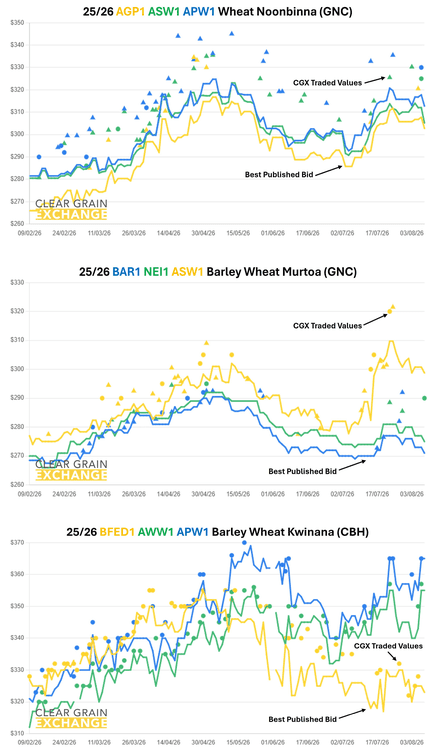
Growers are setting prices and enabling buyer bids to come to those levels across all states and grains. Source: CGX
Mr Cattle said growers should recognise their offer prices have lifted bids.
His advice to growers is to keep offering grain to sell rather than selling into published bids privately where no other buyer can see the price.
“If all buyers can see the price grain is trading at, they know where they need to be to buy grain, either at those prices, or above them.”
“This allows the market to price grain effectively, rather than operating in the dark arts of negotiating private bids which actually diminishes market value.”
CGX last week saw a continued lift in the number of buyers trying to buy Australian grain from growers, and metrics include:
- 30 different buyers purchasing grain through CGX;
- 126 buyer organisations made 4623 searches for grain.
- 36 buyers made 220 bids for grain; and,
- 96 buyers were searching for grain but not able to trade.
“Growers have the opportunity to think about prices they would sell for and offer grain for sale at those prices, rather than watching, waiting and reacting to market price moves each day.”
HAVE YOUR SAY