
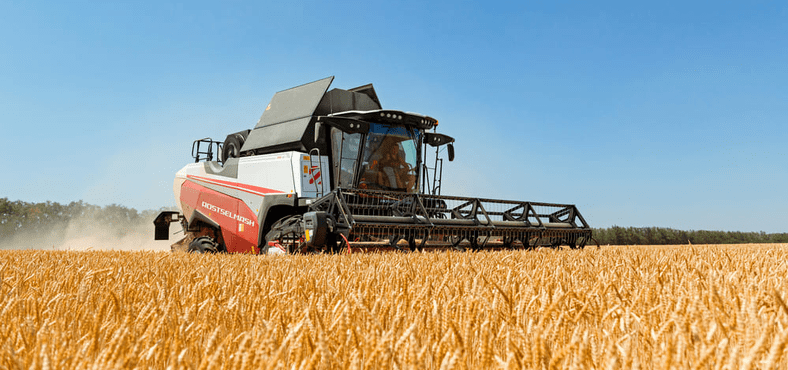
Harvesting cereals in Russia. File photo: Rostselmash Agrotechnics
TOTAL area planted to wheat across the Russian Federation for the 2026 harvest is set to be the smallest in 12 years, with the spring wheat area dramatically lower as a result of persistently unfavourable weather conditions since the campaign commenced.
Snow, rain persist
Meteorologists reported prolonged periods of heavy rain, unusually cold temperatures and lingering snow cover across key agricultural regions in May, seriously delaying field activities and complicating the spring planting program in the central regions, the Volga Valley and Siberia. While progress has been made over the past four weeks, the adverse weather led to one of the slowest starts to the spring campaign in many years, with seeding as much as 50 percent behind last year’s pace in some districts.
Spring wheat typically accounts for around a third of Russia’s total wheat output each season, with timely planting critical as the growing season is so short. A delay in seeding reduces yield potential and leads to harvesting issues in the autumn as the days shorten, rain increases, and snow arrives.
Black Sea agricultural consultancy SovEcon now expects the total Russian wheat area to fall to 25.8 million hectares (Mha) for the 2026 harvest, a drop of 1.1Mha compared to last year. This represents the smallest wheat area since 25.2Mha were sown in 2014 and is the same as the June estimate from the United States Department of Agriculture.
The consultancy is calling the spring wheat area 9.9Mha, down from an early-season projection of 10.5Mha, with local market pundits calling it the smallest spring wheat area in decades. The winter wheat area is pegged at 15.9Mha, unchanged year on year.
SovEcon’s total Russian grain and pulse production forecast for 2026-27 stands at 135.2 million tonnes (Mt), down from its May projection of 137.4Mt, and 4.2pc lower than the 2025 harvest of 141.2Mt. The wheat harvest estimate of 88.9Mt is 1.4Mt lower than the agency’s May estimate.
This month’s global supply and demand update from the USDA pegged the Russian wheat crop at 88Mt. This is 2Mt higher than its May forecast, with the winter and spring wheat production split sitting at 64Mt and 24Mt respectively. The USDA reported that winter wheat yield prospects had been boosted by favourable weather conditions and plentiful rainfall since emerging from winter dormancy. As a result, crop vigour is well above-average, supported by satellite-derived Normalised Difference Vegetation Index (NDVI) data.
The early-season wheat export program is expected to receive a significant supply boost with wheat production in Southern Russia, the nation’s primary export zone, set to jump from last year’s below-average harvest of 31.9Mt to 37.4Mt in 2026. The 2025-26 export program has depleted regional stocks, with exporters eagerly awaiting the new-crop harvest to replenish supplies closer to their Black Sea ports and improve export margins.
At the beginning of June, SovEcon increased its wheat export forecast for the 2026-27 marketing year by 1.1Mt to 46.3Mt, down from 46.8Mt in the current season, which concludes this week. The USDA’s new-crop Russian wheat export projection was unchanged in June at 47Mt, down from its old-crop estimate of 48Mt.
This year’s barley output forecast from SovEcon has been revised 500,000t higher month-on-month to 18.8Mt but still sits 4.6pc lower than the 2025 harvest of 19.7Mt. The Russia-based agency left its corn production outlook unchanged in June at 14.6Mt.
According to SovEcon, the barley harvest has commenced, and the early yields bode well for the winter wheat production outlook. Winter barley yields in Rostov, Russia’s top wheat-producing region, are currently running at 4.7t/ha, up 73pc on last year’s drought-reduced output. Yields in Krasnodar, the nation’s second-largest wheat-producing region, are even more impressive, reportedly averaging 5.54t/ha, up 20pc harvest-on-harvest.
The USDA currently has Russian barley output at 18.5Mt off 6.5Mha, compared to 19.4Mt and 6.4Mha last year. Corn production is pencilled in at 15.8Mt off 2.5Mha, up from 14.8Mt and 2.3Mha in 2025. The US agency’s current barley and corn export forecasts for the 2026-27 marketing year are 3.7Mt and 4Mt, compared to 3.7Mt and 3.8Mt respectively in the current season.
Fuel shortage bites
Meanwhile, as headers start to roll in the south of the country, Russia’s farmers are facing a rapidly escalating fuel crisis, a result of the prolonged war with Ukraine. Many farmers head into the critical harvest period with diesel prices soaring and insufficient stocks to keep their harvesters and trucks operating.
Driven by extensive Ukrainian drone strikes targeting Russian energy infrastructure, domestic refining capacity has dropped significantly. This disruption has sparked diesel price hikes of up to 90pc and widespread supply concerns across the major grain-producing regions of Krasnodar, Stavropol Krai, and the Volga.
The government has held emergency meetings to alleviate the crisis. However, official assurances of “control over the situation” often stand in contrast to conditions on the ground, where farmers continue to report widespread issues. The fuel shortage and government purchasing restrictions have already affected a significant proportion of the country, with the situation reportedly being worse in the main grain-growing regions in the south.
Should the supply disruptions persist, the consequences for Russia’s agricultural sector could be significant: grain production and quality at risk due to a delayed harvest, paralysis of logistics pathways, rising domestic food prices, difficulties fulfilling export contracts, and weakened food security. Such disruptions to Black Sea supply may also create opportunities for other global exporters, eager to take advantage of Russia’s self-inflicted dilemma.
HAVE YOUR SAY