
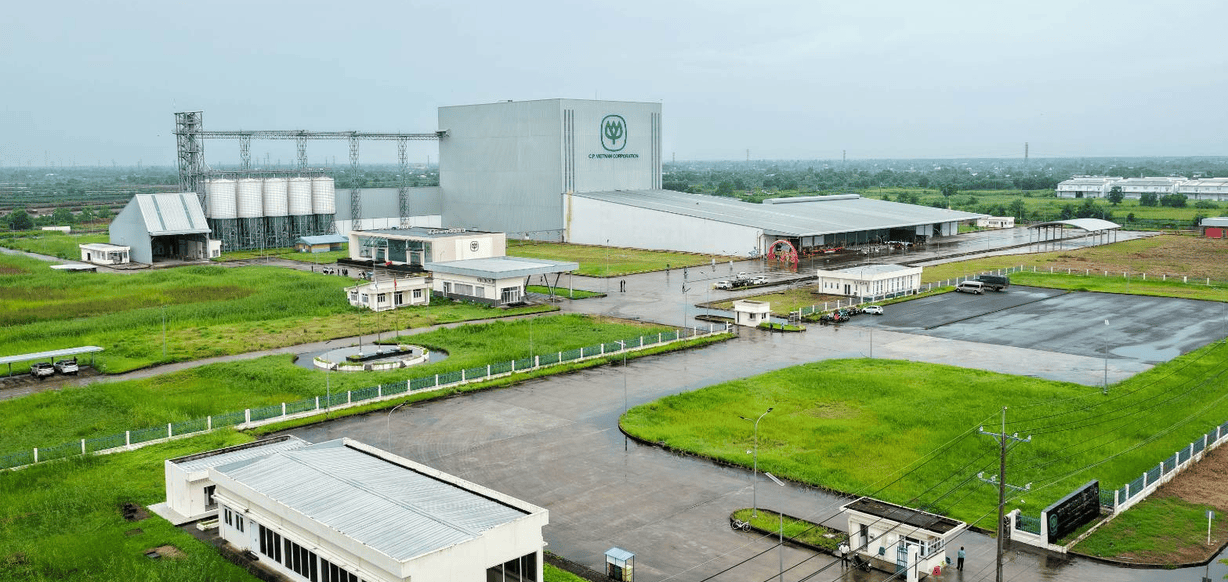
This shrimp feed mill opened in southern Vietnam’s Ca Mau province last month. It is CP Vietnam’s fourth aquaculture mill in Vietnam, and brings the company’s annual aquaculture feed production capacity to 650,000t. Photo: CP Vietnam Corporation
A BURGEONING Vietnamese economy is likely to see domestic demand for grain continue its recent upward trend, driven by steady growth in the livestock and aquaculture sectors and a new bioethanol blending mandate which is likely to lead to structural changes in the procurement of stockfeed ingredients such as wheat and corn.
Vietnam’s agriculture sector has evolved from overcoming food shortages in the 1980s to becoming a major global agricultural powerhouse. It accounts for roughly 12 percent of the country’s gross domestic product and employs over 40pc of the workforce, anchored heavily by small family farms in the Mekong and Red River deltas.
Rice and plantation crops
Rice dominates the nation’s agricultural land use, and the country is consistently among the world’s top rice exporters. It ranks second globally in coffee production, leading the world specifically in robusta bean supply, while seafood and commercial shrimp farming provide significant export revenue. Vietnam is also a major global supplier of cashew nuts, black pepper, natural rubber, cassava, and tropical fruits such as dragon fruit and durian.
Animal proteins’ growth
Vietnam’s agricultural production grew at an annualised rate of around 4pc in the first six months of the calendar year, according to the Ministry of Agriculture and Environment (MAE). The livestock sector also maintained steady growth, with the MAE reporting a notable shift toward larger-scale, biosecurity-focused animal farming practices over the past couple of years.
According to an early August update from the United States Department of Agriculture’s attaché based in Ho Chi Minh City, Vietnam’s pig herd grew by 2.2pc in the first six months of 2026, and pig meat output increased by 4.8pc to 2.9 million tonnes (Mt). The total poultry flock expanded by around 3.1pc, and poultry meat output reached 1.3Mt, up 5.6pc. Egg production touched 10.8 billion units, up 2.6pc year on year.
The nation’s aquaculture output reached almost 3Mt in the first half of 2026, up 5.7pc compared to the same period last year. The Vietnam Association of Seafood Export and Production reported that aquaculture and seafood exports reached almost US$5.8 billion over the same period, up 13pc year on year. Meanwhile, cattle and buffalo farmers continued a trend of herd reduction, declining by 2.8pc and 6.6pc respectively.
Biofuel mandate
Vietnam’s biofuel sector continues to develop gradually, driven by government mandates and climate commitments. June 1 this year marked an important milestone in the nation’s energy transition with the government mandating bioethanol blending in all gasoline grades. This is expected to increase demand for bioethanol blending inputs such as cassava and corn, commodities which also serve as critical animal feed ingredients, and will undoubtedly lead to changes to import procurement and domestic consumption patterns.
The mandate is also likely to impact domestic corn production, which has been decreasing in recent years. Competitively priced corn imports have consistently undercut local farm-gate values, forcing farmers to transition to more profitable and financially secure perennial cropping options, such as fruit and coffee.
The USDA’s Foreign Agricultural Service has pegged Vietnam’s 2026-27 corn production at 3.7Mt, down from 3.8Mt in 2025-26 and 400,000t lower than output in 2024-25. Over that three-season period, yields have remained static at around 5t/ha, but the harvested area has fallen by 10.8pc from 820,000ha to 730,000ha.
The FAS has increased Vietnam’s corn demand projection for the 2026-27 marketing year to April to 18.1Mt, including 16.2Mt for feed and residual consumption and 1.9Mt for food, seed and industrial (FSI) use. This is up from 16.8Mt in 2025-26, 90pc of which was animal feed demand, and 15.9Mt in 2024-25, 90.6pc of which ended up in livestock and aquaculture rations.
The escalating corn consumption profile and lower production are driving import demand higher. The USDA’s attaché is expecting the 2026-27 import campaign to total 15Mt, putting total supply at 19.5Mt when domestic output and the carry-in of 800,000t is added. This is up from imports of 13.5Mt and total supply of 18Mt last season, and international purchases of 12.2Mt and total supply of 17.1Mt in 2024-25.
Corn imports in the first half of the 2026 calendar year totalled 6.8Mt, a 49pc increase compared to the previous corresponding period. The main origins were Argentina, Brazil, and the United States with market shares of 37pc, 36pc, and 13pc respectively. Brazil’s volume grew 230pc year on year, while India’s contribution rebounded to capture 10pc of the first-half volume.
Wheat rises, food and feed
Vietnam’s wheat consumption in the 2025-26 marketing year increased sharply from 5.2Mt a season earlier to 6.3Mt on the back of significant volume growth in the stockfeed and aquafeed sectors. This evolution was primarily driven by feed manufacturers utilising lower-quality feed wheat as an energy substitute for corn, as demand for the latter increasingly shifts toward ethanol blending.
FAS reported that feed wheat served as a key cost-adjusting buffer in stockfeed rations. In the aquaculture sector, the utilisation of vital wheat gluten increased, as it serves as a natural feed binder that optimises water clarity and minimises feed waste. However, demand is forecast to decline slightly to 6Mt in 2026-27 as locally crushed and imported protein-meal inclusion rates increase in animal feed rations at the expense of wheat.
On the human consumption front, expansion in the industrial food processing sector, in conjunction with a demand surge for wheat-based foods, pushed domestic FSI wheat consumption 300,000t higher in 2025-26 to 2.9Mt. A further increase to 3Mt is projected in 2026-27 as the ethanol transition gains momentum.
According to the latest Vietnamese customs data, wheat imports in 2025-26 totalled 7.3Mt, 45pc, or 3.3Mt of which was milling wheat for human consumption purposes, with the 4Mt balance being feed wheat for animal feed rations. FAS currently expects incoming wheat shipments in the 2026-27 marketing year to decrease to 6.2Mt, due to a 500,000t increase to the projected carry-in from the previous season.
Vietnam customs data puts wheat imports in the six months to June 30 at 4.8Mt, 58pc higher than the same period last year, 60pc of which was feed wheat. Argentina was the biggest total supplier, accounting for 58pc of the program, followed by Australia with 16pc, Brazil with 9pc, Canada with 8pc and the US with 6pc.
Argentina’s share of the feed wheat program jumped from 8pc in the first half of 2025 to 87pc over the same period this year. However, Australia remained the largest supplier of milling wheat, claiming 38pc of the first-half total, followed by Canada with 21pc and Argentina with 14pc.
HAVE YOUR SAY