
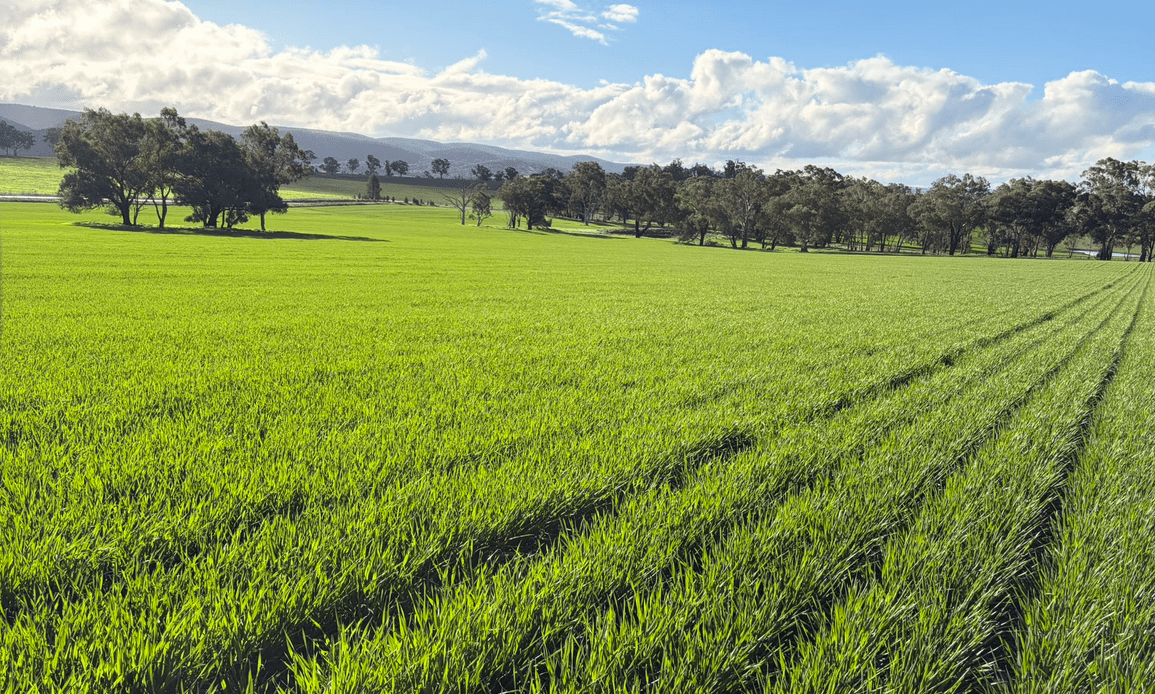
A crop of dual-purpose Brighton wheat ready for grazing on the Central West slopes of NSW. Photo: Lawrence Balcomb
ABARES has today released its initial estimates for Australia’s winter crop now being planted, with the overall production figure at 54.5 million tonnes (Mt) being 21 percent below the 2025-26 total.
At 23.6Mha, this reflects a 7 percent drop from last season’s planted area, with lower forecast yields further factoring into the tonnage figure.
Figures have been released in the quarterly Australian Crop Report.
“A forecast increase in area planted in Victoria and South Australia is likely to be more than offset by
falls in Queensland and New South Wales, while area in Western Australia is largely unchanged,” the report said.
ABARES said high fertiliser and fuel prices, a function of the closure to exports via the Strait of Hormuz, will continue to impact grower returns.
“Farmers’ decisions over the last few months have been shaped heavily by seasonal conditions and gross margins,” ABARES acting executive director David Galeano said.
“Despite the headwinds facing the sector, farmers who have received favourable rainfall are making the most of the opportunity.
“However, variable rainfall in summer and autumn has limited area planted to winter crops and pasture growth in some regions.
“Also, many cropping regions are expected to face drier-than-average winter conditions.”
Drops for the majors
Wheat area at 10.9Mha reflects a 12pc drop from last season, and the smallest wheat area planted since 2019-20.
Area planted to barley is forecast to increase by 4pc to 5Mha in 2026-27, reflecting strong barley prices and its comparatively lower fertiliser requirement than wheat and canola.
Canola area at 3.5Mha looks like being down 6pc from last season, with small increases in WA, Vic and SA more than offset by a significant decrease in the area planted in NSW.
“Despite high fertiliser prices, and high fertiliser requirement, growers with adequate soil moisture have opted to retain or increase canola area in rotations as gross margin returns are expected to be better than cereal crops,” the report said.
The wheat crop now being planted is expected to yield 26.7Mt, down 26pc from last season’s figure, and 23pc below the five-year average, while barley production at 14.1Mt is seen as being down 15pc from 2025-26.
Canola production at 6.2Mt is seen as 20pc down year on year.
| WHEAT | 2025-26 ha | 2025-26 tns | 2026-27 ha | 2026-27 tns |
| Qld | 880000 | 2310000 | 710000 | 1320000 |
| NSW | 3600000 | 11200000 | 2800000 | 7000000 |
| Vic | 1470000 | 4250000 | 1405000 | 4215000 |
| Tas | 12000 | 85000 | 11000 | 73000 |
| SA | 2000000 | 4740000 | 2000000 | 4664000 |
| WA | 4450000 | 13400000 | 4000000 | 9470000 |
| TOTAL | 12412000 | 35985000 | 10926000 | 26742000 |
Table 1: Area and tonnage estimates for Australia’s 2025-26 and 2026-27 wheat crop. Source: ABARES
| BARLEY | 2025-26 ha | 2025-26 tns | 2026-27 ha | 2026-27 tns |
| Qld | 175000 | 515000 | 150000 | 350000 |
| NSW | 1000000 | 3300000 | 900000 | 2300000 |
| Vic | 850000 | 3100000 | 915000 | 2837000 |
| Tas | 12000 | 65000 | 10000 | 57000 |
| SA | 835000 | 2146000 | 880000 | 2178000 |
| WA | 1900000 | 7200000 | 2100000 | 6400000 |
| TOTAL | 4772000 | 16326000 | 4955000 | 14122000 |
Table 1: Area and tonnage estimates for Australia’s 2025-26 and 2026-27 barley crop. Source: ABARES
| CANOLA | 2025-26 ha | 2025-26 tns | 2026-27 ha | 2026-27 tns |
| Qld | 6800 | 12500 | 5500 | 8500 |
| NSW | 950000 | 1600000 | 650000 | 1050000 |
| Vic | 540000 | 1250000 | 550000 | 1183000 |
| Tas | 5000 | 17000 | 4000 | 10000 |
| SA | 250000 | 550000 | 260000 | 533000 |
| WA | 1950000 | 4250000 | 2025000 | 3400000 |
| TOTAL | 3701800 | 7679500 | 3494500 | 6189500 |
Table 3: Area and tonnage estimates for Australia’s 2025-26 and 2026-27 canola crop. Source: ABARES
Input pricing a factor
ABARES said disruptions to fertliser and liquid fuel supplies have resulted in significantly higher input costs rather than physical shortages, although some short-term fuel outages occurred earlier in the planting window.
“We expect fertiliser and fuel input costs to remain elevated in 2026-27,” Mr Galeano said.
In the report, ABARES said the cost of inputs is likely to remain elevated for longer, which could weigh on production if the Middle East conflict continues.
However, very low soil-moisture levels across northern NSW and southern Qld up until mid-May appear to have been the major limiter to Australia’s 2026-27 winter-crop area.
“With the added pressure of high input costs, many growers were expected to significantly reduce area planted to winter crops or not put in a crop at all,” the report said.
“However, late May rainfall may encourage further area to be planted depending on rainfall totals received and seed and fertiliser availability.
While it is expected that growers will have their fertiliser requirements for the sowing period, there is more uncertainty surrounding growers’ willingness to purchase fertiliser at elevated prices – in particular urea – for crops in July and August for top-dressing which could impact yields.”
ABARES has acknowledged reports of surging mouse populations in SA and WA, but has not referenced them as having a potential impact on production.
Record lentils seen despite pulse drop
Lentil production is forecast to hit 2.2Mt to break last season’s record of 2.03Mt.
Forecast chickpea production at 1.1Mt represents a 51pc drop from last season’s 2.19Mt.
Area planted to winter pulses is forecast to decrease 7pc to 3.2Mha, with a 35pc drop in chickpea area to 732,000ha planted the main driver.
The reduced chickpea planting reflects “very poor planting conditions” in the major chickpea-growing regions of northern NSW and southern Qld.
Area planted to lentils and lupins is forecast to increase by 2pc and 23pc respectively in 2026-27, reflecting their lower fertiliser requirement than canola and cereals and, on lupins, increased demand for livestock feed.
WA is Australia’s biggest lupin producer by far, and its area this season is forecast at 500,000ha to produce 990,000t, up from 400,000ha which yielded 920,000t last season.
Grain Central: Get our free news straight to your inbox – Click here
HAVE YOUR SAY