
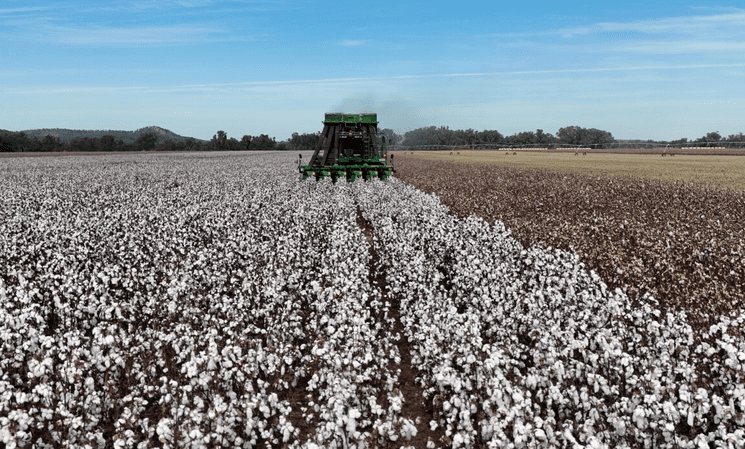
Cotton production is forecast to drop by 34pc in the upcoming season, with NSW to see a fall of 40pc. Photo: LAWD
SUMMER crop production is forecast to fall 25 percent to 3.4 million tonnes (Mt) in 2026-27, driven by below-average soil moisture levels in late winter and low irrigation water availability, according to ABARES quarterly Australian Crop Report.
The forecast production is 11pc below the 10-year average for the period to 2025-26.
Area planted to summer crops in 2026-27 is forecast to fall 17pc to 1.1 million hectares.
ABARES has estimated Australian sorghum production will fall by 26pc to just over 1.9Mt, with area planted to the crop set to fall by 9pc to 592,000ha.
Despite the drop in area planted to sorghum, it will remain 12pc above the 10-year average to 2025-26.
“The fall in area reflects below-average soil moisture and expected dry conditions in the lead-up to the planting window,” the report said.
“If rainfall is better than expected, there is potential for the area planted to be higher, with a significant amount of fallow area available in major cropping regions where winter crops were not planted.”
Production of cotton is forecast to fall by 34pc to 679,000t, or 3M bales, in 2026-27, due to a reduction in planted area and lower yields.
Area planted to cotton is also forecast to fall by 34pc to 301,000ha, “largely reflecting decreased availability of irrigation water and dry seasonal conditions”.
Rice production is forecast to fall 22pc from the previous season to 139,000t, making it the fifth-smallest crop on record.
ABARES attributes this further drop in production to “a further fall in the area planted from the previous seasons low level”.
“Low water availability across the Murray-Darling basin has resulted in an increase in the price of irrigation water, which is expected to constrain the area planted to rice.”
Qld production down 24pc
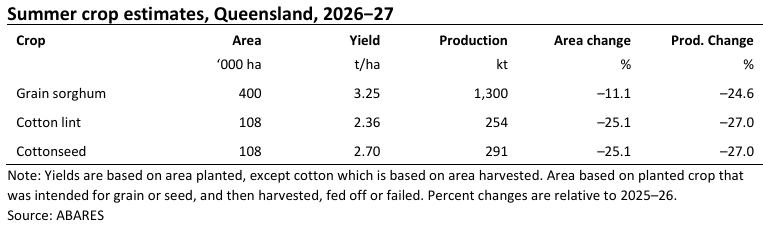
The total summer-crop production for Queensland is forecast to drop by 24pc to 1.7Mt in 2026-27.
“This is 2pc below the 10-year average to 2025–26, as limited stored soil moisture and an average to below average rainfall outlook for spring across most of Queensland is expected to limit planting intentions.
“At this early stage, yields are expected to fall for most summer crops to around 10-year average levels.”
Qld sorghum production is estimated to fall 25pc to 1.3Mt, reflecting lower area planted and yields.
“Expected falls in area planted largely reflect limited stored soil moisture and the reduced chance that this will be replenished prior to planting.”
However, ABARES noted there was “a chance that a late plant could go in if sufficient rainfall is received”, offering some potential upside to the forecast.
Qld’s cotton production is predicted to fall by 27pc to 254,000t, or 1.19M bales, from an estimated 108,000ha, down 25pc from 2025-26.
“This reflects reduced irrigation water availability for irrigated cotton, limited stored soil moisture and an unfavourable spring rainfall outlook for dryland production.”
NSW irrigation to take hit
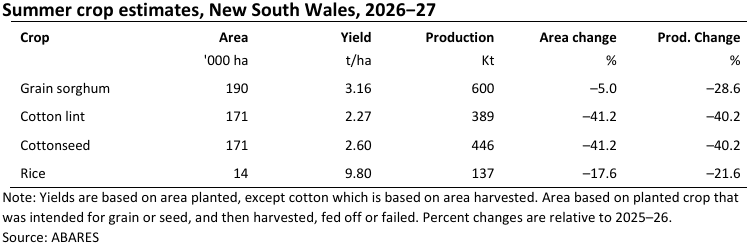
ABARES is estimating NSW summer-crop production to fall by 28pc to 1.6Mt.
This will be 21pc below the 10-year average to 2026-27, driven by “below-average soil moisture in key northern cropping regions and low irrigation water availability”.
“At this early stage, yields are not expected to be as high as the levels seen in 2025–26 for most summer crops.”
Sorghum production is forecast to fall by 29pc to 600,000t, but remain 5pc above the 10-year average to 2025–26.
The area planted is forecast to fall by 5pc to 190,000ha.
“Low soil moisture during winter crop sowing has meant that many growers in sorghum growing regions left fields fallow over winter.
“If spring rainfall is better than expected, it is possible that those growers who forewent a winter crop will plant sorghum.
“At this early stage, average yields are forecast to be below last season.”
NSW cotton production is estimated to drop by 40pc to 389,000t, or 1.7Mb, with area also expected to fall by 41pc to 171,000ha.
“Low carryover water from 2025–26 and below average allocations are expected to drive lower irrigated planting.
“Dryland planting is also expected to fall to well below average, reflecting low levels of soil moisture in key cotton growing regions in northern New South Wales.”
Source: ABARES
HAVE YOUR SAY