
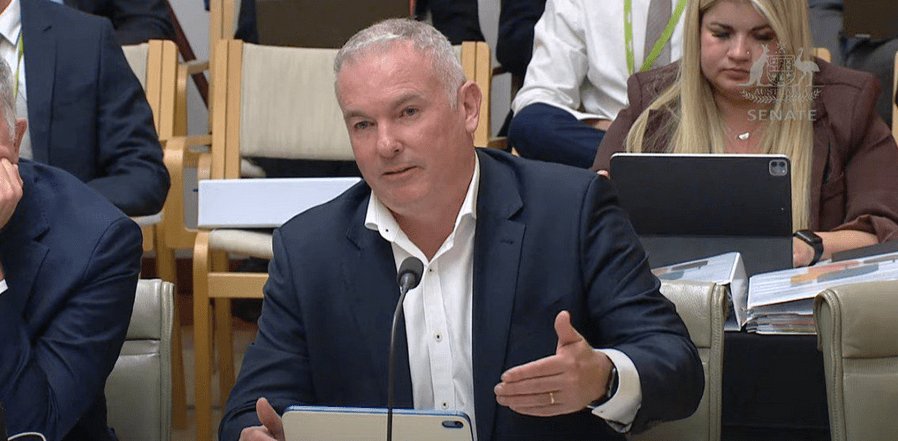
APVMA chief executive officer Scott Hansen appearing before Senate Estimates in October 2025.
THE AUSTRALIAN Pesticides and Veterinary Medicines Authority has announced that final regulatory decisions on paraquat and diquat will be handed down in mid-2026.
Based on a response by APVMA chief executive officer Scott Hansen during a Senate Estates hearing last month, the decision was previously expected by next month.
The timing represents another delay in the process, now around 18 months from the initial target date of January 2025, with public consultation on the proposal closing on October 29 last year.
In a news update, the APVMA said this extension was due to the release by the US Environmental Protection Agency of an updated review of a recent study.
The updated review, released on November 13, centred around the potential for paraquat to volatilise from treated agricultural fields.
Volatilisation is the process by which a chemical converts into a vapour and releases into the atmosphere.
While vapour pressure is a key parameter influencing the extent to which pesticide surface residues may convert into gaseous vapors that could move through the air.
The US EPA review was done in response to a new paraquat vapour pressure study submitted in January 2024 by Syngenta Crop Protection.
“The new vapor pressure study indicated a higher vapor pressure value for paraquat than was previously used in EPA’s risk assessments,” the US EPA statement said.
“The updated review incorporated the new vapor pressure study and presents EPA’s conclusion that there is greater uncertainty regarding the potential for paraquat to volatilise than previously considered.”
In response, the US EPA said it would be “issuing a data call-in (DCI) notice to paraquat manufacturers requesting additional data”.
“Once the data is received and reviewed by EPA, an updated analysis will be performed and published as part of the ongoing registration review process for paraquat along with any possible refinements of EPA’s bystander inhalation exposures analysis.
“After completing this additional review, the agency also intends to complete an Endangered Species Act and endocrine disruption assessment, prior to issuing any final registration review decision for paraquat.”
APVMA, GrainGrowers respond
The APVMA said it would need additional time to consider the findings of the US EPA.
“The APVMA is reviewing its assessments of the volatility of paraquat and ensuring we have appropriately taken into account any concerns raised in the updated review from the US EPA.
“This additional time will allow consideration of the updated review and, if necessary, refinements to the APVMA’s risk assessments.”
Paraquat and diquat are used widely in broadacre cropping, with paraquat an alternative to glyphosate to kill weeds in fallow, and for spot-spraying, while diquat is used as a desiccant in pulse crops.
Grain-grower and farming groups have highlighted the crucial role the chemicals play in modern, sustainable crop production.
Some medical and advocacy bodies, such as Parkinson’s Australia, have called for the chemicals to be banned due to what they claim to be an unacceptable risk to human health.
A spokesperson GrainGrowers said the APVMA timeline extension for the regulatory decision on paraquat and diquat until mid-2026 supports earlier calls by industry to fully consider all available evidence before a decision is handed down.
“If this work from the US highlights new information and risks not considered in the APVMA’s initial assessment, then it is important that industry is given an opportunity to respond to this and identify ways to manage any new risks,” the spokesperson said.
“We have always taken the viewpoint that the APVMA needs to take the time not to rush the process on this decision.”
Source: APVMA, US EPA, GrainGrowers
HAVE YOUR SAY