
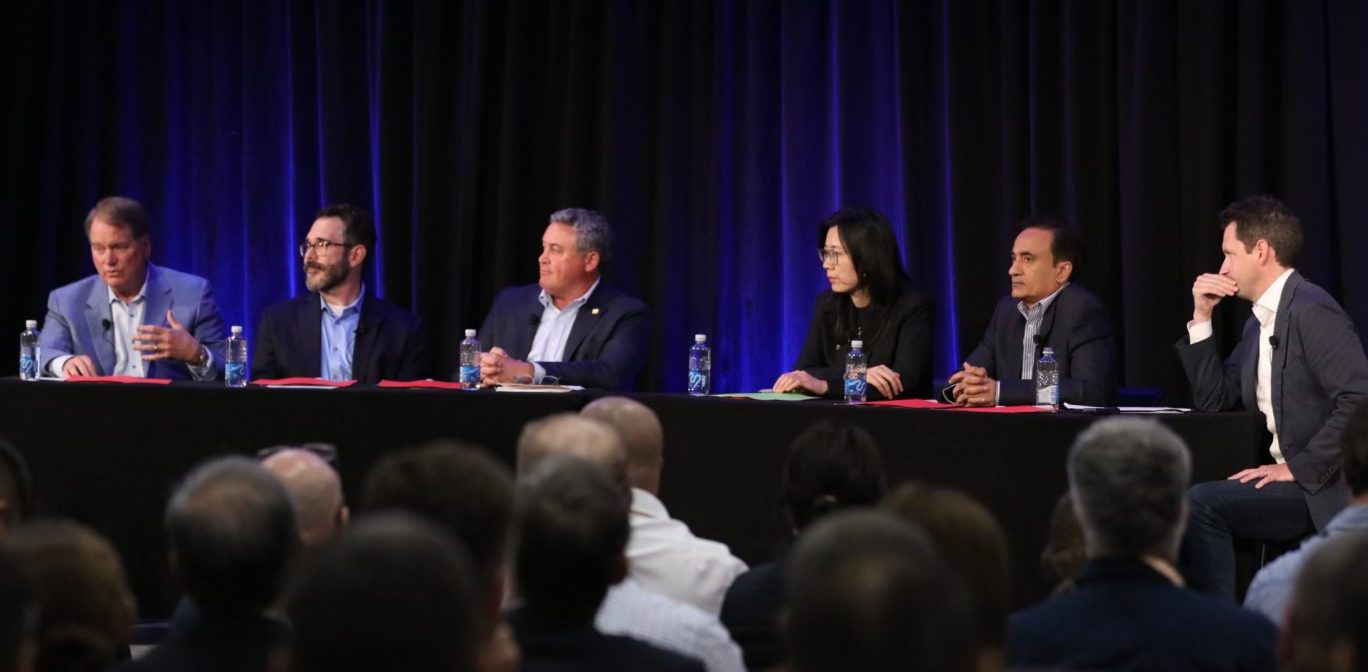
Joe Nicosia (far left) made the argument for Australia to lobby for its own cotton consumption legislation at the recent industry conference. Photo: Cotton Australia
UNITED States cotton industry leaders have called on their Australian counterparts to lobby for a domestic version of the Buy American Cotton Act (BACA), legislation proposed in the US to encourage cotton consumption over man-made fibres.
The US cotton industry is currently working to get the BACA, the scheme provides a tax credit for products sold in the US that are made with US-grown cotton, through Congress.
The legislation is based on the idea that the cotton industry needs to target brands and retailers further up the supply chain rather than relying on advertising to consumers to win market share from synthetic fabrics.
US-based Louis Dreyfus Company senior head of cotton Joe Nicosia said BACA would be a “gamechanger” for the global cotton industry.
“It’s the most powerful thing that could ever happen in the textile industry maybe in 50 years,” Mr Nicosia said.
Speaking at the Australian Cotton Conference last month, he said “consumers buy what the brand puts on the shelf”.
“You put this incentive in, the retailers are going to buy more cotton products and when they buy more cotton products, it creates more awareness with the consumer.
“It brings out more ads, and it brings out more sales, and it’s going to bring out more product.
“It’s going to change the way the consumer starts to see the differentiation of man-made fibres against cotton.”
Mr Nicosia argued that BACA would ultimately “lift world cotton consumption”.
StapleCotn is a US grower-owned co-operative, and its president and chief executive officer Hank Reichle said this approach was a pivot from the “one-consumer-at-a-time” strategy the US sector had previously employed.
“You’re going to make much bigger impact legislatively and regulatorily, much quicker and much bigger than you will win one consumer at a time,” Mr Reichle said.
“Creating an incentive with big business to shift is what we’re talking about.”
US heavy lifting alone
Mr Nicosia said “absolutely” Australia needed its own BACA and, referring to the interchangeable acronomy, said “you don’t even have to change the letters”.
“I think Australia needs a real gut check shift, and the bottom line is you’re not doing your job.”
“It’s not about your water levels; it’s not about your extra little production that you can make out of it.
“The United States is doing everything for the world for cotton today.
“We’re not getting help from Brazil; we’re getting no help from Australia.”
Mr Nicosia said the global cotton industry would succeed by working together against its common competitor, synthetic fabrics, rather than fighting among itself for market share.
“We win not by trying to get a little more fibre out of your field…but, you want a future in the cotton business, you have to attack the other side.
“Everything for the last 15 years is supply, supply, supply, supply, supply: what about the demand side?
“That’s why the United States is going to win this if they get BACA; it’s because it’s attacking the demand side of the equation.
“Australia: you don’t attack the demand side at all, and you don’t advocate for your own commodity.”
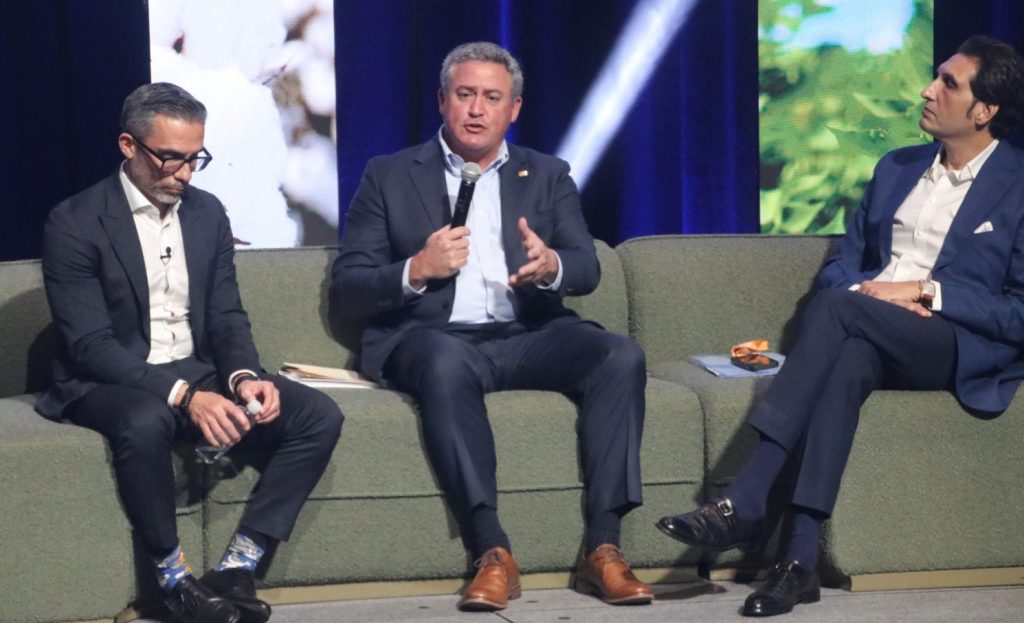
Hank Reichle (centre) with NAB’s Rodrigo Catril and Gill & Co director and co-owner Mohit Shah.
Cotton as a solution
Mr Reichle and Mr Nicosia shared the view that the success of the proposed legislation and its broader impact on consumers would be the positioning of cotton as a solution to a significant health problem.
Mr Reichle said synthetic textiles accounted for 35 percent of microplastic pollution, and public awareness around their potential risks to the environment and human health was growing.
He said, “polyester equals plastic” and “natural fibres, cotton are a solution”.
“If there’s a problem, people are looking for solutions, and we are the solution.”
Mr Nicosia said the Australian cotton industry needed to partner with health professionals and experts outside of agriculture to lobby government.
“Don’t just walk in with cotton, walk in with one of the professors.
“You will find research from the Australian universities here already on microplastics, and you will find one of the mother groups who are worried about what’s happening with plastic in their home and other stuff.
“Walk into your elected official with one of the mothers and/or a doctor.
“It’s a whole different subject…it’s not about how much water you use to grow your cotton any more.
“It’s a health issue, and we can win that on the health-issue side.”
Mr Nicosia and Mr Reichle appeared alongside Meadow Grove Research manager Christopher Kramedjian, Hang Tung Resources Australia manager Sophie Su and Olam Global Agri president Vinayak Mohan at on the Australian Cotton Conference’s Bulls vs Bears: Five Experts, One Big Debate panel.
The session saw industry experts taking opposing bullish and bearish views on the cotton market, challenging assumptions and exploring key drivers shaping prices, demand and trade.
Grain Central: Get our free news straight to your inbox – Click here
HAVE YOUR SAY