
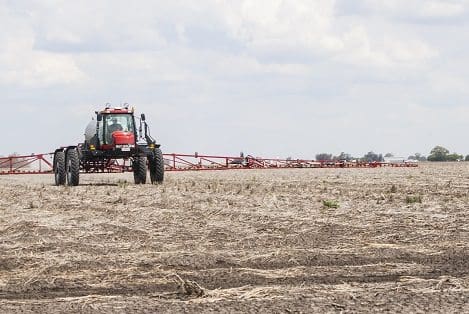
Bayer plans to make its first submission to the APVMA next year to start the approval process for icafolin-methyl. Photo: Weedsmart
BAYER hopes to release its new knockdown herbicide, icafolin-methyl, in Australia in 2028, subject to Australian Pesticides and Veterinary Medicines Authority approvals and registration.
Icafolin-methyl is the first non-selective knockdown herbicide from the new isoxazoline carboxamide chemical class, and offers a novel solution to combat weeds resistant to glyphosate.
Bayer plans to make its first submission in relation to the new herbicide to the APVMA next year.
In a statement released on July 30, Bayer Global said it had advanced its “blockbuster pipeline” by submitting registration applications for icafolin-methyl in the EU, following completed applications in Brazil, the US, and Canada.
Help from HIP
Headquartered in Germany, Bayer is a leader in agricultural chemicals globally, and is targeting Australia as an opening market for icafolin-methyl because of its long-standing Herbicide Innovation Partnership with the Grains Research and Development Corporation.
Bayer Crop Science ANZ managing director Warren Inwood said the HIP has been instrumental in placing Australian farming systems and weed management at the heart of Bayer’s global herbicide R&D efforts.
While not discovered in HIP, Mr Inwood said it has enabled earlier testing of icafolin-methyl under Australian conditions.
“This timeframe will ensure Australian growers are among the first in the world to access this new crop-protection technology,” Mr Inwood said.
HIP aims to accelerate the discovery of new modes of action and embed Australian weed species and farming systems in the earliest stages of research to deliver more effective, sustainable solutions for growers, and shorten the time to market for critical innovations.
“GRDC welcomes the advancement of icafolin methyl as a new non-selective knockdown for use in and around grain crops and its public release in Australia, which is aimed to happen at similar times to other countries,” GRDC managing director Nigel Hart said.
“As a result of GRDC’s investment through HIP, Bayer has been able to bring forward local trials to ensure that Australian grain growers are among the first in the world to access this new herbicide, which will be a critical step in managing resistance and supporting sustainable cropping.
“We can’t underestimate how important is to bring new weed management options to our growers with weeds costing an estimated $4.3 billion per annum or $203 per hectare on-farm.”
Established in 2015, the HIP aims to tackling herbicide resistance – a challenge that costs Australian grain growers an estimated $3.3 billion annually.
Through HIP, Bayer and GRDC have invested in new chemistry candidates, local trials, and scientific capacity-building, including post-doctoral research cohorts in Germany.
More to come
Icafolin-methyl is expected to play a pivotal role in knockdown and burndown applications, helping to alleviate resistance pressure on glyphosate and support sustainable farming practices.
It will complement HIP-developed solutions as part of a broader systems approach to weed management.
“Several promising herbicide candidates developed within HIP are progressing through Bayer’s global pipeline,” Mr Inwood said.
“With product development often spanning more than a decade, field trials are currently underway in Australia and internationally to evaluate these actives across diverse farming systems.”
Source: Bayer Australia
I was involved in glyphosate (Roundup) testing in Australia in the early-mid 70s. At that time, there was no serious total weed control competitors. Glyphosate was a miracle. It targetted all above ground weed growth species and achieved “root release” to assist farmers when preparing fields for another crop planting. This root release feature was a great benefit to farmers when preparing a weed-free seedbed for winter cereals. Glyphosate was later promoted as a preharvest dessicant for both broadleaf and grass crops. This development concerned consumers because of possible contamination. The use of glyphosate pre-planting and early post planting posed no problems, but treatments to achieve crop dessication prior to harvest were another concern. Glyphosate is a safe and effective herbicide if used sensibly. It became the no 1 global herbicide for good reasons.
Thank you for your comment, Roger. It’s always good to receive input from crop specialists. Ed