
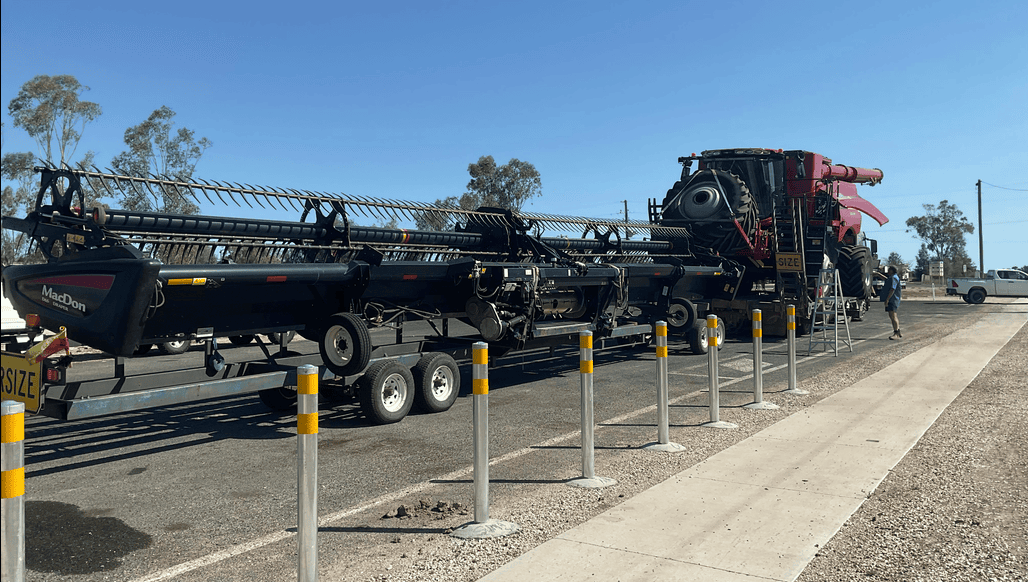
Harvest gear inspected by Department of Primary Industries and Regional Development at Hebel last harvest season. Headers and fronts must be inspected at border crossing sites. All supporting machinery and vehicles which have been in Queensland must be properly cleaned before entering NSW. Photo: NSW DPIRD
EASTERN Australia’s grain harvest is in progress in Queensland, and ahead of it rolling south into New South Wales in coming weeks, growers and contractors are reminded to ensure harvesting equipment crossing the border is free of the devastating parthenium weed and its seeds.
NSW Department of Primary Industries and Regional Development state priority weed coordinator Bill Davidson said headers posed a high risk of introducing parthenium weed into NSW.
“Farmers need to know harvest equipment coming on to their property is clean and should ask contractors for their valid Carrier Biosecurity Certificate to ensure the gear is free of parthenium,” Mr Davidson said.
“The law requires all harvesting machinery, equipment and vehicles which have been in Queensland must be properly cleaned and inspected before entering NSW.
“The person in charge of a header, including the comb and comb trailer, must complete a Record of Movement form online or submit it directly to an authorised NSW DPIRD officer at one of our inspection stations.”
The form includes a declaration that the header and comb have been cleaned in accordance with Schedule 1 of the Biosecurity Order (Permitted Activities) 2019.
Operators of all machinery have a legal duty to prevent their equipment from spreading parthenium weed into NSW under the NSW Biosecurity Act 2015.
It is illegal to bring grain harvesters and comb trailers from Queensland into NSW unless you have a Carrier Biosecurity Certificate from DPIRD inspection sites, which costs $75 for processing and delivery.
To expedite the process, those trucking or driving equipment south over the border are asked to book inspections 24 hours prior to arrival by phoning DPIRD inspection sites at Boggabilla on 07 4671 1227, Hebel on 07 4625 0916 or Mungindi on 02 6753 2323.
Machinery and equipment, including harvest field bins, augers and grain movers, trucks and low loaders carrying a header, harvest support and escort vehicles, mineral exploration drill rigs. and vehicles transporting rigs must be cleaned to remove all plant material, dust, soil and accumulated grease or be treated with a seed sterilant.
Parthenium is the greatest weed threat to NSW, and contact with the plant or pollen can cause serious allergic reactions in people.
It is dangerous to grazing animals, hosts crop viruses, prevents desirable plants from establishing and reduces
More information about parthenium and contact details for inspection sites are available on the DPIRD website.
According to Australia’s Centre for Invasive Species, parthenium hysterophorus can be prolific in disturbed situations, both natural and unnatural, and has a marked preference for highly fertile, black, alkaline, cracking clay soils but does grow on other soils, albeit not usually as vigorously.
Climatically, parthenium is best suited to areas with an annual summer rainfall greater than 500mm.
It is a major problem in rangelands and summer-cropping areas in Qld, and can invade native vegetation.
Parthenium was first recorded in Australia at Toogoolawah in south-east Qld in 1955, and is thought to have been introduced during World War II by aircraft landing at a local airstrip.
It was subsequently discovered north of Clermont in Central Qld, this time as a contaminant of pasture grass obtained from Texas in the United States, and spread rapidly from this locality.
Parthenium does not have established populations in NSW, and previous infestations along roadsides, particularly along the Newell Highway, on farms in various regions, and in the Greater Sydney region have been eradicated.
Source: NSW Government, Centre for Invasive Species
HAVE YOUR SAY