
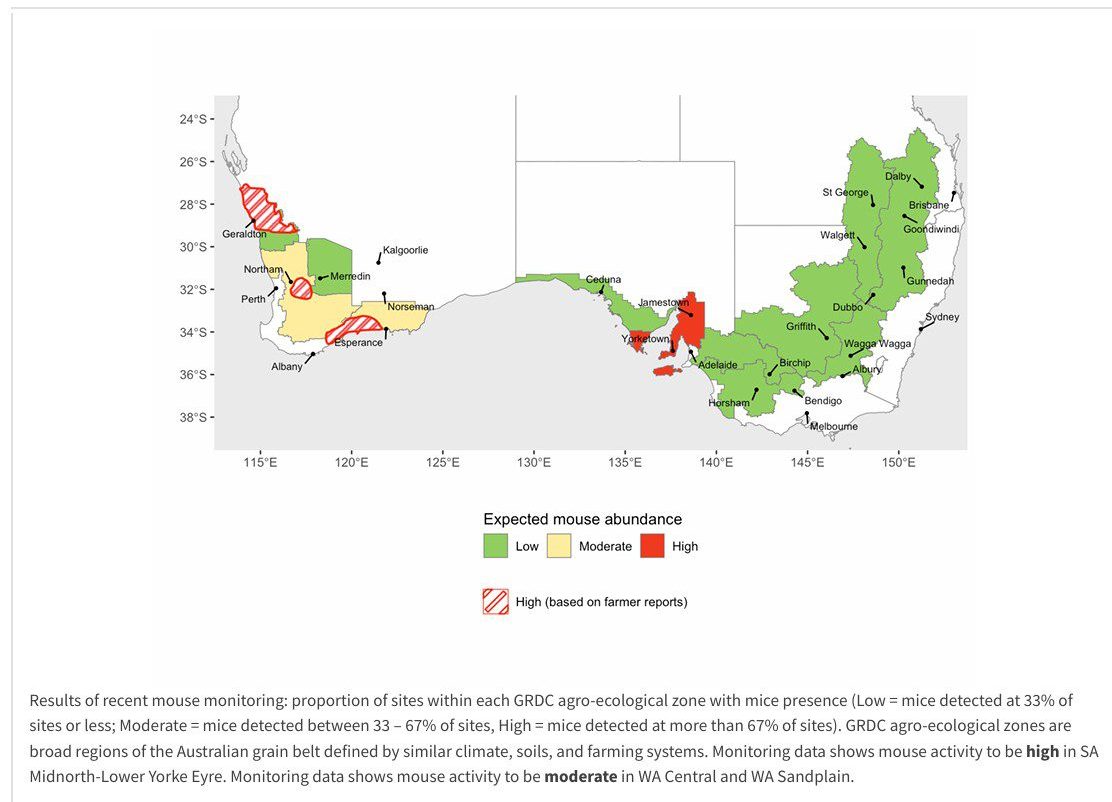
Expected mouse abundance across the Australian grainbelt. Source: CSIRO
SOUTH Australian growers are urged to check their paddocks for signs of mouse activity in the lead up to sowing, with reports of moderate-high activity on the Adelaide Plains and Yorke Peninsula.
This follows a similar warning issued to Western Australian growers in early March.
CSIRO rodent expert Steve Henry, who is one of the lead researchers on Grains Research and Development Corporation-supported investment into mouse management, said conditions are ripe for mouse breeding this time of year.
“Mice start breeding at six weeks old and have litters of 6-10 pups every 19-21 days,” Mr Henry said.
“Breeding starts in spring and can continue through to late autumn.
“If conditions are favourable, the rate of increase is dramatic.”
Mr Henry urged growers to monitor their paddocks throughout autumn, taking steps to reduce sources of available food.
“While mouse numbers vary across cropping zones, if present in high numbers they could have devastating impacts on crops being sown in the coming months.
“It is imperative growers get out of their vehicles, walk into their paddocks and get a good feel for what is going on in respect to current mouse numbers and activity.
“High stubble loads can hide the signs of mouse activity.”
In SA, mouse plagues typically occur every four to six years.
Food left behind from the previous crop provides conditions for mouse numbers to increase rapidly.
Growers Supplies agronomist James Chard, who operates in the Adelaide Plains and Yorke Peninsula, said there has been an uptick in mice sightings and burrows.
“We’ve been noticing a few active holes but have recently experienced some high-rainfall events, and we’re not sure what effect that has had on populations yet,” Mr Chard said.
“We’re seeing the greatest pressure in barley stubbles, and I’ve been advising growers that they may need to be prepared to bait at the very least their high value crops.”
Key management recommendations for growers include:
- Actively gauge mouse numbers by walking through paddocks; use mouse chew cards and active burrow counts to gauge mouse presence and activity. Mouse chew cards can be ordered from GRDC on 1800 11 00 44 or ground-cover-direct@canprint.
com.au; - If mice are present at sowing, bait at or as soon as possible after sowing, to prevent damage to the freshly sown crop;
- Talk to bait suppliers early to ensure timely supply. As with use of any agricultural chemical, use the product in accordance with the label, and report any adverse or off target effects via the APVMA website. Growers should be aware that only baits containing 25g/kg zinc phosphide are currently registered for use by the APVMA.
The most recent mouse forecast, issued by CSIRO as part of a GRDC investment, indicates that moderate to high mouse numbers are likely across the Adelaide Plains and Yorke Peninsula, based on recent survey data.
Depending on future conditions, there is potential for an outbreak.
This suggests a “watch and act” approach at sowing.
Mr Henry said it was crucial that mouse activity in affected areas is monitored over coming months to ensure growers and local bait suppliers are prepared for potential outbreaks.
Log your local mouse activity through the MouseAlert website, via X using @MouseAlert or through the FeralScan Pest Mapping app. This data is key for researchers to refine and verify forecast models.
For more information go to the GRDC Mouse Management page.
GPSA reinforces call
Grain Producers SA is urging growers across SA to remain vigilant for mouse activity ahead of the 2026 seeding program, following the latest seasonal forecast showing increasing populations in key cropping regions.
On top of high and increasing population densities on the Adelaide Plains and YP, monitoring shows high mouse activity in the Mid North, Lower Yorke Peninsula and Eyre Peninsula.
This reinforces concerns that growers could face significant pressure at sowing if conditions favour rapid population growth.
GPSA chief executive officer Brad Perry said the warning came at a critical time as grain producers prepare to put crops in the ground.
“Mouse activity is already building in parts of South Australia, and with seeding just around the corner, South Australian grain producers need to be alert and prepared to act,” Mr Perry said.
“The CSIRO data is clear; populations are increasing in key grain growing regions, and there is a real risk this could escalate into a broader issue if conditions allow.”
Mr Perry said early monitoring and timely action, such as applying bait, would be critical to minimising damage to emerging crops.
“Grain producers should be out in paddocks now checking for signs of activity, particularly active burrows.
“Even two or three active burrows per 100 square metres is considered a warning sign before sowing.”
Mr Perry said work was ongoing to improve control options, but current regulatory settings remained unchanged.
GPSA has established a working group with the Department of Primary Industries and Regions SA, GRDC and CSIRO to assess the current barriers in accessing stronger mouse bait for SA grain producers.
“According to survey data from South Australian grain producers, there is overwhelming feedback that ZP50 is the most effective option to stop the severe impact from mice in our paddocks.
“However, there are currently challenges in gaining access to this tool through the Australian Pesticides and Veterinary Medicines Authority.”
The CSIRO report also highlighted the importance of reducing background food sources such as spilt grain, which can significantly reduce the effectiveness of baiting programs.
Mr Perry said the situation reinforces the need for proactive management, particularly given the financial pressures growers are already facing this season.
“Grain producers are already dealing with high input costs and seasonal uncertainty and the last thing they need is avoidable crop damage from mice.
“This is about being proactive. Monitoring, preparation and early action are important when dealing with increasing mice numbers.”
Source: GRDC, GPSA
HAVE YOUR SAY