
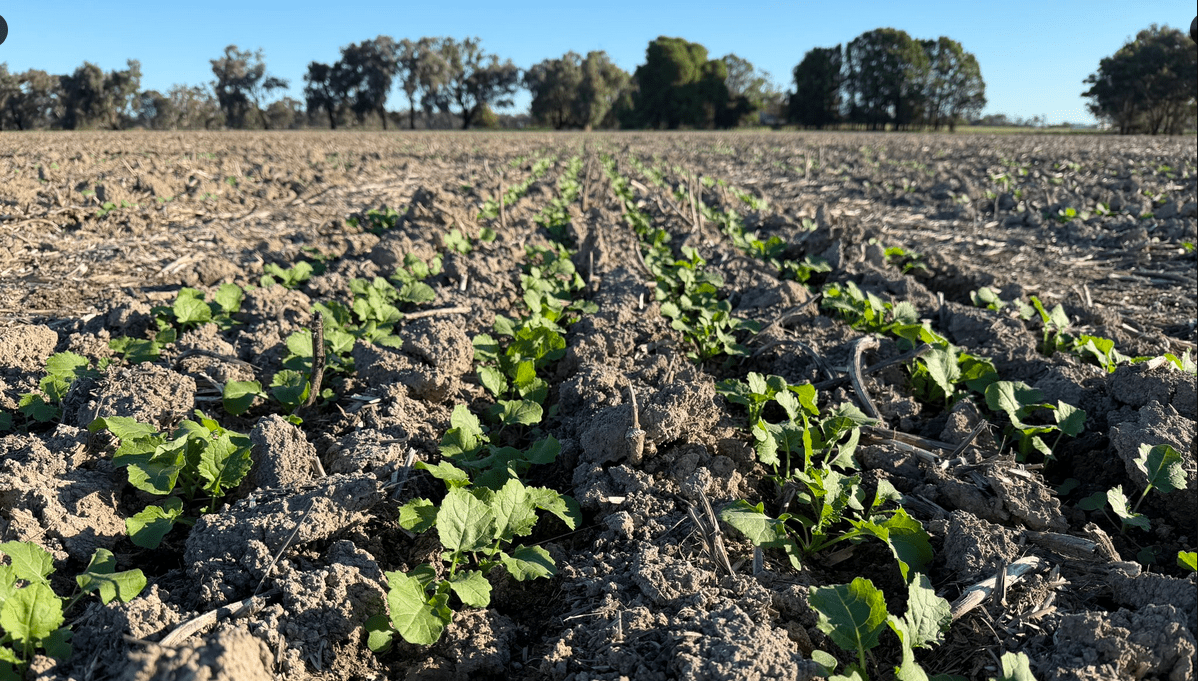
A canola trial site at Gerogery in southern NSW photographed this week. Photo: Justin Kudnig, Pacific Seeds
PLANTING of Australia’s canola crop is almost finished, and is off to a strong and early start in all regions bar the northern half of New South Wales, where area is well down due to dry conditions.
It means the 2026-27 canola crop has little chance of reaching the record set in 2022-23 of 8.45 million tonnes from 3.9Mha, or last season’s runner-up of 7.68Mt from 3.7Mha.
Ahead of an Australian Oilseeds Federation report expected this month, and ABARES’ first new-crop estimate due out early June, independent forecaster Lachstock Consulting is calling the 2026-27 crop 6.78Mt.
While canola has a sizeable appetite for applied nitrogen, sources say its expense as a result of the Persian Gulf conflict has done nothing to diminish planted area.
Most crops are between the cotyledon and six-leaf stage, and those in South Australia, Victoria and New South Wales will benefit from at least 10mm of rain forecast for the coming week, and mice are of concern to establishing crops in parts of SA and Western Australia.
Following is a round-up of conditions by mainland state:
Western Australia
Parts of the WA grainbelt received soaking rain, some from ex-Tropical Cyclone Narelle, which allowed canola seeding to commence well ahead of the traditional Anzac Day opening of the planting window.
In the Grain Industry Association of WA May crop report released last week, author Michael Lamond said WA’s canola area seen at 2.28Mha will set a record, and will account for 24.5 percent of the state’s total winter-crop planting,
“The early sowing opportunity for canola has driven renewed confidence as it is the most profitable crop grown in WA, particularly when it emerges before mid-May, which will be the case for most crops this year,” Mr Lamond said in the report.
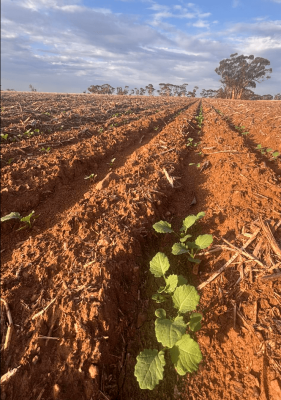
Early-sown canola photographed mid-April at Calangiri on the northern edge of the Kwinana South Zone. Photo: Wyening Mission Farm
In the Geraldton Zone, Mr Lamond said around half the canola area was yet to emerge as of last week.
“About 50pc of the canola area is up and looking good, with the remainder ready to pop out of the ground when it rains,” Mr Lamond said of the Geraldton Zone.
“Mice are hammering the emerged canola crops, with some areas being baited up to three times.”
In the Kwinana South Zone, Mr Lamond has estimated canola area to be up about 10pc from last year, while the Kwinana North East region is looking at a 10-20pc year-on-year increase for canola area.
In the Albany Zone, canola establishment is mixed.
“Some has suffered from drying out too quickly following planting and the combination of hot drying soils and in some cases liquid nitrogen toxicity has reduced canola plant numbers to a point where some paddocks and sections of paddocks have needed re-seeding,” he said of the Albany South region.
In the Lakes region north-east of Albany, Mr Lamond said canola area has again risen, driven by early rain and canola’s profitability over cereals.
The Esperance region is described as having had a “dream start”, with good early rains continuing through April to top up soil moisture.
“Canola crops are up, with some at six-leaf stage already, with most around two to four leaf.”
South Australia
In stark contrast to the past two seasons, SA growers from Eyre Peninsula to the Murray Mallee have been able to plant canola early, and crops are establishing well.
Clare-based principal Michelle Bammann of Ground Up Agronomy said SA growers were generally around halfway through their winter seeding programs, with canola finished.
“It’s all in and it’s up and it wants a drink; even 15mm to wet the top would be fantastic,” Ms Bammann said.
Rain on dry-sown seed and since germination has been patchy, with some paddocks getting 25mm or more, and others single-digit figures.
The impact can be seen in paddocks where rain since seeding has been light.
“There has been some staggered germination.”
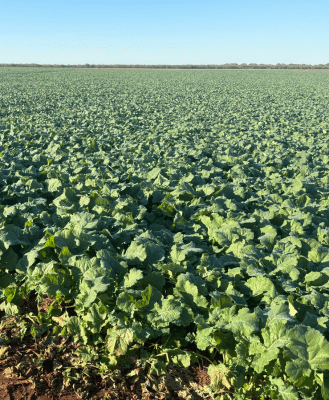
Canola planted March 10 and photographed April 23, ahead of grazing by ewes and lambs. Photo: James Stacey, Strathalbyn
Soaking rain for SA and Vic which fell mostly over the weekend of February 28-March 1, coinciding with the outbreak of conflict in and around the Persian Gulf, has spread the footprint of SA’s canola this season.
Ms Bamman said even growers at Loxton, on the north-eastern edge of SA’s grainbelt, had sown some canola this year.
“They’ve put canola in because they’ve got the soil moisture.”
The Persian Gulf conflict has reduced the availability of urea to the world market, and prices have steadied at around $1300-$1400/t ex port, up at least $400/t on pre-war values.
Even with the expense of urea, plus the cost of two or three knockdown-herbicide applications to control weeds after the rain, Ms Bammann said canola’s gross margin looked encouraging.
“All of my clients have put their programs in.
“With moisture in the ground, no-one’s willing to cut back.”
Mice are of considerable concern to SA growers, and Grain Producers SA said on May 5 that a survey of almost 400 producers showed half were regularly seeing mice, and observing damage in key SA growing regions during seeding.
Victoria
Canola in the Mallee and Wimmera, and surrounding districts, has been planted early on top of good subsoil moisture.
Driscoll Ag senior agronomist Brett Douglas is based at St Arnaud, and said the expense of urea has not caused a reduction in canola area.
“Everybody’s planted canola, and we’ve certainly had good summer subsoil rain that’s given us confidence,” Mr Douglas said, adding that “people have stayed pretty close to their rotation”.
“We’ve had no issues in sourcing urea.”
Mr Douglas said with sulphate of ammonia as well, enough fertiliser has been secured for planting and top-dressing.
“We’ve got enough for our season…to hit our target yield of 3t/ha.”
Across the district, canola crops range from the cotyledon stage to the first top-dressing and grassweed-herbicide application stage.
Vic growers are ripping through sowing of all winter crops ahead of at least 20mm forecast in coming days.
“By the end of the week, I’d say 80pc of our crop will be in.”
Mr Douglas said a couple of the company’s senior clients have called this year’s autumn break one of the best they’ve ever seen, with crops off to a strong and early start.
Mice are yet to make an impact on seeding in Vic, but slug populations are building, and baiting is taking place.
New South Wales
Canola on the inner southern, south-west and central slopes of NSW has been sown early and into good subsoil moisture, but dry conditions have limited area on the state’s outer slopes and plains west of the Newell Highway.
In the heavy soils of northern NSW, very little canola has been planted due to ongoing dry conditions.
“A lot of people have pulled the pin on canola, particularly west of the Newell,” Parkes-based PY Agronomy principal Peter Yelland said.
With sheep prices being so strong, some growers who did not have enough soil moisture to plant canola have shown “a little bit of a swing to pulses”, namely lupins and faba beans.
“We’re able to moisture-seek for fabas by planting down to 100mm.
“A lot of people are moving towards a pulse crop for many reasons, urea being one, and weed control being another.”
Intended canola area has been planted east of Parkes, but close to the Newell, Mr Yelland said canola hectares look like being down around 30pc on the planned program, and very little has been planted further west.
Mr Yelland said uncertainty around the season rather than price was limiting demand for urea.
“Most people use it for sowing, and have enough to get them to a certain point.
“A lot of people have a little bit of cover; they might have 20pc of what they require.”
“Rates have been wound back based on soil moisture, and we wouldn’t be using as much as we would have, for example, last year.
“We had zero rain in April, and in March we had very isolated patchy rainfall.
“The rain we got last week is the first decent fall since September last year.”
Sheep, lambs and wool are all fetching high prices at present, and while mixed farmers have hay and grain on-farm to bridge the feed gap until dual-purpose or fodder crops can be grazed, water is a limiting factor.
“The biggest driver for livestock at the moment is groundwater, or lack thereof.
“There are definitely grazing crops in, but nothing’s grazable yet.”
Grain Central: Get our free news straight to your inbox – Click here
HAVE YOUR SAY