
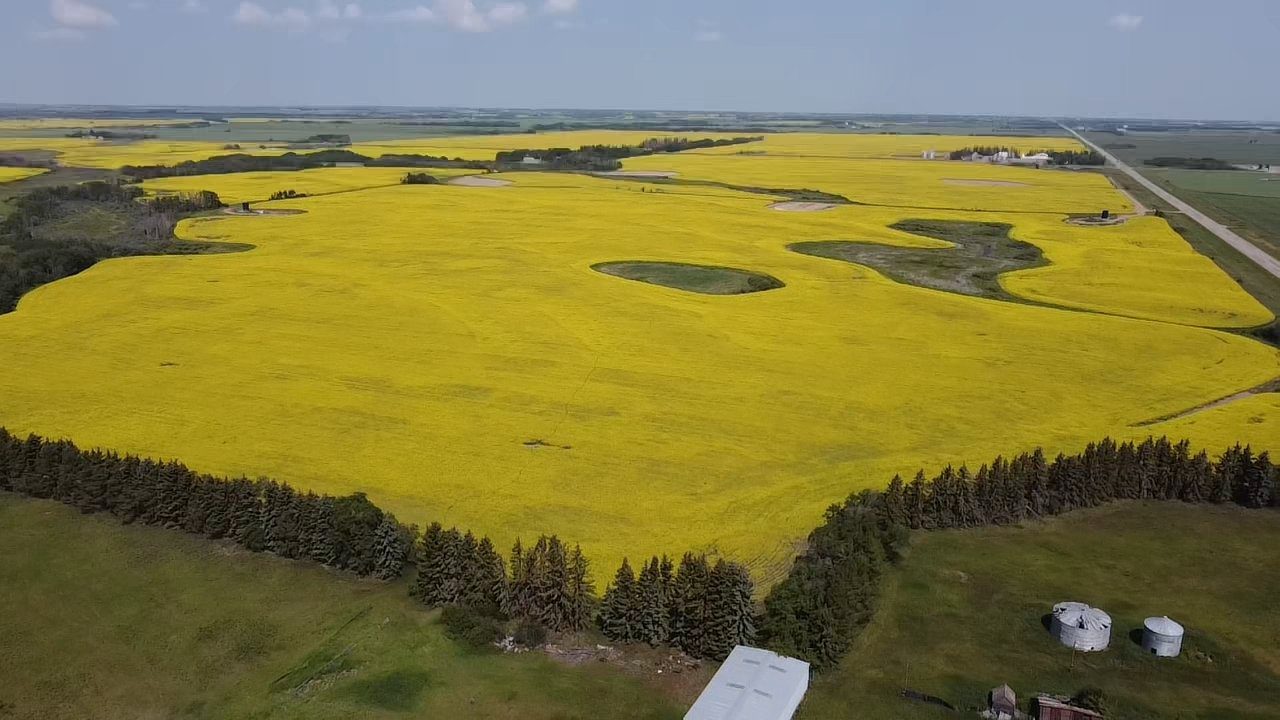
A Saskatchewan canola crop in full flower last month. Photo: Jordan McCormick
CANADIAN canola farmers are reeling from last Tuesday’s shock imposition by China of hefty anti-dumping duties on canola seed imports from Canada, escalating the year-long trade dispute that began with Ottawa’s imposition of tariffs on Chinese electric vehicle last year.
The news of a preliminary 75.8 percent duty, effective 14 August, came after a Chinese Government investigation reportedly made a preliminary finding that dumping had occurred. China’s Ministry of Commerce (MOFCOM) said an anti-dumping probe was launched in September 2024 and had found that Canada’s agricultural sector, in particular the canola industry, had benefited from “extensive government subsidies and preferential policies” that distort demand and lead to oversupply.
Tariff imposition by China on Canadian canola began with a 100pc tariff on canola oil and canola meal on 8 March 2025. At the time, tariff on canola seed remained unchanged.
High stakes
China is the world’s largest importer of canola seed and has traditionally sourced almost all of its annual import requirements from Canada. In 2024, China purchased 5.9 million tonnes (Mt) of Canadian canola seed, around two-thirds of Canada’s total canola export. While canola is Canada’s second-largest crop by area, it is the country’s most valuable field crop, with farm cash receipts of C$12.9 billion in 2024.
In a joint Canadian Government statement issued by International Trade Minister Maninder Sidhu and Agriculture Minister Heath MacDonald, Canada disputed the preliminary anti-dumping ruling, saying it was “deeply disappointed with China’s decision.”
“We do not dump canola,” the statement said. “Our hard-working farmers provide world-class food to Canadians and international trading partners. Canadian canola products meet the highest standards, and our inspection systems are robust. Canada is committed to ensuring fair market access for our canola industry, and we remain ready to engage in constructive dialogue with Chinese officials to address our respective trade concerns.”
In response, a spokesperson from the Chinese Embassy in Ottawa is reported to have stated: “China has always exercised prudence and restraint when using trade remedies to safeguard fair and free trade. China will continue to conduct the investigation in accordance with the law, fully protect the rights of all stakeholders, and make a final determination objectively and impartially based on the investigation results.”
The investigation will formally end in September, giving Beijing until then to make a final decision on the duties, though it does have the option of extending that deadline by a further six months. A final ruling could result in a different rate, or overturn Tuesday’s decision. However, if the steep duties are maintained, the Chinese market would effectively be closed to the Canadian canola industry, a market valued at as much as C$5 billion annually.
Market reacts
The tariff has had an immediate impact on Canadian producers, with grain buyers reported to have pulled new crop grower bids as soon as the anti-dumping measures were announced. The November canola futures contract on the Intercontinental Exchange (ICE), the global canola trading benchmark, also fell 6.5pc to a four-month low when the news broke. However, it did rally into Friday’s close to finish the week 2.9pc below Tuesday’s open.
The timing of MOFCOM’s latest tariff escalation appears deliberately to maximise pressure on Canadian policymakers, coming as the new-crop harvest approaches and just a couple of months before the government’s one-year review of the electric vehicle tariffs imposed in October last year. Despite the United States leading the western charge on electric vehicle tariffs, Beijing has chosen thus far to focus its retaliation primarily on Canada, while leaving US tariffs largely unanswered.
Opportunity knocks for Australia
Replacing the Canadian canola flow will be difficult in the short-term, but it does provide a golden opportunity for Australia, the world’s second-largest canola exporter. Australia has been shut out of the Chinese market since 2020 due to phytosanitary concerns around the spread of the plant fungal disease, blackleg. With a few trial cargoes on the books, the extended freeze on Australian canola trade to China could be over, with renewed market access a distinct possibility by the time new-crop supplies become available for shipment in November.
However, with the Australian carry-out expected to down to fumes in the lead-up to this year’s harvest, and demand from Australia’s traditional markets such as the European Union, the United Arab Emirates, Pakistan, and Japan likely to remain strong, entirely replacing Canadian canola flow into China will be impossible without some drastic changes to traditional international trade flows. On a volume basis alone, China’s imports in 2024 were equivalent to almost 95pc of Australia’s entire export program, the second-biggest calendar-year canola export on record.
If the tariff remains in place beyond the September deadline, Canada will be hungry for new markets. It seems logical it would look to price more competitively into the EU in particular, which could simply mean an origin swap where Australia increases shipments to China at the expense of the EU, and Canada does the opposite.
Of course, this does assume that China would relax the current restrictions on Australian canola, that Canada would have sufficient supplies of the preferred non-genetically modified seed, and the EU would be satisfied Canadian production meets the required sustainability and low-emissions thresholds. Under the EU’s 2009 Renewable Energy Directive, all biofuel feedstocks supplied to the EU must be certified as sustainable by an approved scheme, such as the International Sustainability and Carbon Certification (ISCC), which Australian growers have widely adopted.
Nevertheless, while China is an extremely important destination for Australia’s agricultural exports, Australia has been on the receiving end of Beijing’s belligerent anti-dumping stick in 2020 when similar allegations were made about barley. The repercussions of the resultant ban for growers and exporters were widespread. Australia will rightly be very protective of existing markets and relationships in the global canola sphere, and it is highly unlikely that the trade will be willing to move all of its eggs into the volatile China basket.
EDITOR’S NOTE: Reuters has today published a report saying China’s COFCO has bought a 50,000t cargo of Australian canola for Nov-Dec shipment. Grain Central has asked the Australian Government to confirm whether protocols are in place to allow this to take place.
HAVE YOUR SAY