
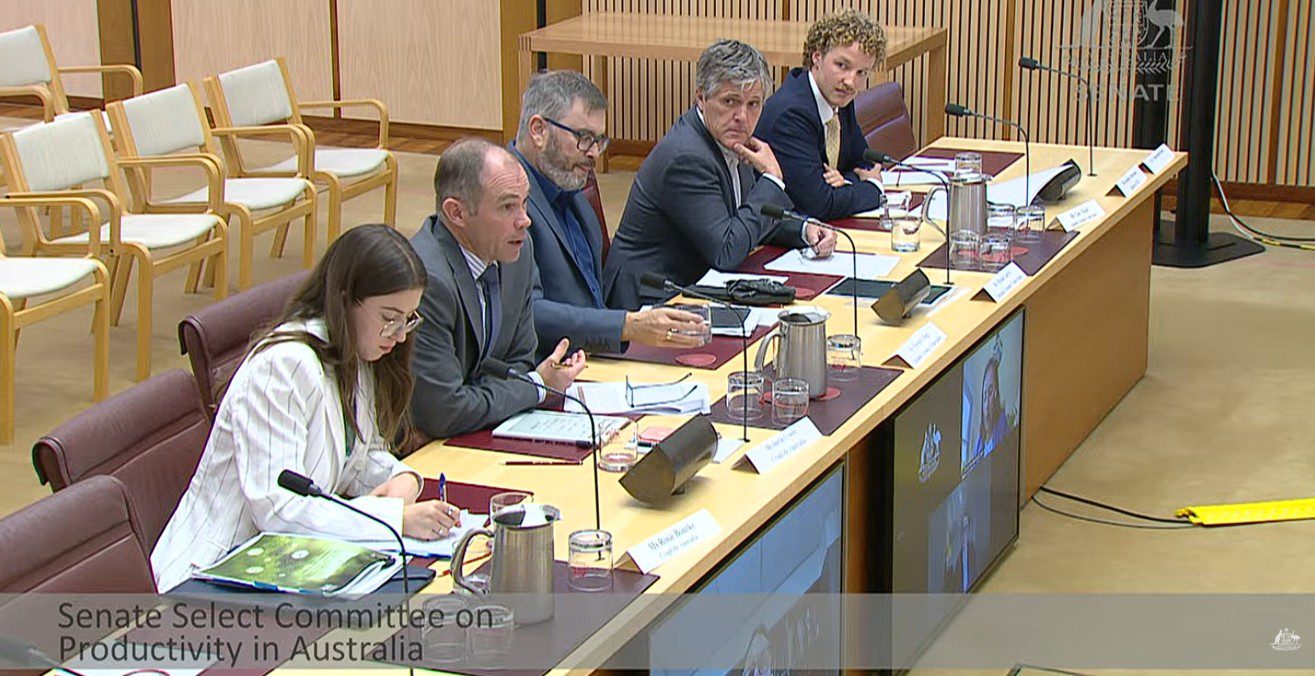
CropLife Australia director government and strategic relations Justin Crosby (second from left) addresses a Senate committee alongside NFF and AgForce representatives.
INDUSTRY body CropLife Australia has outlined to a Senate committee its wish-list of government reforms which it says could drive productivity in the cropping sector.
Given the organisation’s remit, the recommendations targeted policy changes specific to crop protection and ag biotechnology.
The measures include boosting funding to the Australian Pesticides and Veterinary Medicines Authority and reconsidering its cost-recovery settings, fast-tracking delayed gene technology reforms, and introducing a patent credit scheme for plant science.
During a hearing of the Select Committee on Productivity in Australia, CropLife Australia director government and strategic relations Justin Crosby detailed the group’s plan alongside representatives from the National Farmers’ Federation and AgForce Queensland.
This was one of several hearings held this month in which the committee heard from organisations and businesses across the economy on ways to lift productivity, drive growth, and boost competition.
Mr Crosby said developing crop protection products was “ultimately…an investment game”.
He said it cost AU$450 million and took 12 years to get a single pesticide product registered in “the major markets”, with it costing more to come into Australia.
Over one third of this cost is related to compliance with regulation and registration requirements.
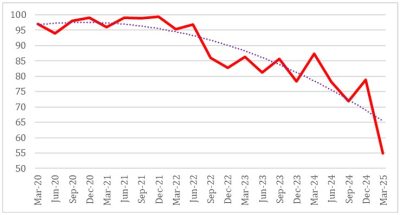
APVMA’s on-time performance for major pesticide applications from 2020 – 2025. Source: CropLife
“What we see in terms of that is that we really need to have a regulatory framework that’s open to investment,” Mr Crosby said.
“That doesn’t mean that we need to take down our regulatory standards, but we need to use science and risk-proportionate regulation to ensure that members have certainty when they come to Australia.”
He noted that the APVMA’s status of on-time regulation of new products was “lagging behind” at just 37 percent for the latest quarter.
“The corollary of that is we’ve been talking to government about the opportunity to invest in the [APVMA] because it is the only pesticide regulator in the OECD which is fully funded by cost recovery, but yet it delivers large swathes of public good in terms of compliance.
“So we think that there’s an opportunity for government as it asks for more from a regulator to actually fund more and that will enable science-based regulation that is again on time, that it’s efficient, that it’s science-based, it’s risk proportionate that delivers farmers the tools that will actually grow that productivity.”
While Mr Crosby did not nominate a figure, CropLife’s submission cited DAFF 2023-24 recommendations that an additional $8.4M a year would “fully support the APVMA’s public good functions”.
Potential for patent credit scheme
For crop-protection products, Mr Crosby said Australia needed to overcome its status as just 1.5-3pc of the global market to attract investment.
He said, in addition, Australia had “really high costs of regulation”.
As a reform to support investment, Mr Crosby suggested an IP patent credit scheme, like the one already operating in the pharmaceutical industry.
He argued that this would encourage more products to be registered, more quickly, for more uses.
CropLife also proposed other changes to patent regulation, including term extensions and stronger data protection, as internationally recognised ways to address market thinness and regulatory delays.
Opportunity for GM crops
Mr Crosby said there was also an opportunity to capitalise on genetically modified crops already in Australia, as well as new technologies such as gene editing (CRISPR), to develop higher yielding, more resilient crops at a faster pace.
CropLife considers the government behind in Third Review of the National Gene Technology Scheme, which started in 2017.
In its submission to the inquiry, the organisation said these delays have “led to an environment unconducive to commercial investment in bringing these newer technologies to market”.
The submission also highlights that technologies considered “new, emerging and unfamiliar” in 2017, like CRISPR, are “now established technologies with their application extensively studied”.
“The prolonged delay means that Australia’s regulation of gene technology perpetuates a layer of red tape that is unnecessary to meet the scheme’s objectives of protecting the health and safety of people and to protect the environment,” the submission said.
“This is impeding improved agricultural productivity, enhanced environmental sustainability and the delivery of varieties of fruit and vegetables with enhanced nutritional profiles.”
Mr Crosby told the hearing that this was “an opportunity for regulatory reform” that was “well overdue” and would “put Australia in a position of leadership”.
Grain Central: Get our free news straight to your inbox – Click here
HAVE YOUR SAY