

CSBP was one of three companies to participate in the FFSF program. File photo: CSBP Fertilisers
THE DEPARTMENT of Agriculture, Fisheries and Forestry has confirmed six more companies were recommended for the Fuel and Fertiliser Security Facility but had yet to contract urea tonnages before the scheme was paused.
The companies were in addition to Incitec Pivot, CSBP and Summit Fertilizers, which participated in the program and imported a combined 340,000 tonnes of urea fertiliser into Australia during a price spike triggered by the Iran war earlier this year.
The companies were named during Senate Estimates last week as being Nutrien Ag Solutions, Koch Fertiliser, Ameropa, Fertiglobe and CBH Group, which were successful on May 6, and Marnco, which was recommended on September 18.
DAFF officials stated that some companies listed were still in negotiations with Export Finance Australia, while there were “some” that had opted out for commercial reasons.
Facility background
The Federal Government launched the $7.5 billion Fuel and Fertiliser Security Facility (FFSF) in April to support additional supplies of fuel of fertiliser imports.
EFA documents revealed the contracts were structured as a “contract for difference”, with price floors and ceilings that left the Federal Government carrying the risk while retaining potential upside if the market rose.
A total of 10 individual cargoes of urea were supported under the scheme from April until mid-June.
The first two companies chosen under the scheme, CSBP and Incitec Pivot, secured four cargoes each under the program.
Summit Fertilizers, which was selected to participate on May 6, was supported with two cargoes.
EFA’s transaction register had the total exposure of the program to June 30 at $421.4M.
The document listed CSBP Limited’s exposure at $179.46M, Incitec Pivot’s at $151.85M and Summit Rural (WA) Pty Limited’s at $90.49M.
Grain Central understands this was not the total cost of the fertiliser program to the Federal Government.
During Senate Estimates, EFA revealed that the overall FFSF cost the government $250-350M with the $7.5B figure considered “total exposure”.
The figures were not broken down by fuel and fertiliser transactions, although fuel was understood to account for the larger share of the program.
Recently released documents under Freedom of Information (FOI) stated that EFA’s “maximum aggregate committed financial exposure” to the program would not exceed USD$535M, about AUD$762M.
The documents stated that EFA’s maximum potential exposure under the contracts would be calculated using the floor price, rather than accounting for potential gains from rising market prices.
Additional participants
FOI documents revealed that Fertiliser Australia CEO Stephen Annells had named all eight companies – excluding Marnco – to EFA on April 1, presumably as potential candidates for the FFSF.
These were CSBP, Summit, Nutrien, and CBH in Western Australia, and IPL, Koch, Ameropa, and Fertiglobe, in Australia’s east.
Mr Annells’ email listed these companies in “descending order of relative size”.
Following contract finalisation with the larger two participants (IPL and CSBP), in May, emails show EPA commenced engagement with the following six companies.
These companies were assessed on several factors, according to the documents, including:
“a. Capacity to buy, store and distribute fertiliser nationally.
b. Capacity to purchase, insure and hold title on shipments.
c. Appropriate commercial capabilities (including advisers).
d. Confirmed willingness to accept Government policy advice and enter into a Strategic Deed.
e. Ability to progress negotiations within EFA’s required timeframes and risk settings.
f. Ability to meet EFA’s necessary due diligence requirements.”
Particular attention was paid to the companies’ import volumes over the last five years, distribution networks and end use volume and locations.
Emails showed that DAFF and the Department of Science and Resources (DISR) considered all six “eligible to participate”.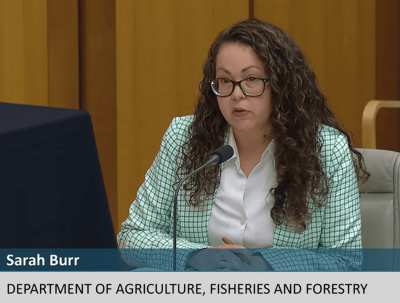
There were also indications that other companies had expressed interest in participating, with some approaching EFA directly and others nominated by DAFF and DISR to progress to further contract negotiations.
These included ABG Trading and Samsung, both recommended by DAFF.
Emails show Marnco was initially deemed “not recommended for further engagement” by DAFF, but the department revised its position on September 18 after receiving further information from the company.
Only Summit concluded the process, and was the only “tier two” participant in the scheme.
DAFF deputy secretary Matt Lowe told Senate Estimates that all the chosen companies had “been given the opportunity” to participate in the program.
“It’s not a subsidy, it’s a price risk sharing mechanism and companies need to make commercial decisions of their own about whether they decide to participate in the facility or not,” Mr Lowe said.
“The offer was made…to that long list of companies, but only three have chosen or elected to participate in the facility.”
DAFF assistant secretary Supply Chains and Strategy/ Middle East Regional Conflict Taskforce Sarah Burr said some of the potential participants had concerns with the specific terms of the contracts.
“This wouldn’t necessarily be correct for every company, but in general terms, we understand that the design of the mechanism in the sense that it shares both upside risk and downside risk has potentially been a sticking point for some companies,” Ms Burr said.
“Then other specific terms might be more particular to individual companies.”
She confirmed that some of the named companies were still negotiating with the EFA while others had officially opted out of the program.
Impact on others
Liberal National Party Senator for Queensland Paul Scarr said he had been told companies outside the program had estimated losses of between $20-25M because of “the way the market was distorted”.
He did not specify the data or number of companies underpinning the estimate.
DAFF secretary Victoria Anderson said that she appreciated that those companies that couldn’t participate “may feel aggrieved about that, but the reality is we were dealing with a situation in the national interest and took the best decisions we could according to the criteria”.
“I think the impact on these importers would have been significant as a result of the Middle East crisis, irrespective of what the government did because of the lack of supply of fertilisers,” Ms Anderson said.
“I would suggest you would need to compare that with the situation they would have been in, irrespective of whether or not the facility existed.
“This would have been a very vexed situation for fertiliser importers, irrespective of the government’s actions, and the government’s actions in this instance have secured fertiliser for Australia’s farmers.
“We hope we have worked in this very careful, considered way to think about the national interest and to minimise our impact on the market to the extent possible.”
There was also questioning centred on the information provided in the Ridley financial reports for 2026.
In its FY26 report, released in August, IPL owner Ridley said its contract-for-difference arrangements had a “favourable market value” of $53.6 million at June 30, 2026.
Ms Burr said the “intent of the facility was not around support for importers”.
“The intent of the facility was to support the supply of urea for Australia’s farmers.”
Grain Central: Get our free news straight to your inbox – Click here
HAVE YOUR SAY