
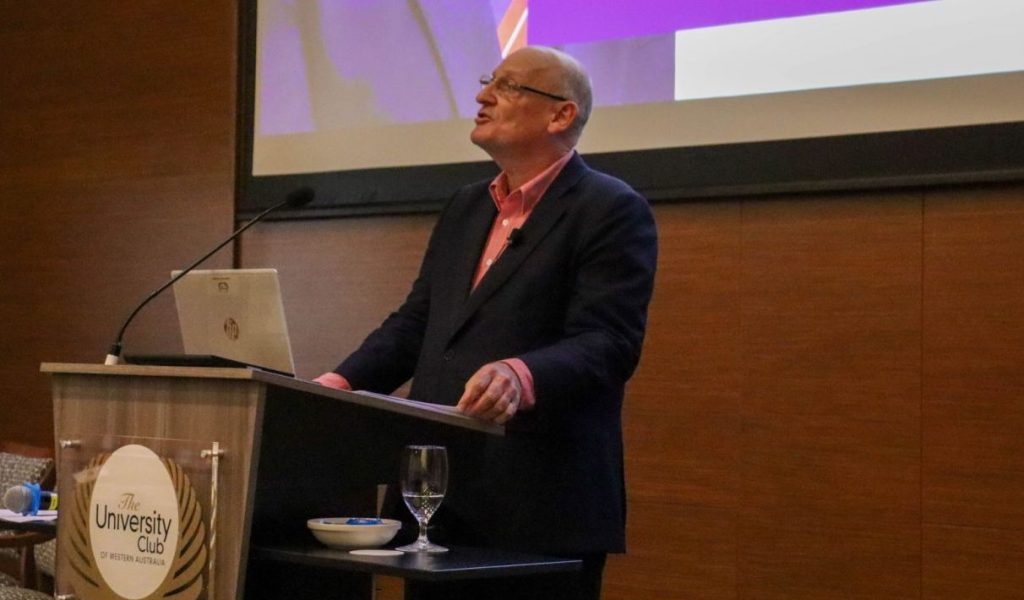
Mark Allison presenting the keynote speech at the UWA IOA 2026 Industry Forum. Photo: UWA IOA
OUTGOING Elders chief executive Mark Allison has described the fragmented nature of agricultural representation as a “massive issue”, saying it has undermined the industry’s ability to secure meaningful national policy reform.
During his keynote speech at the recent UWA Institute of Agriculture (IOA) Annual Industry Forum, Mr Allison pointed to the divide between peak bodies Grain Producers Australia and GrainGrowers Limited as an example of this fragmentation.
Mr Allison was GrainGrowers’ chief executive officer from 2010 to 2014, where he helped lay the foundations of the modern organisation before departing for Elders.
He left GrainGrowers about one year before the then Federal Agriculture Minister Barnaby Joyce decided that both GPA and GrainGrowers should jointly share the representative organisation role.
Mr Allison said the fragmentation had led the agricultural sector into “suffering neglect at a policy level”.
“Australia has many organisations speaking on behalf of agriculture, commodity bodies, state organisations and industry associations, but collectively, the result is often fragmentation rather than influence,” Mr Allison said.
“Agriculture has representation everywhere, but influence nowhere.
“On the flight over…I was reading about the port code and lo and behold the two grower groups – GPA and GrainGrowers – have the opposite view.
“I remember Barnaby Joyce when he was Ag Minister way back then.
“He’d tell us about how good it is when the grower groups don’t agree, because he doesn’t have to make a decision; it’s easy.
“In fact, what he said to us was: ‘you go away, when you agree, then I’ll make a decision’.
“It’s only 20 years later.
“They’re doing valuable work individually, and…you can’t knock the intent.
“We’re all trying to do the right thing, but in different ways and sometimes in conflict with each other, the two often lacking a unified national competitiveness agenda.”
Cross-commodity problem
Mr Allison said a weakened voice because of shared representation was also an issue for agricultural commodities beyond grain.
“Across all of the commodities, everyone’s fighting everyone.
“Meanwhile, sectors with stronger concentration and clearer messaging often secure greater policy influence, and we know the Minerals Council, we’ve seen the Mining Council, we’ve seen what’s happened.
“Agriculture sometimes spends too much time debating internal structures while broader economic settings move against us.
“There remains an imbalance in national thinking.”
Mr Allison highlighted one occasion during a GrainGrowers-held focus group in Western Australia where farmer participants where asked who they saw as their major competitor.
“I’ll never forget it because one of them stood up and said, ‘Billy, up the road, because he gets a cheaper rate with his truck driver to the grade’.”
He pointed to the cotton industry as an example of an agricultural commodity that was successful in unifying under one voice to policy makers.
“[I]t was going to be blocked out of existence because its licence to operate was being challenged, with 28 sprays of SPs and OPs and you have birds falling out of the sky, fish floating in the rivers, all this sort of stuff.
“[I]t almost has to be a crisis for the industry to unify.
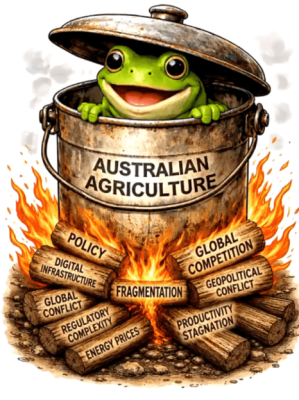
Mr Allison shared imagery of a frog, representing the agriculture sector, slowly boiling in a billy due to a range of external factors.
“Each time we get close to a crisis in Australian agriculture, in my observation 40 years later…there’s a good season and there’s a crop fail in North America or Europe, commodity prices or a war, and we don’t quite do it.”
Areas for national focus
Mr Allison gave his take on key issues that needed an “urgent national focus” to ensure a profitable agricultural industry into the future.
He said “productivity growth” should be returned as “the centre of agricultural policy”.
“When you go through the RDCs, universities, public company investment, private companies, there’s enough money, but it’s driving a national agricultural policy to optimise that and prioritise.”
He said government and industry should target energy and import security, as well as ensuring regulations were designed with the “cumulative impact on competitiveness” in mind.
“We need greater strategic thinking around fertiliser supply, diesel exposure, and cyber manufacturing capability.”
Mr Allison said investment in national infrastructure and workforce capability was critical to ensuring agricultural businesses and supply chains operated efficiently.
“Ports, roads, telecommunication, regional energy systems remain critical.
“Agriculture must remain attractive to young people, skilled migrants, and future leaders.”
Finally, he said Australia needed a “national mindset” that recognised the value of agriculture, farmers and the broader supply chain.
“Agriculture cannot simply be viewed as a legacy industry or a political talking point.
“It is one of Australia’s most strategically important industries because the reality is this; Australian agriculture still has world-class farmers operating inside increasingly second-class policy settings and that is not sustainable forever.”
Grain Central: Get our free news straight to your inbox – Click here
HAVE YOUR SAY