
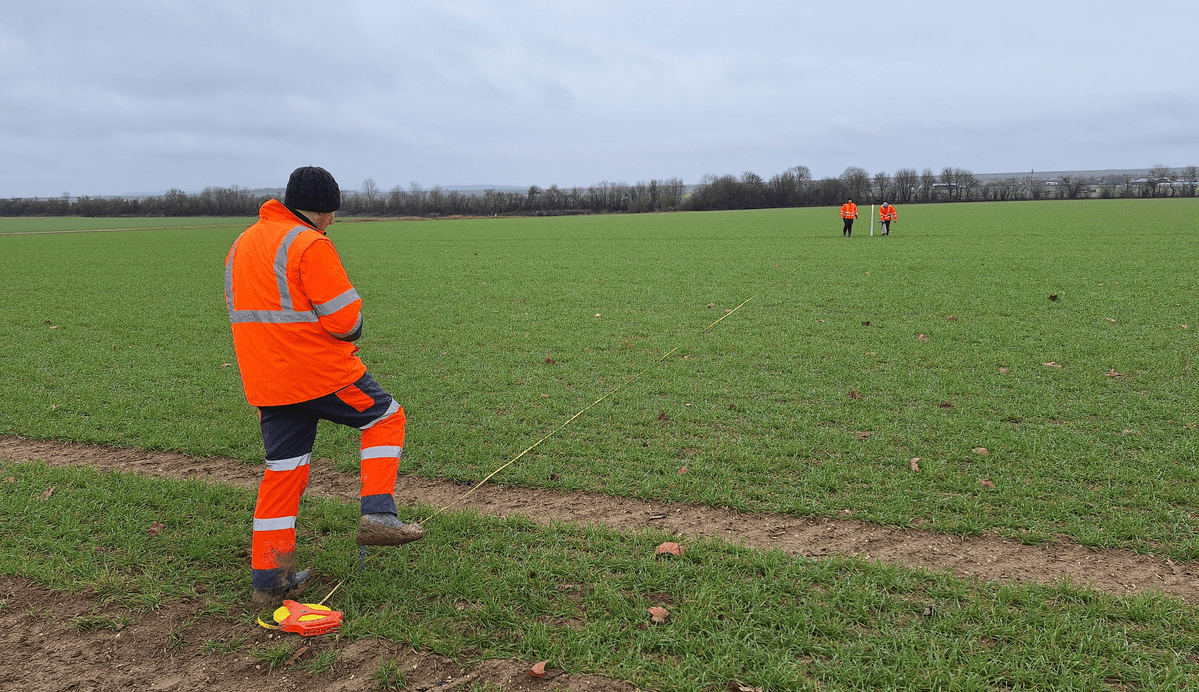
Setting up nitrogen fertiliser trials in cereals at Pomacle in north-eastern France in late January. Photo: @Vivescia
WINTER-crop conditions and production potential across the European continent remain generally favourable entering the boreal spring, although recent weather extremes have increased regional contrasts, raising concerns of localised output challenges.
An extreme cold spell swept down from the Arctic and through much of northern Europe in late January and early February. With little snow cover at the time, the severity and duration of the freezing temperatures experienced have raised winterkill and yield penalty concerns. The latest report from the European Crop Monitoring Centre (MARS) suggests that eastern Poland, the Baltic states of Lithuania, Latvia and Estonia, and western Ukraine were the worst affected. Temperatures of minus 20 degrees Celsius were common, with the mercury dropping to minus 30 degrees in some districts. Under such conditions, frost damage to winter crops is likely, even when snow coverage is adequate.
Temperatures in north-eastern Germany, Denmark, Sweden, central and western Poland, and central Ukraine were reported to be less extreme, although minus 15 degrees Celsius was recorded in isolated instances. Despite the relatively shallow snow cover in most of these regions at the time, the risk of significant frost damage is considered low. On the other hand, excessive rainfall in western France, the western and southern parts of both Italy and Spain, and most of Portugal has replenished soil-moisture reserves and regional water reservoirs but also caused some localised flooding. Falls of over 250mm for the month to February 21 were recorded in districts where the 10-year average is around 100mm. Crop damage is expected to be minimal at this stage, with an overall improvement in winter-crop yields anticipated.
Weather observations for January 1 to February 21 reveal rainfall surpluses in eastern Ireland, western and south-western Europe, parts of Slovenia and Croatia, and eastern Ukraine. A precipitation deficit was observed in most of Scandinavia, Finland and the northern Baltic region, with rainfall totals less than half the long-term average. Average daily temperatures in Greece and western Türkiye over the 52-day period were up to 4 degrees above the long-term average, with at least 15 fewer cold days than usual.
Conversely, Scandinavia, Finland, the Baltic states, the North European Plain and most of western and central Ukraine all experienced a deficit in accumulated temperature. The average daily temperatures in the broader Baltic region dropped to more than six degrees below the long-term average.
Wheat hardening fast
According to MARS model simulations, the hardening process in Europe’s winter wheat crop is more advanced than at the same time in 2025 and is currently slightly above the mean. Winter wheat is fully or almost fully hardened in most parts of northern and eastern Europe. Partial or advanced hardening has been reached in western and south-western France, central Spain, some parts of central and southern Italy, southern Bulgaria and the Aegean Sea region. Winter crops remain slightly hardened or not hardened at all across the southern reaches of the continent.
The models reportedly indicate frost-kill events for winter wheat in southern Finland, Estonia, Latvia, Lithuania, eastern and north-western Poland and in parts of Ukraine. This is especially evident in areas where the snow cover was limited at the time of the severe frost events. Crops such as rapeseed and barley are less tolerant to low temperatures, and MARS expects these crops will have suffered even more from the cold conditions.
Planting estimates firm
In France, planting of soft winter wheat, the country’s primary cereal crop, is now expected to reach 4.59 million hectares, according to the French Farm Ministry. This is 2.8 percent higher than the area harvested in 2025, but 0.3pc below the average of the past five years.
For winter rapeseed, the nation’s largest oilseed crop, the ministry raised its estimate to 1.37Mha. This represents an 8pc increase year on year and is 11.6pc above the five-year average. The projected barley area of 1.26Mha is 5.3pc higher than last year’s harvested area.
According to the German National Statistical Office, the area under winter grain cultivation increased to 5Mha during the autumn sowing campaign, an increase of 1.3pc compared to last year. Winter wheat cultivation was 0.3pc higher than last year at 2.9Mha, while the winter barley area rose 4.9pc to 1.3Mha. The winter rapeseed area of 1.1Mha is 4.9pc higher than last season.
Meanwhile, abundant rainfall has boosted the yield prospects for cereal crops in the Maghreb region of northern Africa. The 2025-26 planting program commenced last November under generally dry conditions, particularly in Algeria and Morocco. This led to a 22pc decrease in the area planted to wheat in Morocco, and a 34pc fall in the barley area. However, significant rainfall events occurred in late December, especially in northern and western Morocco and northern Algeria, with registrations in some regions as much as three times the long-term average. In contrast, Tunisia only received moderate falls in the north but far less in the south, where drought conditions persist.
The winter precipitation has alleviated the drought conditions that have lingered across the key grain-producing areas of the western Maghreb region for the past six years. It also helped replenish critically low water-storage reservoirs, which are now at 70pc of capacity in Morocco and above 50pct in Algeria and Tunisia. The recovery in soil-moisture reserves is an extremely positive signal for the yield prospects of this season’s rainfed winter and spring crops. Winter cereal conditions are good overall, and an above-average harvest is now expected in 2026, provided no adverse weather events interfere with the critical spring growth phases. Current projections for the region put wheat and barley yields around 10pc and 12pc higher respectively than the average of the past five years.
HAVE YOUR SAY