
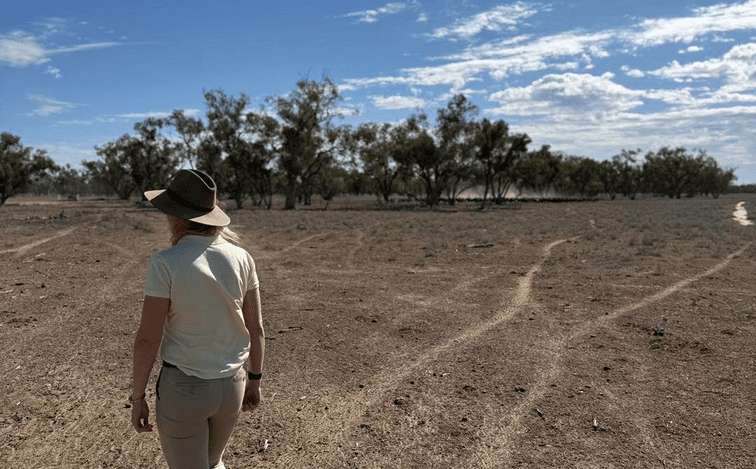
Conditions are extremely dry in the Walgett district of north-west NSW, where winter-crop planting is expected to be minimal. Photo: Councillor Dr Rebecca Vonhoff
THE region bounded roughly by Goondiwindi, Moree, Mungindi, Narrabri, and Walgett can produce well in excess of 3 million tonnes (3Mt) of wheat alone in a good year, but may max out at 1Mt this season without substantial rain in the next four weeks.
Agronomists are already pointing to winter-crop area in this key growing region of northern New South Wales being its smallest since 2023, but say as little as 30mm of rain to wet the topsoil could kickstart canola, wheat, barley, and chickpea planting, and expand faba bean area.
However, many paddocks in north-west NSW need 100mm or more to top up subsoil moisture and wet the topsoil too.
With wheat and durum prices still flat, and the optimal planting window for canola and faba beans closing early next month, barley and chickpeas look like being popular choices for May-June planting if it rains.
Agronomists say growers had mostly applied nitrogen prior to the Iran-US war breaking out early last month, and that dryness and low wheat prices rather than expensive fuel and fertiliser are the reasons for the cut to intended area.
The plus of the warm and dry conditions is that cotton defoliation and picking is advancing at pace, and minimal winter-crop planting is not eating into the region’s fuel supplies needed to power the cotton program.
Half to nil planting expected
Mungindi grower and Coleman Agriculture agronomist Brad Coleman said limited subsoil moisture and slim chances for getting rain in the planting window and during the growing season have impacted ideas about how much to plant.
“I’d say it will be 50-100 percent fallow for a lot of our growers,” Mr Coleman said.
“Unless we can grow 3t/ha of wheat, or 2t/ha chickpeas, you’re better off to not plant.
“A 2t/ha wheat might make you $100-$200 and leave you with no moisture for the following year.”
Mr Coleman estimates only around 5 percent of the faba bean area in his client base will be planted this season, with only three growers now putting them in the ground.
“The others don’t have enough moisture, and canola’s out — there’s not enough moisture,” Mr Coleman said.
Mr Coleman said levels of subsoil moisture vary greatly in paddocks across the region, and some could be planted with as little as 30-50mm to wet the topsoil.
“It really depends on plant-available water.
“If they don’t have much now, then it’s all over; it could rain 200mm in the next month but it’s very unlikely.
“They’ll probably fallow through to summer or next winter.”
Mr Coleman said many of his clients bought urea late last year and have already put it in the ground, where it can stay in readiness for either a summer crop or next year’s winter crop.
With an El Niño watch now in place, growers are aware that August and September are more likely to be warm to hot and dry, and Mr Coleman said that made them want to get most of their crop in early, or not at all.
Stored grain provides buffer
Walgett grower and Outlook Ag director and agronomist Greg Rummery said little rain has fallen since September.
“We’ve come off a big crop, and a decent run of years, and if we have to fallow for a year because Mother Nature deals us that, that’s what we’ll do,” Mr Rummery said.
“At the moment, we don’t have any real soil-moisture reserves on 80-90pc of our country.”
The export market is providing little incentive for growers to sell wheat stored on farm, but the barley market is strong based on up-country feed demand.
“We’ve benchmarked over the years, and found when there’s not really an opportunity to plant, you’re best to sit on your hands by maintaining your fallow, and selling the grain you have on farm.
“Most people are in pretty good spirits; they’ve got grain on farm, and the grain prices domestically aren’t too bad.”
Some growers, particularly north-east of Walgett, have already applied urea bought at a pre-war $800/t “or a bit more by the time it was delivered”.
“Since the outbreak of the war, nobody has been looking for it.”
Barley in favour
At Goondiwindi, Macintyre Independent Agronomists principal Dave Kelly said many growers in the company’s client base have had only single-digit rainfall events since harvest.
“It is relatively early days yet, but at the moment, we need anywhere from 30 to 80mm to get a decent movement in planting,” Mr Kelly said.
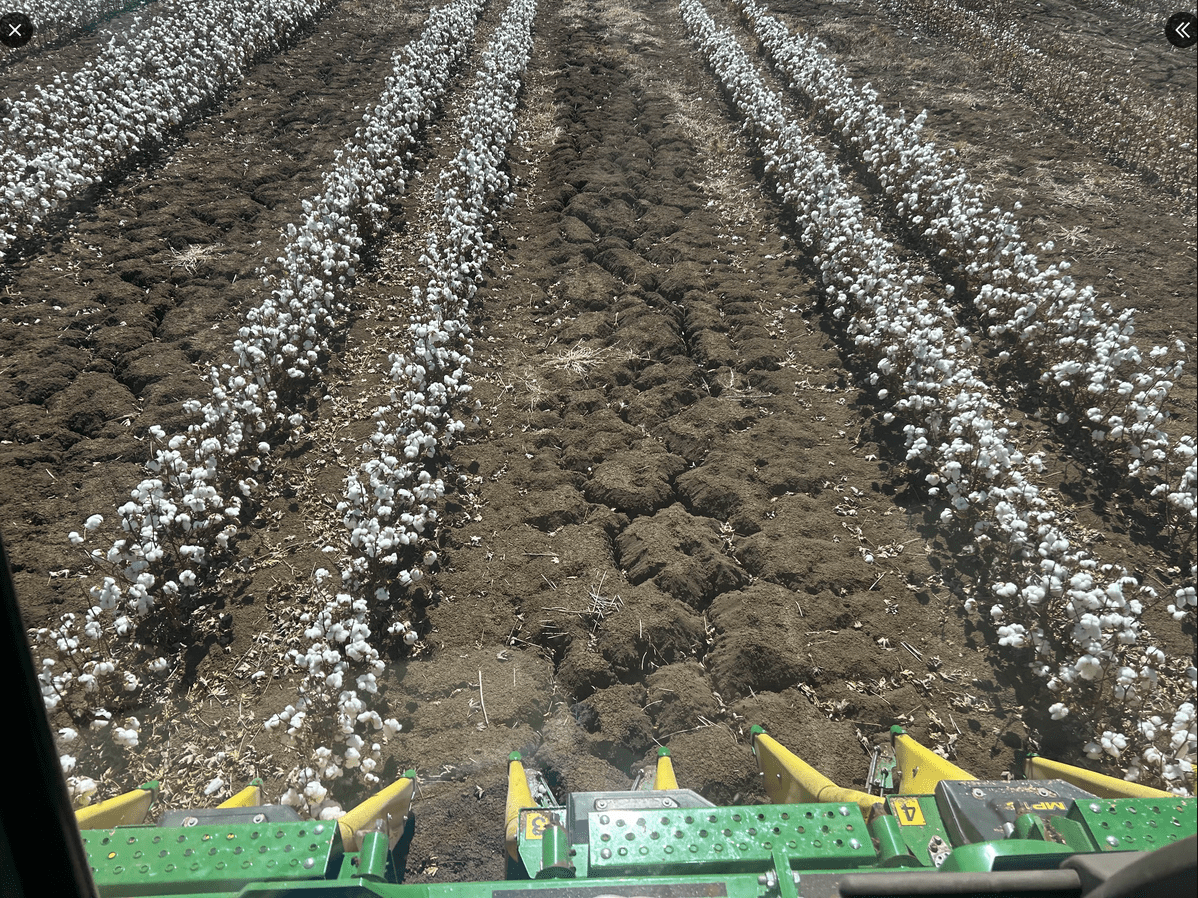
Deep and wide cracks in the self-mulching soils of northern NSW indicate how dry conditions are as cotton picking advances and the winter-crop planting window opens. Photo: Andrew Watson, Boggabri
While some paddocks are primed with urea and ready for wheat, Mr Kelly said a great deal of urea still needs to be bought, and the going rate is around $1200-$1400/t.
Proximity to western and Darling Downs feedlots means barley grown in the Goondiwindi region has a ready domestic market, and this is expected to make it a more popular than wheat, where export-based pricing has been relatively flat.
“There have been people swinging to barley; you generally don’t load it with as much urea as you do with wheat.
“Barley’s probably one of the few good-news stories; it’s been a bit of a poor cousin [to wheat] until now.”
Mr Kelly said canola was being dropped from planting intentions because of its appetite for in-crop urea, and because of the dry conditions.
“We had several clients that had their names on seed, but they have opted to give it back.
“Throwing a heap of urea at canola without moisture under it doesn’t make sense.”
Moree-based AMPS agronomist Tony Lockrey said while it was “great weather for defoliating and picking cotton,” the clear and warm conditions point to a small year for canola and faba beans.
Area planted to early canola looks minimal, and Mr Lockrey estimates roughly 10-15pc of the normal faba bean area in his client base will be planted.
Faba beans and chickpeas are the two major pulses grown in northern NSW, and while they require no applied nitrogen, Mr Lockrey said planting depth may be seen as prohibitive given the price of diesel.
“Burning diesel to get them on to moisture at a depth of 15cm means that spending that money on fuel, and…without a full profile is a risk.”
He said most growers have a 50pc soil-moisture profile at best.
“We need 50mm to open the season for us properly.”
Provided it rains, Mr Lockrey said 90-95pc of growers are committed to planting a 4t/ha barley or milling wheat crop, as they did at this time last year, when the season saw plenty of yields in the 5.5-6.5t/ha range.
The dry outlook points to a planted crop needing little to no top-dressing, in contrast to last year, when rain and in-crop feeding led to above-average yields.
“The season’s not done yet, but it doesn’t look at this stage like we’ll get a crop.”
Mr Lockrey said most growers had three plans now that the planting window had opened.
“Plan A is canola, fabas and early wheat, and that’s faltering.
“There are a few starters; the window hasn’t closed – they’ve still got two weeks.
“If it rained by Anzac Day, we’d still put some late canola in.
“Plan B is main-season wheat, and maybe some late canola.
“Plan C is barley and chickpeas.”
Mr Lockrey said its lower requirement for in-crop nitrogen, plus robust local feedgrain demand for it, were adding to the appeal of planting barley, while chickpeas were on the radar for their nil applied nitrogen requirement, and ability to be planted late and into a less-than-full profile.
Mr Lockrey said growers would certainly leave some area for summer crop as they weighed up varying degrees of fuel and fertiliser coverage.
He said growers with cotton have enough fuel on farm to pick and cart it, plus mulch fields after harvest.
“Fuel’s been a bit slow coming; some big suppliers can get a million litres one week and only get 400,000 the next.
“A few of our growers have enough fuel, water and urea to plant the next cotton crop and take it all the way through.”
Mr Lockrey said growers are likely to use the downtime from having a below-average winter-crop area to improve and maintain the farm.
Activities may include feral pig management, laser-levelling, cleaning out dams, and rock picking.
“If you’ve got available labour, you can get in and get those projects knocked over.”
Mr Lockrey said a sizeable on-farm carry-out for most growers can be cash flow into next year if needed.
“Growers have still got grain to sell, and they might have a bit of a buffer in farm management deposits.
“They cannot afford to grow an expensive crop, and not harvest a profitable one.
“Most of our profit’s in the bottom foot of moisture and we don’t have it.”
Despite its appetite for nitrogen, Mr Lockrey said durum may shape up if rain falls next month or into June.
“If they’ve already put nitrogen down, they’re looking hard at barley, but durum is a quick crop, and if it’s going to be worth $500/t at harvest, you wouldn’t want to be planting barley.”
Grain Central: Get our free news straight to your inbox – Click here
HAVE YOUR SAY