
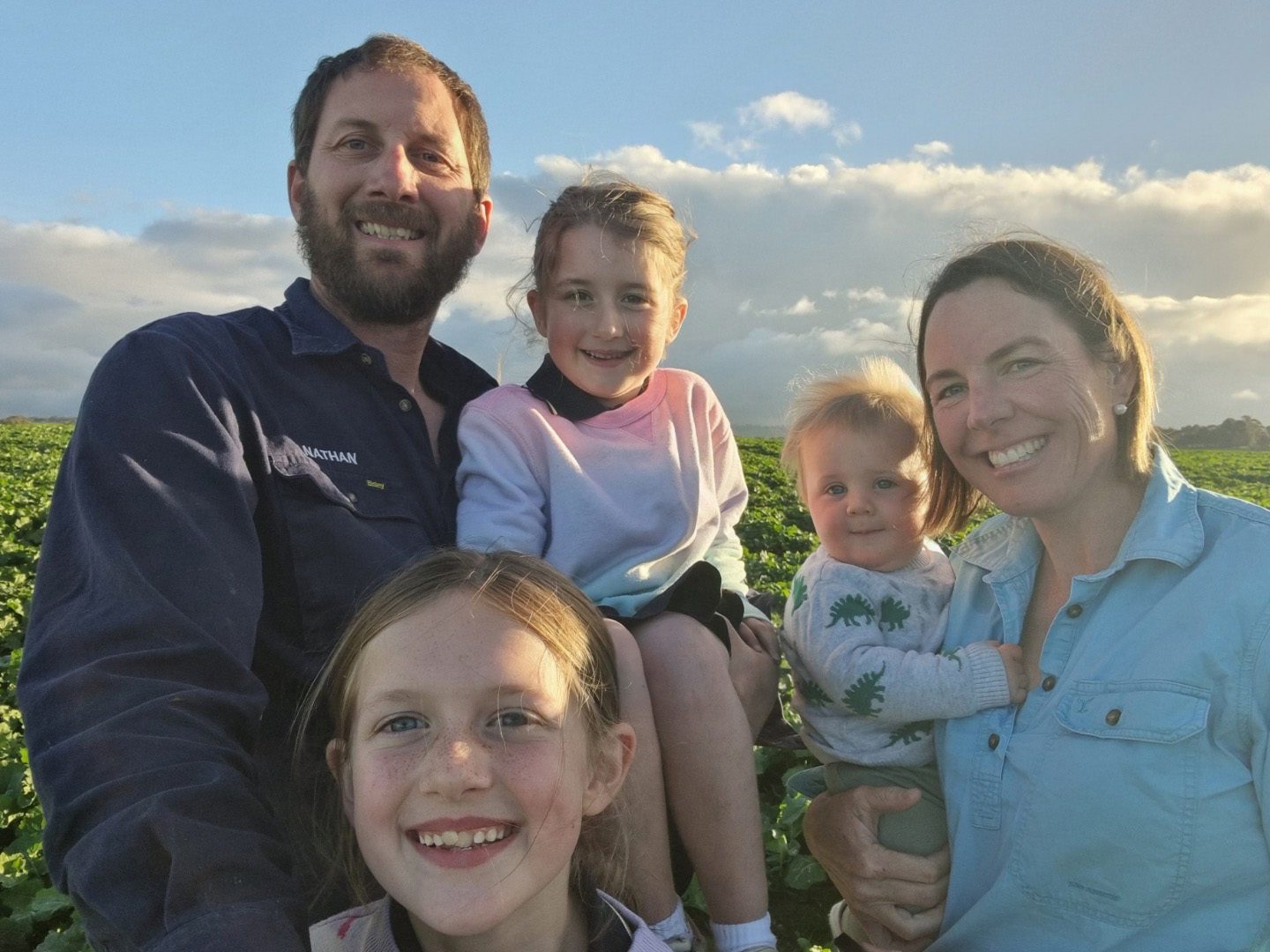
SA hay producers Robyn and Nathan Faulkner, Renklauf Trading, have won the 2026 SA cereal hay visual award and did a video link to their awnless barley crop in today’s webinar. Photo: Feed Central
SOUTH-EASTERN Australia looks to be heading for a bumper hay season in volume terms, but quality could be a challenge, and ex farm pricing is under pressure.
They were some of the messages from Feed Central’s Top of the Stack webinar held today, which gave insights into the domestic and international markets, as well as announcing the company’s state and national winners.
It also offered a step-through of the season from three Feed Central suppliers: Robyn Faulkner in South Australia’s Mid North, Jake Thompson in Victoria’s Goulburn Valley, and Mark Burkinshaw in southern New South Wales.
Export outlook solid
Australia exports around 1.2 million tonnes of hay each year, and JT Johnson & Sons international marketing manager Corey Ryan provided an update on international market dynamics.
Based at Kapunda in SA, it also has facilities in Vic and WA, and Mr Ryan is speaking to growers in those states in coming days.
Based on what an end user would pay, he said the new-season market for cereal hay delivered to factory was around $150-$250/t, compared to around $250-$300/t this time last year, when stocks had been depleted by dry conditions in south-eastern Australia.
“We would not have one farmer walk up to us and accept that,” Mr Ryan said of the nominal price.
He said the domestic market needed to find its “happy medium”, and an exporter would have to set its price in order for it to “find its feet”.
“We’ll need to get some string around some bales first to see where that’s going to be.”
Mr Ryan said the hay industry felt the pinch of the fuel and fertiliser price hike earlier in the year, and $30/t had been added to costs at their height, but only $10/t could be recovered through its end market.
“The end user is under pressure; everyone’s costs have gone up.”
Japan is Australia’s biggest market, and its demand for high-grade product has been a mainstay for exports.
He said China has “gone through the worst with their dairy market”, and its recovering market was also a bright spot, while growth was being seen in South-east Asia from countries including Vietnam.
In contrast, he said South Korea was oversupplied, and the Middle East “works when freight does”.
He said the high-grade hay market was positive based on demand from the horse, premium dairy, and pet sectors, and “most of the pain” is in low-grade hay, where more alternatives exist to compete with Australian product.
He summarised the export hay market as being “in a good position”, with quality hay attracting reliable demand, and drove home the message generated by customers wanting consistent quality.
“Every rejected load costs someone some money.”
Freight squeezing domestic market
Feed Central founder and managing director Tim Ford said the business and its arms Local Ag Marketplace and Feed Standards Australia is expecting to touch close to one million tonnes of hay this season.
Mr Ford said despite “a lot of cynicism” about the El Niño having developed, and the drying trend nationally being obfuscated by successive rains over south-eastern Australia, the market has not responded.
“In the southern part of the country, where by far largest volume of hay gets made, we’re seeing a very good season,” Mr Ford said.
For some growers, that includes waterlogging.
“The reality is we’re not seeing a booming market by any stretch of the imagination.”
After a run of south-to-north hay sales into autumn, Mr Ford said the market was reacting in ways other than lifting its bid for hay.
“We’re seeing large volumes of agistment cattle…moving into areas with better seasons, and we’re seeing a large cattle sell-off, and high freight prices.”
Mr Ford said the ex-farm hay price has been falling, but the price for delivered hay has been rising, a trend he has not seen before in Feed Central’s 25 years.
Based on a 39.6t load of Victorian hay travelling 1269km to Dalby in southern Queensland, the ex-farm price per tonne has not changed from $275.
However, the freight component has risen around 15pc to $244/t this year from $212/t in 2024, lifting the landed price to $519/t from $487/t, based on $8/km, up $1 from the 2024 rate.
“More realistically, a lot of carriers are charging $8.50 for that B-double.”
Mr Ford said that can add around $60/t to the price, and from a buyer’s point of view, that takes the delivered price from under $500/t in 2024 to over $500/t, “a really significant psychological barrier”.
“It’s a significant change in the market with no change to the ex-farm price.”
He said the fodder industry shows the impact of dearer running costs, including diesel, across the board, with farmers, transport operators and end-users missing out on any kind of gain from the higher delivered prices.
“I think the fodder industry is the canary in the coalmine.”
Mr Ford said diversified grower incomes which include cereal grain as well as canola and pulses may alleviate supply-side pressure on the ex-farm market already being felt from full hay sheds.
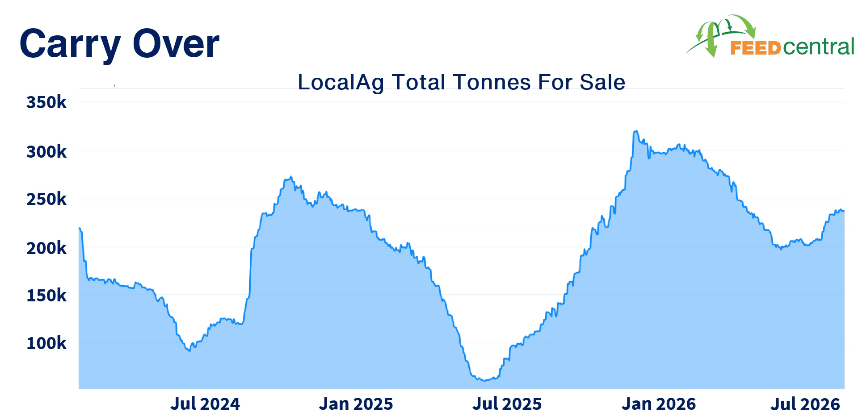
“The big elephant in the room is the carryover.”
He said Feed Central’s Local Ag platform showed just under 250,000t last month, as opposed to “just about zero” in July 2025, and stocks are expected to increase, especially in the south.
In the field
Crops shown by video in the webinar all look to be in good stead.
At the Faulkner family’s farm at Mintaro, Robyn Faulkner said hay was a mainstay of their 800ha operation, including “highly frost-prone” country, which also runs cattle.
Last year, the Faulkners grew an as-yet unnamed short-season awnless barley variety for the first time which yielded well and was cut and baled ahead of rain that affected the quality of later hay crops.
Quality for the upcoming crop, as always, is unknown.
“We’ve had 50mm of rain in the past five days,” Mrs Faulkner said.
At Wyuna, Jake Thompson, who farms with his brother Sam, farms 1200ha in irrigation country, growing wheat, barley, and canola, plus oaten and lucerne hay, and corn in summer.
The Thompsons’ lucerne generally gets five or six cuts, the last in early April, and Jake said recent rain means the irrigation outlook looks promising for this summer.
Their lucerne is well developed for this year after a “fairly warm autumn” and a reasonably mild winter.
“We have had frosts but it’s been a year when we’ve had a lot less frost than normal.”
He said they opt for longer-season varieties, particularly of vetch and grazing wheat, to best avoid baling before mid-October, when getting moisture down would be an issue.
“We can’t really push it earlier than that.”

Boree Creek farmer Mark Burkinshaw.
Mark Burkinshaw is part of a family farming operation which crops canola, wheat, barley, vetch and occasionally faba beans over 7500ha.
He said 40mm in recent days has been “very timely” in an excellent season which is running just short of average rainfall, and “hard to believe” based on the gloomy forecast.
Mr Burkinshaw started sowing vetch on April 1 into limited moisture, and caught a little early rain.
He said sowing was “on the early side” based on the forecast for “no spring”.
The same approach in 2018 gave good results, and cutting started “very very early” on September 1.
Mr Burkinshaw said cutting of the vetch varieties grown this year, Morava and Volga, are expected to start around mid-September, and with two fungicide applications applied, they have ““shut the gate now until the mower”, barring a glyphosate application 5-7 days prior.
Mr Ford said vetch looked like being “the clear winner” in the current market for constant demand, and feed testing “exceptionally well”.
He holds concerns about new-season vetch and other hay.
“My hunch is that old-season hay will be better quality than new-season hay.”
Mr Ford said after rain of recent days, thick and tall vetch crops could potentially harbour mould and mildew before they are cut.
Winners’ circle
The webinar included the announcement of Feed Central’s state-based awards, national awards for producers of large square bales, with national results as follows:
National cereal hay visual award: Adam Gardiner, Gardiner Bros Farms, Calwell, NSW;
National cereal hay feed test award: Anthony Wilken, RA & HM Wilken, Tarranyurk, Vic, with a 11.15 megajoules/kg of metaboliable energy, and 10.5pc protein.
National lucerne hay visual award: Mark and Susie Green, Forbes;
National lucerne hay feed test award: Alexander family of Haylin, Riverleigh, Qld, with ME of 10.47 and 25.2pc protein.
National vetch hay visual award: Stuart Shifferle from Schifferle Freight Services, Berrigan, NSW;
National vetch hay feed test award: Wayne Huf of Claralda, Hopetoun, Vic with 10.47 ME and 25.3pc protein;
Heaviest hay bale: Tom Bell and Nathan Ovington, Narromine with a 785kg bale weight over a B-double; and,
Heaviest straw bale award: Brad Johnston of Johnston Agriculture, Quandialla, NSW, with 590kg over a road train.
Grain Central: Get our free news straight to your inbox – Click here
HAVE YOUR SAY