
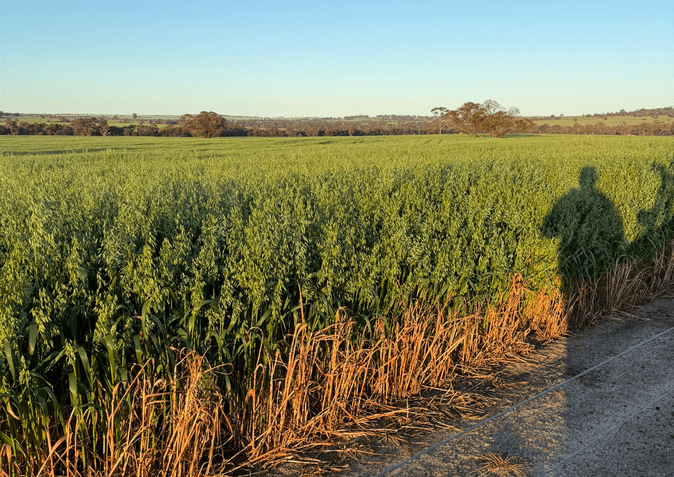
A crop of oats in the Arthur River district east of Bunbury early this month, when grain yield potential was seen at around 4t/ha. Photo: Sam Burgess
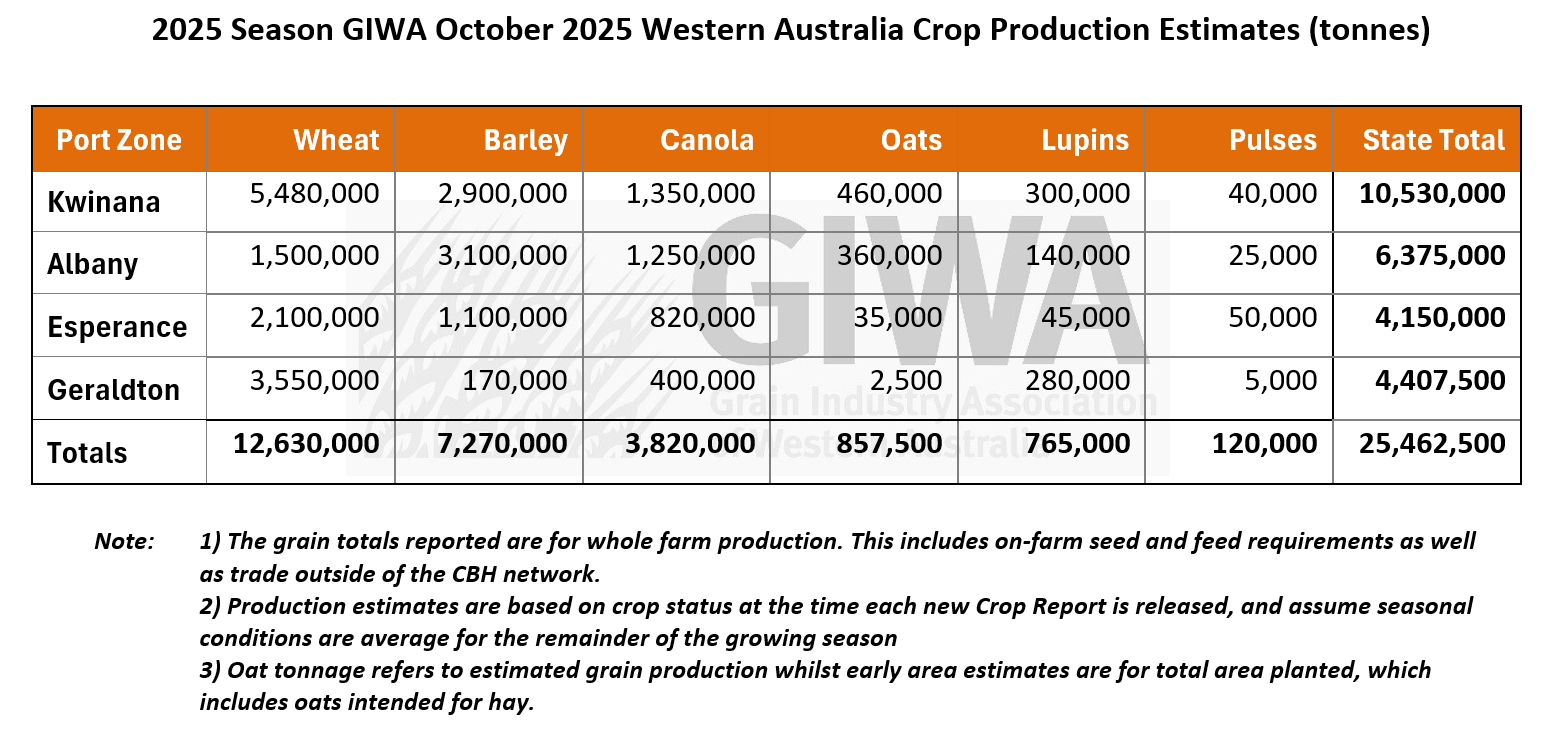
THE GRAIN Industry Association of Western Australia has added 1.78 million tonnes (Mt) to its forecast for the impending WA grain harvest, now seen at 25.46Mt, up from 23.68Mt forecast in September.
In its monthly crop report released today, GIWA report author Michael Lamond said WA was on track to come close to or possibly exceed the production record set in 2022 of 26.06Mt, despite yield potential sliding recently in its medium-rainfall regions.
“While little useful rain has fallen during the critical grain-fill period, the good areas to the north, west and south of the state are very good and have a similar potential to 2022,” Mr Lamont said in the report.
On top of this, GIWA puts WA’s total cropped area at around 500,000ha, or 6 percent, more than in 2022, and 300,000ha more than in 2021, the state’s second-highest grain production year.
“Harvest is just starting in the Esperance zone on early sown barley and canola crops and is expected to begin in the Kwinana and Geraldton zones from late October and early November — around one to two weeks later than normal.
Factors point to big year
In the higher-rainfall zones, Mr Lamond said there has been a significant shift from pasture to crop as more farmers get out of sheep, and cropped area has increased by about 15pc over the past four years.
“The crop mix is also quite different, with more barley and less canola in 2025 than in 2022.
“Barley generally yields around twice as much as canola, irrespective of the rainfall zone, and the large barley crop this year is probably going to be the star performer, contributing more than 30pc of the total grain in the state.
“The combination of these factors means the top coming off the crop in the central regions could be made up elsewhere, resulting in another record production year.”
Frost, heat hits minimal
GIWA ’s September crop report highlighted the potential impact of frost and heat shock on total production should either of these events occur during the remainder of September and early October.
“Both have been minimal, and whilst there have not been the finishing rains in the last month across all regions to push yields higher, potential yields have held in all areas other than the central region.”
Mr Lamond said cereal grain quality was expected to be good, with grain fill “ticking along nicely”, and most growers reporting good grain size as crops approach maturity.
“Grain protein is likely to hold, even where the yields are going to be above average, as there has been significant practice-change in the last four years, with growers applying more nitrogen than just a few years ago.
“This was quite noticeable all year in the colour and health of crops.
“In addition, the rapid adoption of controlled-release nitrogen products is resulting in nitrogen-use efficiencies increasing to a point where the dilution in protein that occurs with high yields looks to be a thing of the past.”
The exception is where grain yields have pushed well beyond what growers anticipated and fertilised to target.
Several light frost events during spring caused some flower frost in wheat and barley in low-lying and susceptible areas of the central regions.
“These areas have had the top taken off grain yields, but the impact on the state’s tonnage will be minimal.
Light levels of flower frost usually results in larger grain in affected heads rather than higher screenings, as those grain-fill sites that are lost are compensated by unaffected sites which take up more nutrients and produce fewer but plumper grains.
In the more severely frost-affected areas, growers are expecting some yield reduction and higher screenings.
Barley shines, wheat, canola mixed
Wheat production in the Geraldton, Albany and Esperance port zones is likely to be greater this year than in 2022, while production in the central regions of the Kwinana zones will be lower due the late start and lack of finishing rains.
There are some bright spots in the lower rainfall fringes in the central regions of the Kwinana East zone where growers jagged some useful falls of rain around the end of September and these crops will now be above average.
The 2025 season has suited barley across the state, with harvest expected to deliver more than 7Mt, making it WA’s largest barley crop on record.
“Barley crops have looked sensational all year.
“Grain size and protein are expected to be good in most areas, with the early flowering allowing time to fill heads and the warm soils and soil moisture allowing more soil nitrate mineralisation than normal.”
Canola is expected to deliver mixed yields, as much of the crop had to make up ground during the winter to fill the gaps left from its scratchy start.
“The extended grain-fill period has helped to give crops time to branch out and set more pods, although in the central regions the lack of rain during the last six weeks has put a lid on grain yields.
Mr Lamond said canola crops are looking “exceptional” in the higher-rainfall regions of the Geraldton, Midlands, West Albany, South Coast and Esperance regions, and will deliver big tonnages.
Lupins have benefited from the past month’s mild conditions, which have given pods more more time to fill, and lifted yield estimates.
“As hay-cutting is still under way, it is difficult to predict the final outcome, but it is likely that the ratio of oats harvested for grain and that cut for hay will be similar to past years.
“However, with the increase in total area planted this year, total oat grain production will definitely be higher than it has been for many years.”
Source: GIWA
Further detail on crop conditions in individual WA port zones can be found as part of the full report on the GIWA website.
HAVE YOUR SAY