
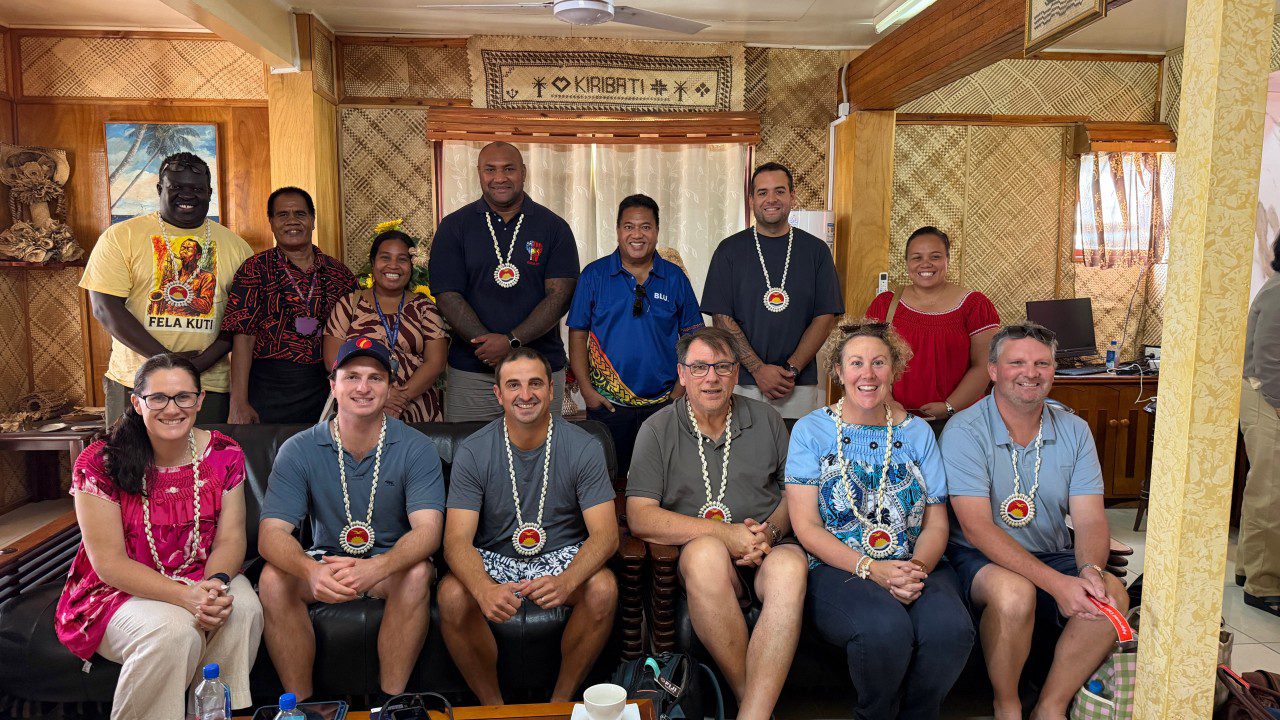
The Goondiwindi region business delegation being received by Kiribati Minister for Employment and Human Resources Auria Kitina (standing third from right). Photo: Supplied
BUSINESSES from the Goondiwindi region are taking an ambitious and proactive approach to one of regional Australia’s toughest challenges: finding skilled workers and giving them reasons to stay.
A delegation representing six businesses and organisations from across the Goondiwindi Regional Council area travelled to Kiribati from June 29 to July 4 to meet and interview potential employees and investigate a long-term Pacific workforce pathway for the region.
Rather than individual employers trying to solve persistent workforce shortages alone, the initiative brings businesses together around recruitment, settlement and retention, recognising that attracting workers to regional communities is only part of the challenge.
Delegation lead Julia Spicer said the visit was about local businesses working together to find practical solutions rather than waiting for workforce challenges to resolve themselves.
“Finding staff continues to be a major barrier to the growth of businesses across our region,” Ms Spicer said.
“In our region, we have jobs, businesses that want to grow and communities that need people. Instead of six businesses individually trying to navigate the same challenges separately, we’re asking what we can achieve by working together.”
The delegation met prospective employees face-to-face, visited training organisations and spent time understanding Kiribati’s culture, communities and workforce preparation.
“Successful regional recruitment is about much more than filling a vacancy. If we want people to come to our communities, stay and become part of them, we need to understand who they are, where they come from and what they need to successfully make that transition,” Ms Spicer said.
The delegation was also hosted by representatives of the Kiribati Government and the Australian High Commission, providing an opportunity to better understand the broader relationship between workforce mobility, skills development and regional communities.
Gary Bartlam, Woods Group Human Resources Manager said “The Kiribati assessment visit was a valuable opportunity for Woods Group to meet candidates directly and assess not only their skills, but also their attitude, motivation and fit for our business.
The PALM Scheme forms an important part of our workforce strategy, particularly for regional operational roles where reliable labour is increasingly difficult to source.
We were impressed by the quality of the candidates we met in Kiribati and are looking forward to welcoming selected workers into our team.”
Goondiwindi Regional Council representative Chris Smith said meeting prospective employees in person changed the recruitment experience entirely.
“Taking the time to meet candidates in person, learn about their culture and share the experience with others from within our community was important,” Mr Smith said.
“It also gave us the opportunity to be open about what living and working in our region is really like.
“That kind of understanding has an impact both ways, and it gives us a much stronger foundation for successful recruitment and retention.”
Businesses participating in the delegation represented a cross-section of the regional economy, including agriculture, engineering, hospitality, and local government.
Brad and Lynda Johnson from Blask Engineering in Inglewood said they were impressed by the skills they encountered and saw potential for the process to provide another pathway for regional businesses struggling to source staff.
Pieter and Estelle Van Jaarsveld from the Royal Hotel Inglewood used the visit to better understand the skills available through connecting with people in Kiribati and explore whether the Pacific Australia Labour Mobility (PALM) scheme could work for their business.
They Van Jaarsvelds said the cultural experience and relationships developed through the delegation were as valuable as the recruitment opportunities.
For Tom Oakes from Coulton Farming, the delegation provided an opportunity to investigate alternatives for addressing seasonal labour shortages in agriculture.
“The geographical disadvantages of some of the Pacific islands like Kiribati were quite eye-opening; however, the resilience of their citizens was inspiring,” Mr Oakes said.
He hopes the visit will help Coulton Farming address seasonal workforce gaps while developing a strong relationship with a Kiribati workforce.
Adcorp managing director of contingent staffing Zeb Riddell will continue working with participating businesses as they move through recruitment, onboarding and settlement.
As an Approved Employer under the PALM scheme, his team provides the compliance, welfare and retention infrastructure that sits behind successful long-term placements.
“A trip like this opens the door, but what determines whether it works is everything that comes after,” Mr Riddell said.
“Bringing workers into a regional community and helping them stay takes proper welfare support, compliance and a genuine commitment from employers.
“That is what makes the collective model work, and it is why businesses are better off approaching this together rather than alone.”
The initiative has also attracted the interest of Welcoming Australia, with Ken Dachi identifying its potential to develop into a best-practice model for connecting Pacific workers with employment and community life in rural Australia.
Ms Spicer said the collaboration could ultimately offer lessons beyond Goondiwindi.
“There is a real opportunity here to think differently about regional workforce development,” she said.
“If businesses, government and communities work together from the beginning, we can create employment opportunities that are good for employers, good for workers and good for the communities they become part of.”
“This trip was the first step.
“The real measure of success will be what happens next, whether we can turn those relationships into sustainable jobs, stronger businesses and people who feel genuinely welcomed into our region.”
The delegation will now work through employee onboarding and next steps with shortlisted candidates and participating businesses.
Source: Supplied
HAVE YOUR SAY