
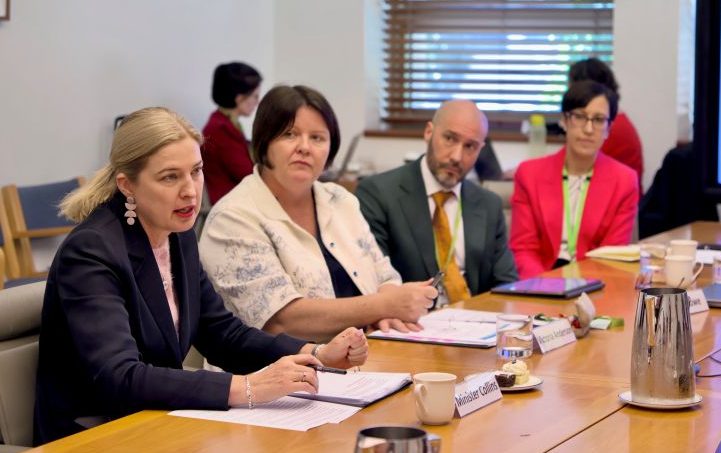
Agriculture minister Julie Collins during a meeting of the National Food Council in Parliament House, Canberra today. Photo: Julie Collins
THE FEDERAL Government has today commissioned a National Food Supply Chain Assessment, with the work to initially focus on diesel supply chains then move to other inputs like crop protection and fertilisers.
The assessment will feed into the work of the newly established Fuel Supply Taskforce, and provide advice to government on practical steps to strengthen preparedness for disruptions to food production and supply chains.
The work is part of the development of the National Food Security Strategy.
It is an outcome of today’s meeting of the National Food Council, which focused on the current impacts of the conflict in the Middle East on Australia’s food system.
The assessment will initially focus on diesel supply chains, and will then expand to other critical agricultural inputs, including crop protection products and fertilisers.
The assessment will be led by Andrew Henderson on behalf of AgriFutures, who will step away from the National Food Council to undertake this work.

Simeon Gilding.
Simeon Gilding will join the National Food Council.
Mr Gilding brings significant expertise in national security and international relations, having held senior positions at the Australian Signals Directorate, the Department of Defence, the Department of Foreign Affairs and Trade, and the Department of Prime Minister and Cabinet.
An interim report focused on diesel supply chains will be provided to the Minister for Agriculture, Fisheries and Forestry within one month, with a final report to be delivered by the end of the year.
The government is also continuing to boost fuel supply to allow Australian farmers to keep operating.
This includes the release of up to 762 million litres of petrol and diesel from Australia’s domestic reserves by amending the Minimum Stockholding Obligation, and around 100 million litres a month of new petrol supply a month by amending Australia’s fuel quality standards through to May.
Minister for Agriculture, Fisheries and Forestry Julie Collins said the government continued to work with farmers, producers and Australia’s agriculture industry to manage the impacts of the conflict in the Middle East.
“The Albanese Labor Government is working day and night with our farmers and producers to help manage the impacts of the conflict in the Middle East,” Ms Collins said.
“Our farmers and producers feed millions of people both here and abroad, but events like the conflict in the Middle East reaffirm why we cannot be complacent.
“While Australia is food secure, we recognise the importance of supply chain resilience, including the supply of fuel and fertiliser, which is why we have commissioned this assessment.
“This assessment will provide advice to government on ways we can continue to strengthen preparedness for disruptions to food production and supply chains, building on frameworks already in place that help safeguard Australia’s food production.
“We continue to progress our National Food Security Strategy, which is about keeping food production and supply chains moving, and ensuring Australia continues to remain competitive on the global stage.
Source: Federal Government
HAVE YOUR SAY