
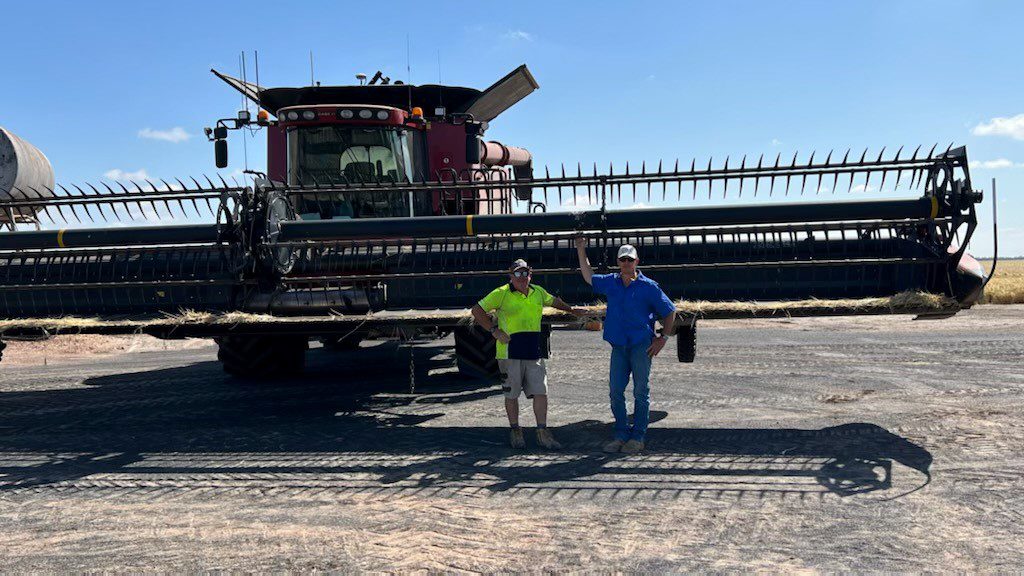
Sean “Spud” Murphy (left) served in the Royal Australian Navy from 1988 to 1995 and worked on Phill Eulenstein and family’s Boola property at Tulloona, north of Moree, in 2021 when on long-service leave from a Victorian Government job. Mr Murphy found the position through OGHA. Photo: GPA
THE Federal Government’s changes to visa processing have caused a labour headache for many growers ahead of harvest, and Grain Producers Australia is looking to help alleviate it by rebooting Operation Grain Harvest Assist (OGHA).
Initiated when border restrictions made finding harvest staff difficult during COVID-19, it put former Australian Defence Force members into harvest jobs, and helped to build a permanent pipeline of skilled Australian workers for agriculture.
With many backpackers waiting on Working Holiday Maker visa approvals, and not sure they will get them, growers who need casual labour for harvest are seeking it locally, and some have already tapped into the veteran community.
“When GPA launched the initiative in 2021, an estimated 300 veterans answered the call to assist grain producers throughout Australia,” GPA chair and northern New South Wales grower Matthew Madden said.
“They were welcomed on to farms because they brought what a harvest crew actually needs: mechanical aptitude, situational awareness, an understanding of safety, and a willingness to work.
“Many have come back season after season.
“Most of the national conversation about agricultural labour is a conversation about visas; this one is a conversation about Australians.
“Where we can solve a workforce problem at home, we should, and in the veteran community there are thousands of people with precisely the skills our members are looking for.”
OGHA can lead to a new career path for ex-ADF personnel.
“Several thousand ADF members retire from the Defence Force each year, after an average eight-year service,” OGHA founder and retired Lieutenant Colonel Garry Spencer said.
“These are trained, skilled and disciplined potential staff in their prime, looking for new purpose.
“Agriculture can offer them that purpose, and in return it gains the workforce it has been searching for.
“We have several hundred experienced veterans ready to go for this harvest, and attention of this kind reaches people who have never considered agriculture as an option.
“Every story told brings more of them forward.”
Mr Madden said the initiative was ready to be scaled, and governments looking for durable answers around the agricultural workforce should look closely at it.
“This is a workforce solution that does not depend on a visa class,” Mr Madden said.
“The wages stay onshore, the workers are Australian, and growers pay them.
“It answers the concern that agriculture is drifting toward a guest-worker model, and it does so without asking the taxpayer to carry the cost of the work itself.
“It also offers a purposeful transition from service into civilian life for veterans, which is worth a great deal, and agriculture is well placed to provide.
“What governments can usefully do is help us find and prepare people faster.”
Mr Madden said a modest investment in recruitment, screening and machinery induction would multiply what OGHA is able to put into the paddock this and following seasons.
“GPA would welcome that conversation, and we are ready to have it now.”
Varying pressure
The government appears highly unlikely to approve all the visas in the pipeline lodged with an eye to harvest 2026 work.
However, some are through, including two for Canadians who will work on the Madden family farm east of Moree to help with harvesting and carting grain.
Mr Madden estimates across the wider Moree district, tonnage will be down by more than half overall due to a lack of rain in the ideal planting window.
“Across the district we’ll be down about 60pc; that depends on what side of town you’re on, and if you got under a storm.”
“Some people had staff organised earlier, but those waiting for visas to be stamped have run into problems.”
The relatively small northern harvest means its call for casual labour is reduced, and growers in the south have some time to make contingency arrangements if they have been left short by visas not being approved.
Harvest in Queensland has started, and will roll into NSW next month before cranking up in Victoria, where bumper yields are expected, and also the Riverina of southern NSW, where the yield outlook is mixed.
South Australia is in for a bumper harvest, but its growers are generally set up to handle it themselves.
Western Australia, where all regions harvest at roughly the same time, relies heavily on visa-holders, and can therefore be expected to look to OGHA to help fill otherwise empty casual positions.
GPA stands by its earlier statement that visa holders make up an important part of the harvest workforce, but is pointing to former ADF personnel as a source of onshore labour who can return to the same farm year after year.
“Not that they’ll all want to, but up to 6000 veterans redeploy or leave the forces every year,” Mr Madden said.
“OGHA is a chance for them to get into agriculture for harvest…or for longer.”
Grain producers seeking harvest workers, and veterans seeking work, can register through OGHA via GPA at www.grainproducers.com.au/
HAVE YOUR SAY