

GRAINCORP has released a white paper outlining how Australia could leverage readily available canola and other feedstocks to develop a domestic sustainable aviation fuel (SAF) industry.
This view was echoed by speakers at last week’s Bioenergy Australia webinar, who identified oilseed feedstocks such as canola, carinata and camelina as scalable, traceable feedstocks for a domestic renewable fuels industry, while creating another market for Australian growers.
Titled From Paddock to Plane: Feedstock White Paper, the paper sets out a clear and practical pathway for Australia to leverage existing agricultural and waste-based feedstocks to build a globally competitive SAF industry.
Developed as part of GrainCorp’s role on the Federal Government’s Jet Zero Council, the paper finds that Australia’s SAF opportunity is not constrained by feedstock availability, but by the need for investment, policy settings and market signals.
The paper highlights existing feedstocks as capable of supporting SAF production equivalent to 117 percent of Australia’s projected jet fuel demand in 2030, rising further as new feedstocks and technologies emerge.
GrainCorp managing director and chief executive officer Robert Spurway said the findings demonstrated Australia’s ability to secure its aviation fuel future could begin immediately.
“Australia’s competitive advantage begins in the paddock, and it’s an advantage we can act on now,” Mr Spurway said.
“We already produce the feedstocks needed to underpin a domestic SAF industry, including canola, tallow and used cooking oil, supported by established infrastructure, expertise and supply chains.
“The challenge is that those feedstocks are currently undervalued and largely exported, leaving the country reliant on imported fuel.
“Australian growers can play a central role in strengthening the nation’s fuel supply using crops we already produce – but like any industry, they need clear market signals to make long-term commercial decisions.”
The white paper outlines a three-stage pathway for industry development:
- Start with existing feedstocks produced at scale, such as canola, tallow and used cooking oil;
- Scale through expanded feedstock supply, improved crop yields and developments; and,
- Optimise through next-generation feedstocks and refining technologies to capture long-term value.
Australia’s extensive feedstock base spans canola, sugarcane, wheat, used cooking oil, municipal solid waste, tallow, crop residues, forestry by-products, and emerging sources such as carinata, pongamia, perennials, and algae.
Scalable feedstock
Seed company Nufarm is developing next-generation feedstocks such as carinata, camelina and energy cane, alongside its established Australian canola seed business.
Nufarm global lead, sustainability strategy and low-carbon solutions Dan Lieberman said production of biofuel crops could be scaled in a traceable and sustainable way as demand from the fuel industry grows.
He said this would provide an advantage as supplies of traditional waste feedstocks, such as tallow and used cooking oil, become increasingly constrained.
“Ultimately, wastes, while I will advocate for the use of wastes all day long, they’re limited,” Mr Lieberman told a Bioenergy Australia’s Unlocking feedstock potential: Scaling the Global Low Carbon Fuels Market webinar held July 2.
“They’re not renewable resources and we will be coming up against that supply crunch over the next several years.
“Brassica, carinata, and other purpose-grown feedstocks we can scale.”
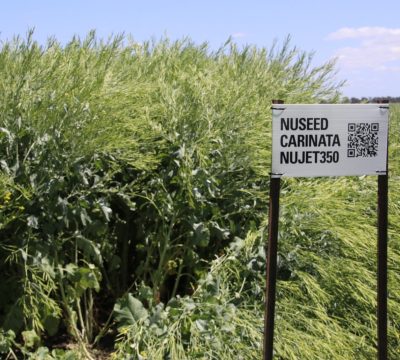
Nuseed carinata growing at the Tosari Research Centre.
He said there was “no one single silver bullet” biofuel crops and there was “trade-offs across all feedstocks that we consider”.
“I’d say that across the board we really do need all the solutions to bring to the table here.”
He said that canola was the “anchor” in Australia and that Nufarm was currently developing carinata in Australia, although it was currently a very small crop.
“Brassica carinata is a high biomass cover crop; it’s grown as an intermediate crop between primary rotations.
“It produces a non-food industrial oil without displacing food, without driving land-use change, and that characteristic right there is why it scores so well under carbon and sustainability rules.
“For the grower, it means additional revenue, better moisture and nutrient management, biodiversity, and better disease and pest control.
“The deep taproot…improves soil quality, reaches way down to the ground, resists erosion, sequesters carbon.”
Mr Lieberman said carinata was “purpose-built for a policy environment that demands low emissions, traceability, and no food versus fuel trade-off”.
Calls for policy change
GrainGrowers general manager – policy and advocacy Zach Whale told the webinar that GrainGrowers saw “a massive opportunity” for growers and regional communities from a renewable fuels industry.
He said another domestic market for Australian grain could provide growers with a buffer against a “volatile international trade environment”.
Mr Whale said making the new industry a success meant shoring up demand, with part of that involving discussion of a national mandate.
“These markets won’t exist on their own, they only exist in the presence of policy certainty and policy consistency and alignment of international certification programs, so that’s the missing gap in the Australian context,” Mr Whale said.
“We’ve had some state-based mandates over time that haven’t been overly successful.
“We need this mechanism, now on the demand side, so that the investment environment has certainty and so that everybody along the value chain, starting with farmers, can feed in.
“It’s all connected and you can’t get the investment without the policy certainty.
“You can’t get the feedstock produced without the offtakes; you need it all to happen together.”
Alongside the release of its white paper, GrainCorp also called for changes to the policy settings and noted that the Federal Government was preparing to consult on a demand-side measure to stimulate investment in refining capacity.
“The Federal Government has recognised the importance of developing our domestic capacity, and the forthcoming consultation on a demand-side measure is an important step toward providing the certainty needed to attract investment in refining capacity,” Mr Spurway said.
“With the right policy framework, Australia can scale refining capacity, reduce reliance on imported fuels and build a globally competitive SAF industry.”
Qantas chief sustainability officer Fiona Messent said aviation needed “policy and industry to move together”.
“We welcome the government’s recent commitments to support SAF development and look forward to working with industry and government to get the balance of demand and supply-side policy right, building an Australian SAF industry alongside a thriving aviation sector,” Ms Messent said.
In his 2026-27 Budget speech on May 12, Federal Treasurer Jim Chalmers flagged that the government would introduce measures to support demand in renewable fuels.
“We’ll produce more fuel through our $1.1 billion Cleaner Fuels Program, backed with reforms to our low carbon liquid fuels market to support demand,” Mr Chalmers said.
No more details have been provided on specific reforms.
Grain Central: Get our free news straight to your inbox – Click here
HAVE YOUR SAY