
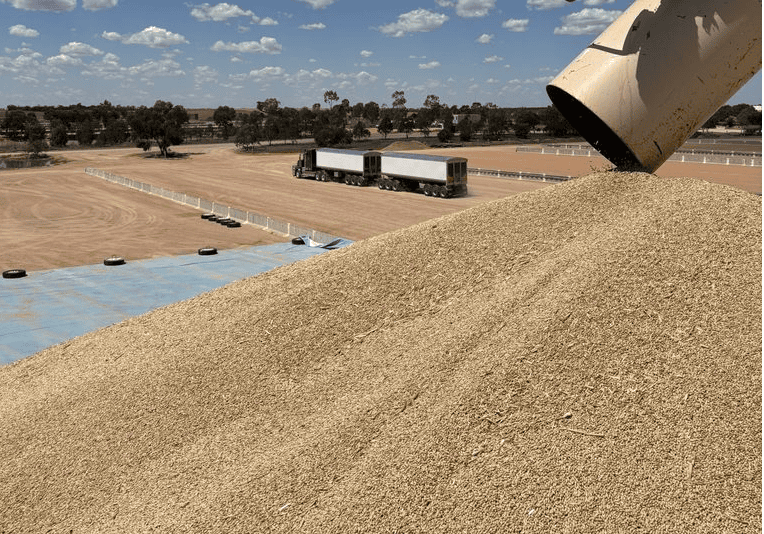
A barley bunker grows at GrainCorp’s Ouyen site in the Victorian Mallee. Photo: Emily Funcke, Ouyen site manager
HARVEST deliveries to eastern Australian bulk handler GrainCorp have jumped 58 percent in the week to today to hit 3.12 million tonnes (Mt).
In its latest Harvest Update, GrainCorp has detailed the week’s deliveries of 1.14Mt as harvest across Queensland winds down, with widespread rain in recent weeks delayed final receivals in many areas.
GrainCorp’s update said rain has provided a welcome boost to summer-crop prospects across Qld, and into parts of northern New South Wales.
“In northern NSW, growers have made good progress between weather events, particularly wheat and barley deliveries around the Macquarie region,” the update said.
“Harvest has gathered pace across southern NSW, with canola, barley and wheat moving through the network and the strongest activity currently concentrated across the northern Riverina.
“In Victoria, deliveries remain concentrated across the Mallee and Murray regions, with forecast rainfall potentially slowing progress before harvest activity builds more broadly across other areas.”
| Week to 19 Nov 2026 | Harvest to 19 Nov 2026 | |
| Queensland | 24,900 | 202,000 |
| New South Wales | 795,400 | 2,331,400 |
| Victoria | 315,900 | 583,600 |
| Total grain receivals | 1,136,200 | 3,117,000 |
Table 1: Deliveries to GrainCorp sites, excluding direct-to-port receivals, since 1 October 2026. Source: GrainCorp
Half century for ‘Tank’
When John ‘Tank” Kyte arrived at a small grain depot in Toobeah, Queensland in 1976, he was looking for a job and a decent pay packet.
He certainly wasn’t expecting it to turn into a 50-year career.
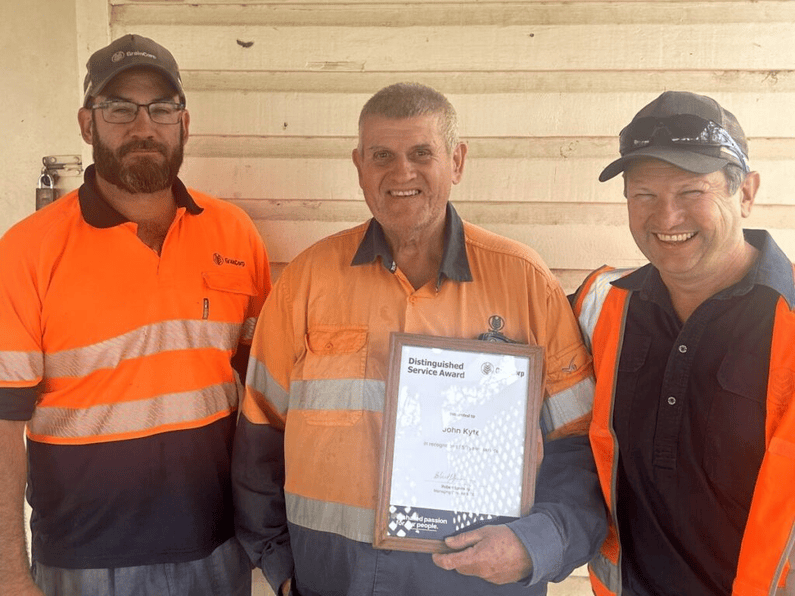
John “Tank” Kyte with his Distinguished Service Award acknowledging 50 years with GrainCorp, pictured with Goondiwindi East site manager Chaise Wells (left) and best practice and compliance manager Brad Foster. Photo: GrainCorp
Originally from Goondiwindi, Mr Kyte had already packed plenty of work into his early years.
He left school at 14 and worked on a farm, earning $1.15 an hour for days that could stretch to 18 hours behind the wheel of a tractor.
He later joined the Goondiwindi Council, digging kerbs and gutters with a pick and shovel for $42 a week.
Then a former shearer told him about harvest work.
“In my first week, I made $74. I was very happy with that,” Mr Kyte said.
At the end of his first harvest, he was asked to stay and help with outloading.
He agreed and, in his words, “never looked back”.
“Harvest looked very different in those days.
“A truck might have carried just five to eight tonnes of grain, compared with some combinations carrying up to 90t today.
“There were no tip trucks either – grain came through chutes along the sides of trucks, and once the truck emptied, the tools came out to shovel and wheelbarrow it to the bunker by hand.”
There were no modern stackers; slingers threw grain on to the bunkers, while heavy hardwood beams and large sheets of iron were used to build covers.
Mr Kyte sums up the standard workwear of the era simply: “Dunlop Volleys, footy shorts and a singlet.”
Tarps began arriving in the late 1970s, followed by loaders in the early 1980s.
In the decades since, machinery and technology and improved safety practices have transformed the way grain is received, stored and outloaded.
“It’s a lot easier now.
“You’re not out in the heat and dust as much, and everything is quicker to handle.”
The scale of harvest has changed too.
Back then, receiving 1000 tonnes in a day was a major achievement, and long days were part of the job, with shifts often stretching to 15 hours and sometimes longer.
During the enormous 1996 harvest, Mr Kyte remembers working for 10 weeks straight.
Today, better equipment and much stronger employee health and safety practices and fatigue management mean a harvest shift is generally no more than 12 hours.
Across five decades, Mr Kyte has learned every part of the job by doing it.
He progressed from seasonal harvest work to becoming a permanent grain handler, helping prepare sites throughout the year and outload each season’s crop.
These days, he is passing that knowledge on, teaching countless new colleagues along the way.
Now working his 50th harvest at GrainCorp’s Yelarbon site, Mr Kyte has straightforward advice for anyone beginning their first harvest.
“Listen to the people who know what they’re doing.”
Source: GrainCorp
HAVE YOUR SAY