
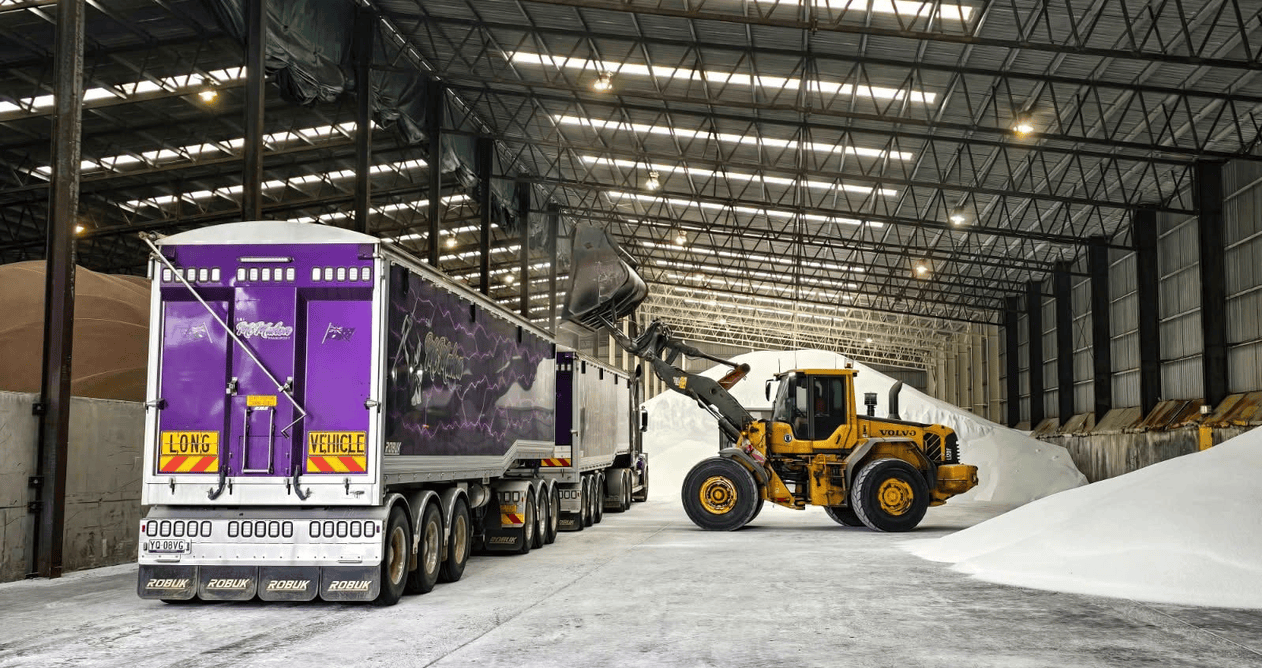
GrainCorp’s Fisherman Islands and Pinkenba facilities in Brisbane moved 2.2Mt of bulk materials, namely sand, woodchips, cement, and fertiliser, in FY26. Photo: GrainCorp
GRAINCORP has reported a $10 million net loss after tax for the year to September 30, alongside the announcement that managing director and chief executive officer Robert Spurway will step down after six years in the role.
The company did not specify when Mr Spurway would leave, instead describing it as a “succession announcement”.
“As I approach seven years in the role, the Board and I agree that it is the right time to look for my successor and indeed for me to look for new opportunities ahead,” Mr Spurway said.
“Importantly, I want to be really clear that this is a succession announcement, and I will be continuing to lead GrainCorp as part of an orderly transition.
“It is very much business as usual, not just for me but the entire management team, as we focus on executing our priorities and keeping the business performing strongly.”
GrainCorp chairman Peter Richards said the board was undertaking a comprehensive search process to identify a new managing director and CEO, and further updates will be provided in due course.
“On behalf of the Board, I thank Robert for his significant contribution to the Company,” Mr Richards said.
Managing director and CEO Robert Spurway has announced he will be leaving the company after six years. Photo: GrainCorp
“During this time, he has advanced strategic priorities that diversified and strengthened the resilience of the business and positioned GrainCorp as a leading voice on issues critical to Australian agriculture, including international trade, sustainability and the development of a credible pathway for a domestic renewable fuels industry.”
Results breakdown
The overall result was a significant decline on FY25, when GrainCorp recorded a net profit after tax of $40M.
Earnings before interest, taxes, depreciation and amortisation fell 27.6 percent to $223M, but remained in line with guidance.
GrainCorp’s agribusiness segment, the more traditional part of its operations, weighed on the overall result, with earnings falling 28.4pc to $156M.
The result reflected lower grain margins and fewer tonnes handled across East Coast Australia (ECA), partly offset by a stronger result from the international operations.
The company said ECA trading margins were impacted by low global grain prices and reduced grower sales.
Total grain handled for FY26 was 28.6 million tonnes (Mt), down on the prior year’s result of 31.6Mt.
Both domestic and export volumes declined, with domestic outloads falling to 5.8Mt from 6.5Mt, and exports dropping to 5.9Mt from 7Mt.
The nutrition and energy business, which includes animal feed, oilseed crushing and agri-energy facilities, also recorded an 18pc decline in EBITDA to $96M in FY26.
The decline was driven by weaker earnings in the edible oils category amid softer demand, despite record animal nutrition sales volumes of 751,000t, up from 713,000t in FY25.
Agri-energy also delivered record sales volumes and improved margins in the second half.
Company priorities
Mr Spurway said areas identified as current priorities for GrainCorp include “cost management, capital discipline and portfolio optimisation” with “meaningful progress and initiatives” delivered against all the areas.
“We’ve completed and implemented the East Coast Australia operating model review in the second half.
“We’ve maintained a steady underlying corporate cost despite the inflationary environment, so continue to build credibility around our cost management over multiple years.”
This work was reflected in the loss of 80 jobs across GrainCorp’s ECA operations, announced in September.
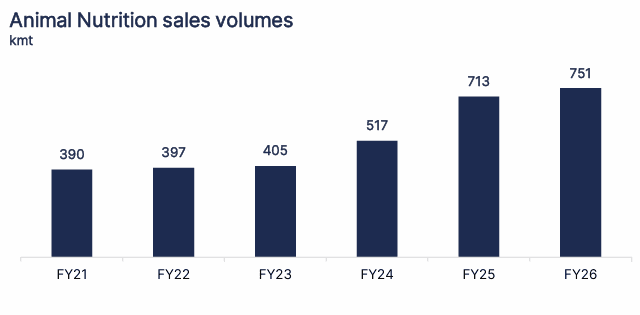
GrainCorp looks to capitalise on growing animal nutrition volumes.
He said the company has also focused on “investments in delivering volume and earnings growth in animal nutrition”.
GrainCorp completed several capital works projects in the segment during FY26, including increased production capacity at Kyneton, and a blender expansion at Timaru, New Zealand.
“More of those sorts of expansions continue to be underway, driving forward momentum for ongoing growth.
“We’ve got expansion of manufacturing capacity in both Queensland and New Zealand underway, and we’ve got progress on commercialisation of methane reducing additives to our feeds business.”
Harvest update
Mr Spurway noted the ABARES September forecast of a winter crop of 26.6Mt.
He said it highlighted “the excellent growing conditions throughout the growing season in Victoria and southern New South Wales, with more variable and drier conditions in northern regions.”
“With harvest now underway after a very wet spring, we’ve seen a very strong acceleration of that with 1.3Mt received in the last week alone and total receivables for the harvest period of 2.1Mt.
“We expect those numbers to climb rapidly.
“Just yesterday we received close to 200,000t into the network, so you can see how busy and how quickly things improve at this time of the year.
“We’re also providing an update today that year-to-date we’ve exported 500,000t and so, not only are we receiving strongly, we see good strong export demand as well.”
Mr Spurway said the wet spring conditions had set the “potential for the summer crop outlook in northern regions” as well as helped build “soil moisture profile more generally as we look to beyond the harvest into the planting season next year”.
Grain Central: Get our free news straight to your inbox – Click here
HAVE YOUR SAY