
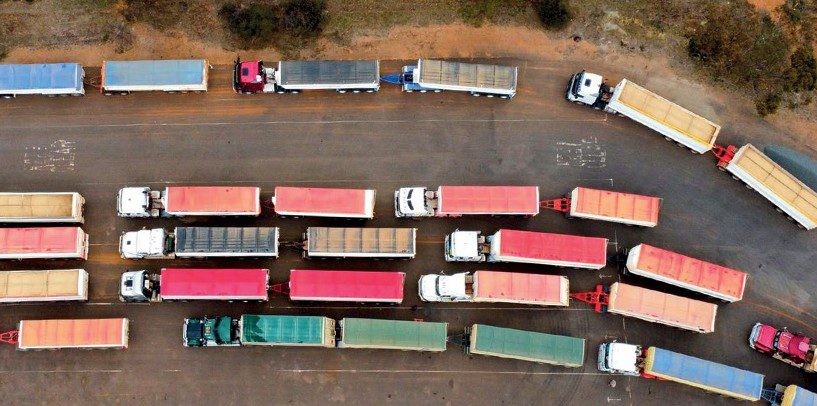
Lined up for delivery – Michael Shanhun, WA via GrainGrowers
GRAINGROWERS has released a report highlighting the complexity of Australia’s grain freight task and the urgent infrastructure investments needed to support growers and regional communities.
The report, Australia’s Priority Grain Freight Routes: Critical Infrastructure, Bottlenecks, and Strategic Investment Requirements, provides a state-by-state breakdown of grain freight movements.
Drawing on CSIRO’s Transport Network Strategic Investment Tool (TraNSIT), the analysis reveals the complexity of grain freight routes, with distinct networks and patterns in each state shaped by production, markets, and infrastructure access.
GrainGrowers chief executive officer Shona Gawel said the findings highlighted the diversity and challenges of moving millions of tonnes of grain from farm to market.
“Grain freight in Australia is not a one-size-fits-all task,” Ms Gawel said.
“The report shows the complexity of freight movements and the unique challenges in each state — from bridge weight limits at the New South Wales-Victorian border to gaps in the PBS A-double network in Queensland, or the high volume of grain on local-government roads in Western Australia.
“These bottlenecks add costs and reduce efficiency for growers.”
Shared challenges
The report highlighted issues common across the country, from mitigating flood risks, upgrading regional roads and bridges, addressing Performance-Based Standards (PBS) network limitations, and improving cross-border harmonisation on the east coast to reduce inefficiencies.
The report highlighted the potential for flooding or impacts from other climatic events as a key risk for routes in NSW, Qld and WA.
“Without targeted infrastructure upgrades and flood-mitigation measures, these risks could result in increased transport costs, delays, and disruptions to the grain supply chain, with downstream impacts on grower profitability and Australia’s global grain competitiveness,” the report said.
“Strategic investment is needed to future-proof these routes against climate risks and ensure the resilience of Australia’s grain freight network.”
It highlighted the South Coast Highway in WA and the Newell Highway in NSW, especially between West Wyalong and Forbes, as having a high risk of flooding.
Addressing PBS network limitations was a key finding for Qld, NSW and WA.
The report pointed to the continued “critical gaps” in the WA PBS 3 network as limiting “its effectiveness for grain freight” alongside gaps in NSW’s overall PBS network and called the Queensland PBS A-double network “not fit-for-purpose”.
In SA, Victoria and NSW, ageing bridges have been identified as a major investment priority.
Specific examples included the Swamport Bridge on the South Eastern Freeway in SA and the Mulwala and Tooleybuc bridges in NSW.
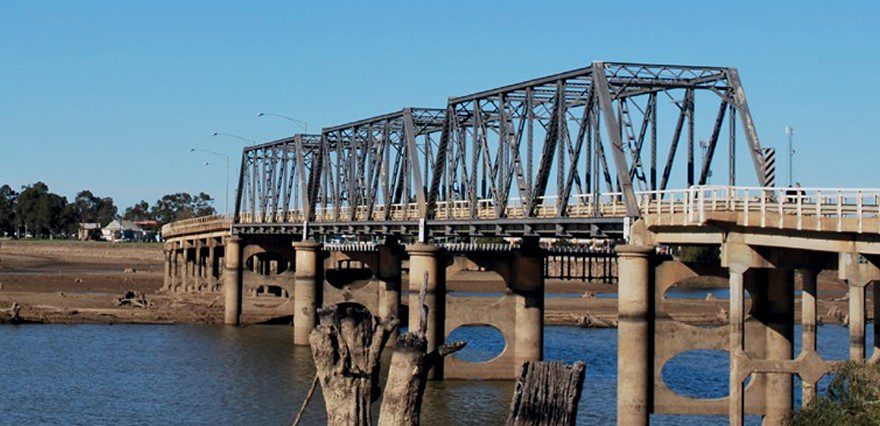
The Mulwala Bridge, a narrow structure built in 1924, connects the twin towns of Mulwala in NSW and Yarrawonga in Victoria but is unsuitable for PBS vehicles. Photo: GrainGrowers
Freight-route facts
The report gave a state-by-state breakdown on top freight routes and estimated trailer movements across these networks.
For NSW, the most travelled grain-freight routes were concentrated within the state’s grain belt, namely: West Wyalong-Condobolin Road, Goldfields Way, Newell Highway, Burley Griffin Way, Federation Way and the southern end of the Carnarvon Highway.
CSIRO TraNSIT estimated that over 880,000 trailer loads are moved in NSW, with the average trip distance being 131km, below the average distance from receival site to port of 418km, and demonstrating the role of rail freight in NSW.
Qld’s dominant routes were highly concentrated around the western and southern Darling Downs, namely the Gore, Barwon, Moonie, Leichhardt and Warrego highways, and the northern end of the Newell Highway.
The report estimated Qld grain trailer movements at more than 325,000 each year at an average distance travelled of 173km.
An export heavy market, South Australia’s top freight routes were the Dukes, Tod, and Sturt highways, Port Wakefield Highway/ Road, The South Eastern Freeway, Augusta Highway, Tod Highway and Sturt Highway.
CSIRO TraNSIT estimates that nearly 450,000 trailer loads of grain are transported by road annually in SA.
In Vict, the top six freight routes were Dukes Highway, Newell, Western and Calder Alternative highways, Port Fairy Road, and Goulburn Valley Freeway.
A large domestic user and containerised grain export market, over 570,000 trailer loads of grain are transported via road in Vict each year, travelling an average distance of 176km.
Most grain exported in Australia comes from WA, where the top freight routes are concentrated across the its Wheatbelt and include the Mingenew-Morawa Newdegate-Ravensthorpe, and Mullewa-Wubin roads, and the Chester Pass, Brookton and South Coast highways
Unlike other states, where major grain freight routes carry only a few hundred thousand tonnes a year, each of WA six busiest lines moves more than one million tonnes annually — a sign of both the state’s production scale and export focus.
Source: GrainGrowers
HAVE YOUR SAY