
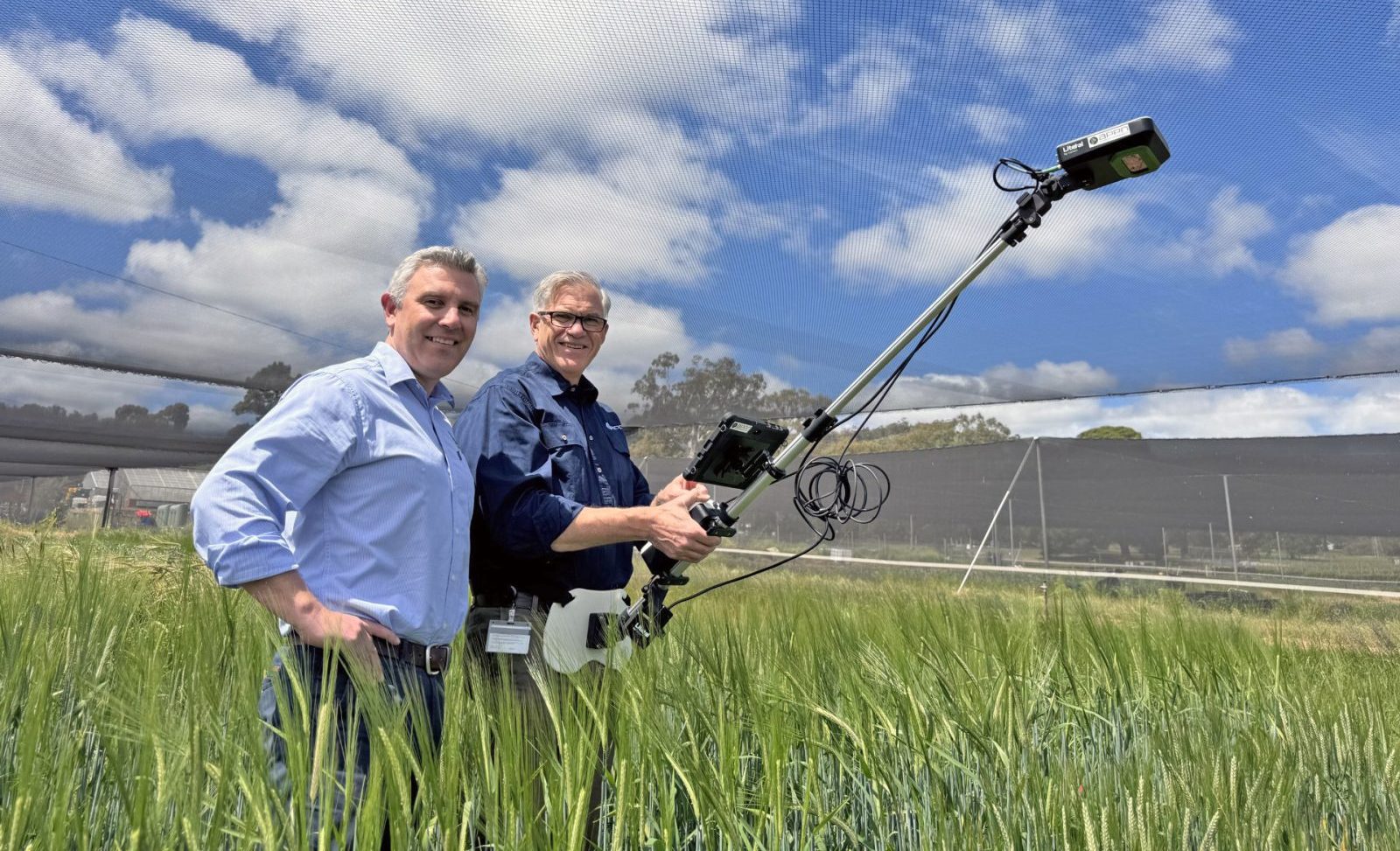
GRDC senior manager – enabling technologies Tom Giles (left) and APPN National Field Phenomics director Trevor Garnett with an APPN Literal pedestrian phenotyping system, part of the GRDC investment in mobile phenotyping. Photo: Belinda Cay
A NEW $4.5 million investment from the Grains Research and Development Corporation into Australian Plant Phenomics Network (APPN) will equip researchers with cutting-edge crop measurement technology to boost their capacity for large-scale crop improvement.
The funds expand on a $2M GRDC investment in 2024.
Plus, a further $60M from APPN’s primary investment partner, the National Collaborative Research Investment Scheme (NCRIS), means APPN can offer a consistent national ecosystem of cutting-edge phenotyping technology for crop research.
The mobile phenotyping technology is a key new resource for Australian field research.
It can be used for research into plant physiology, disease detection, agronomic constraints and genetic improvements, and can enable new research and accelerate research outcomes.
Advanced mobile phenotyping technology allows researchers to use equipment like drones and sensors to measure observable crop characteristics of interest, quickly and in more detail.
GRDC senior manager – enabling technologies Tom Giles said GRDC support enables APPN to build a unique, nationally distributed network of mobile phenotyping platforms, underpinned by consistent sensor technologies, expertise, and standardised protocols for data collection and analysis.
“The new investment gives us the capacity to develop and refine algorithms that automate the measurement of key plant traits, improving both the speed and accuracy of phenotyping at the plant, plot and paddock scale,” Mr Giles said.
“Through this partnership, GRDC and APPN are ensuring that Australian crop research remains at the forefront of global innovation in digital agriculture and phenotyping science.
“Ultimately, it’s about delivering better outcomes for Australian growers.
“By accelerating crop improvement and enhancing agronomic practices we are helping to boost productivity, manage risk and support the long-term sustainability of the grains industry.”
APPN’s field research nodes at Adelaide, Gatton, Narrabri, Northam, Perth and Wagga Wagga will each be equipped with a mobile phenotyping unit.
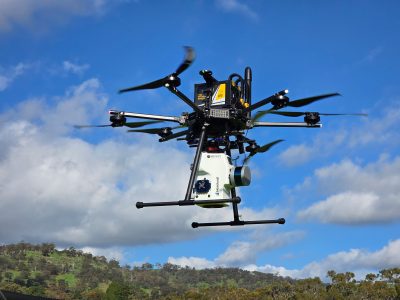
GRDC’s investment includes a APPN CALViS mobile phenotyping platform that will help scientists quickly measure and record how plants are growing in the field. Photo: Molly Ellis Hennekam, URAF
These units improve the scale and precision of critical research measurements using sensors mounted on unmanned aerial vehicles (UAVs) or drones, ground-based scanning platforms and an on-site Trial Environment Monitoring System (TEMS).
APPN National Field Phenomics director Trevor Garnett said the mobile phenotyping units offer a versatile range of options for analysing crops at different scales, speeds and resolutions at almost any trial location in Australia.
“APPN has developed a national capability for high-throughput phenotyping in the field, enabling researchers and industry to generate more accurate and comparable data, regardless of geographic location,” he said.
“Each mobile phenotyping unit includes a suite of high-resolution imaging tools, including hyperspectral and multispectral sensors, alongside 3D imaging systems to enable repeatable, non-destructive assessment of a wide range of plant traits in the field – including water status, nutrient levels, and the presence of disease long before symptoms are visible to the human eye.
“Our premier UAV platform, APPN CALViS, is one of the most advanced airborne units ever deployed for Australian agricultural research.
“It features a high resolution co-aligned hyperspectral and LiDAR sensor package, which can be used to measure a wide range of visible and non-visible traits as well as each plant’s physical structure.
“Backed by APPN’s in-house machine learning, computer science and data analytics expertise, the consistent technologies of our mobile phenotyping unit fleet will allow researchers to collaborate more effectively across regions and disciplines, while ensuring the data they produce is reliable and directly comparable.
“It is a major advancement in Australian plant phenotyping capacity.”
APPN is a national research infrastructure network funded through the Australian Government’s National Collaborative Research Infrastructure Strategy. It comprises nine nodes hosted by leading plant science institutions across Australia, each supporting plant phenotyping research and technology development.
Source: GRDC
HAVE YOUR SAY