
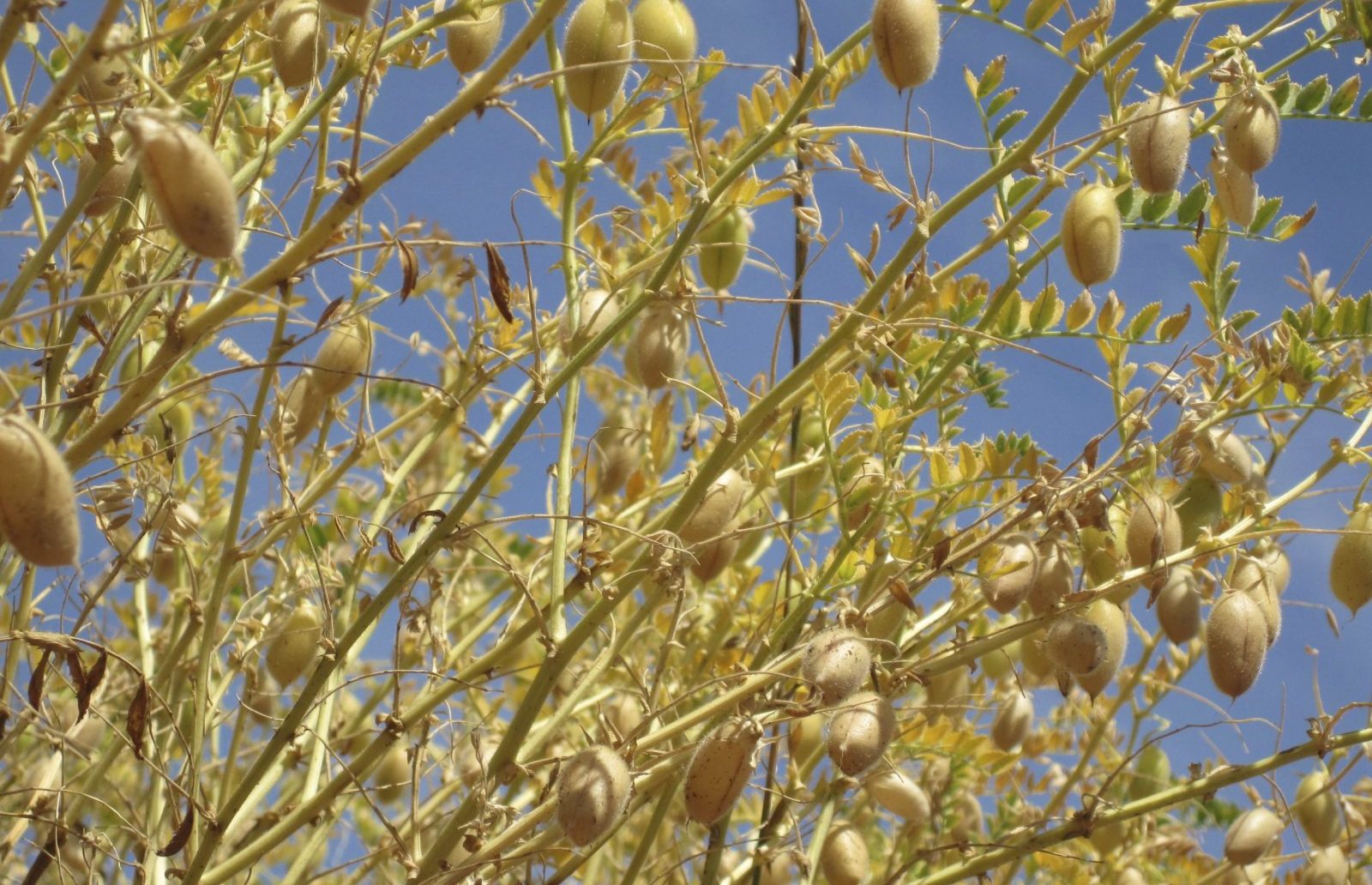
Chickpeas are one of four crops chosen to be part of the initial part of the program
THE GRAINS Research and Development Corporation has opened tenders for four large-scale projects aimed at increasing pulse adoption and outcomes across Australia’s broadacre cropping regions.
The proposals could revive the pulse agronomy and extension work previously carried out by Pulse Australia, addressing a gap that emerged after the organisation was integrated into Grains Australia in 2023.
With a total proposed budget over five years of $22.5 million to $30.1M, the projects will initially target chickpeas, lentils, faba beans and lupins.
The overarching program, titled The National Pulse Expansion, Improvement and Adoption Program, includes a national coordination project and four regional projects covering Northern, or New South Wales and Central and southern Queensland, Western Australia as the Western region, and the Southern region covering Victoria and South Ausralia.
The Northern region will be covered by two separate projects, one spanning northern NSW to CQ and the other covering southern and central NSW.
According to the tender information, “the program aims to increase grower’s profitability from pulse crops and improve their adoption”.
“The four regional projects will deliver small-plot trials, paddock-scale trials, demonstration trials and extension activities to address knowledge gaps, skills, confidence, and other barriers to their profitability and adoption,” the documents said.
“The mix of activities and allocation of resources across crop types will vary in each regional project based on local needs and priorities.
“The coordination and strategy project will drive information sharing, and coordination of the regional RD&E projects with the pulse breeding programs, relevant functions in Grains Australia, and other relevant investments in pulse RD&E.
“The intent is to support regional partners to deliver against local priorities with the backing of a coordinated, national network of expertise covering pulse breeding, agronomy, pathology, grain storage and handling, market dynamics, and other areas.”
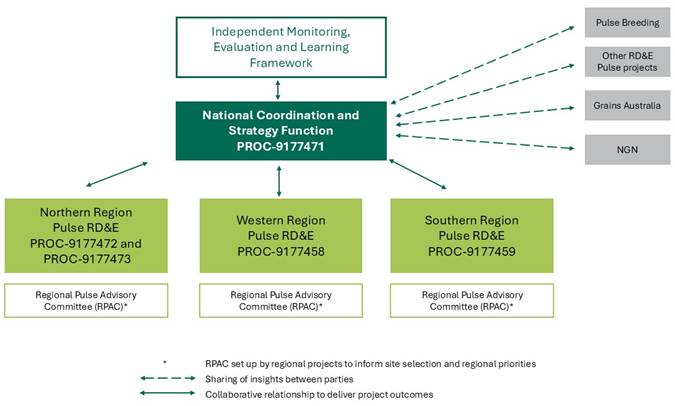
The structure of the proposed National Pulse Expansion, Improvement, and Adoption Program. Source: GRDC
GRDC investment manager sustainable cropping systems Courtney Peirce said the program aimed to build growers’ confidence in incorporating pulses into their farming systems.
“Pulses across our grain growing region are still producing below their water-limited yield potential and whilst there are clear benefits to having pulses in the rotation, adoption can be patchy, with some regions firmly established while others are still trying to get there,” Dr Peirce told an industry briefing.
“Growers’ confidence is held back by variable performance season to season and knowledge gaps at a local level and there’s limited understanding of some of the market dynamics and the information out there tends to be fragmented both across crops and across regions.
“So that’s what this program is set up to address.
“GRDC is establishing it to increase grower profitability from pulses and lift their adoption, and it aligns with the visions that have already been set out in the crop-improvement plans for chickpea, lentil, faba bean and lupin.”
Pulse Australia role revival
The program bears striking similarities to the former work of Pulse Australia, an industry body established in 1995 that has been integrated into Grains Australia.
Pulse Australia was funded directly by GRDC until about 2016, when the arrangement was replaced with project-by-project funding.
Several staff worked on this basis for about five years until the decision was made for GRDC entity Grains Australia to absorb Pulse Australia.
Under the merger, Grains Australia took over the pulse technical functions associated with trade and market access, pulse varietal classification and market insights and education on behalf of the Australian pulse industry.
Responsibility for chemical-use permits went to Grain Producers Australia, while pulse trading standards were to be managed by Grain Trade Australia.
However, the arrangement left a gap in formal pulse agronomy and extension, with no national body responsible for co-ordinating the work.
Project expertise focus
A key part of the evaluation criteria for all projects was a requirement for applicants to provide a “list of all key personnel, including proposed sub-contractors”.
For the regional projects, this included staff with “knowledge and experience in pulse production research, development, extension, adoption, and monitoring and evaluation”.
Under the national co-ordination and strategy project, the team must include personnel with expertise in:
- pulse research, pathology, agronomy, modelling and related fields;
- pulse crop markets and supply chain dynamics;
- monitoring, evaluation and learning;
- extension and adoption; and,
- research data management.
Dr Peirce said the national project would be more than an administrative body but bring “findings from different trials and regions into a coherent national picture”.
“It’s giving delivery partners clear points of contact and timely technical support through planning, delivery and analysis.
“The national function will provide guidance, feedback and practical support to help regional providers upskill when necessary to provide the best outcome for growers.
“So we really want expertise across a large number of different domains including pulse agronomy, pathology, weed management, nodulation, extension, adoption, market insights and so on.”
Targets set
Dr Peirce said “ultimately, what we want to see is an increase in the profitability, yield stability and adoption of pulse crops”.
Each program has a set of outcomes to be met, in line with other GRDC projects.
For the Southern region, the program is targeting at least a 10-percent increase in pulse production area and rise in gross margins by 2032.
GRDC has identified the starting point as 118,000ha and 151,000 tonnes.
By 2032 the program is targeting a 5pc increase in pulse production area for the Western region, starting with about 315,000ha and 470,000t, and a 10pc rise in gross margins.
The project is targeting a 2.5pc increase in pulse production area across the entire Northern region and a 10pc rise in gross margins.
The tender documents note targets for the two northern projects will be refined in the first year of the project.
Tenders for all projects close September 29, ahead of their anticipated start date of 1 February 2027, after which GRDC hopes to have a program co-ordination meeting to support the development of the operating plans for the 2027 field season and scaling of the program.
Grain Central: Get our free news straight to your inbox – Click here
HAVE YOUR SAY