
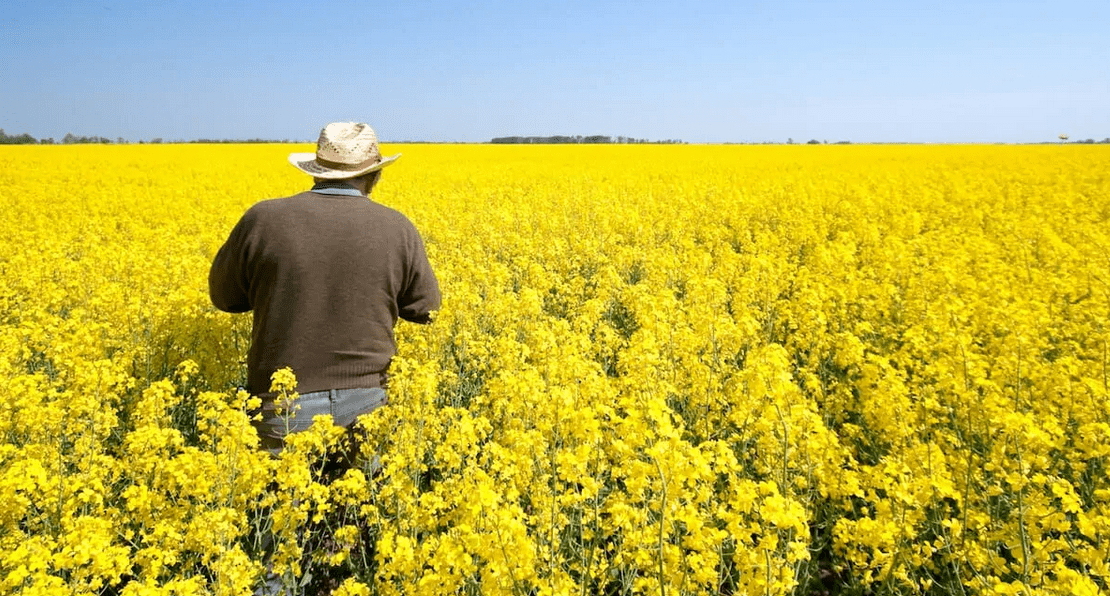
Canola growing in Western Australia. Photo: Alba Edible Oils
A REPORT commissioned by the Grains Research and Development Corporation has found that the costs and practical challenges of establishing an Australian counterpart to the German-based ISCC program would outweigh its potential advantages.
The ISCC certification program has been used by Australian growers since 2013, with Sustainable Grain Australia, an initiative of the Australian Oilseeds Federation, helping to manage the process in most states alongside CBH Group in Western Australia.
The 2024 report authored by L.E.K. Consulting Australia Pty Ltd and obtained by Grain Central found a domestic scheme would cost an estimated $17-33 million over 10 years.
The ISCC program, meanwhile, was projected to cost certificate holders only $1.8M in audits across a decade, while CBH Group and AOF together spent roughly $1M annually on its management and administration.
Alongside financial estimates, the findings featured interviews with growers, traders and end users, with more than 60 stakeholders consulted during the review.
Proposed scheme costs
The report assumed a domestic scheme would be a “like-for-like replacement of ISCC” and had associated costs that were “not insignificant”.
Of the estimated costs over 10 years, $10-20M of this was estimated to be “on-going administration costs”, followed by $2.5-5M for “domestic grower rollout”, a further $1.2-$3.6M for “scheme development and approval from EU commission”, $2-3M for “end-market advocacy” and $1.8M for audit costs.
On top of this, the report said the scheme would “need to overcome non-financial barriers” such as:
- an at least five-year lead time to set up the scheme;
- the requirement to have the scheme be “very similar to the current ISCC scheme” to access valuable EU markets;
- significant advocacy and marketing would be required to recognise and adopt the new program;
- the lack of an Australian industry sponsor; and
- the need to get support from local traders.
Overall, the report found the “investment may be better deployed equipping growers to capture sustainability related data”.
“Grains and oilseed growers may benefit more by investing in supporting growers build their data capture and reporting capabilities rather than developing a local scheme that, on its own, may not meet the evolving and expanding global sustainability requirements,” the report said.
Grower concerns
The report estimated that preparing for an audit cost the average grower a “relatively modest” $4800 in time, based on 24 hours at $200/hr.
It found the average grower “did not need to outlay capital to comply” with the requirement for chemical sheds and OH&S signage already needed under Australian legislation.
Of the growers consulted, the report found most did not need to upgrade chemical sheds to be compliant, but some viewed “chemical shed upgrades as a cost of ISCC compliance”.
These findings were lower than a GRDC Update Paper from 2021 which found ISCC compliance costs for audits were $10,000-$45,000.
Outside of cost, the report cited concerns from growers interviewed, including data security worries, onerous compliance paperwork, and a lack of tangible sustainability or efficiency benefits compared with current Australian practices.
The marketers interviewed had an overall positive view of ISCC certification, and said the EU was an important market and “sustainability schemes provide access to those markets”.
They said that none of the existing schemes were “perfectly fit for the Australian context but there is more work that can be done with the ISCC”.
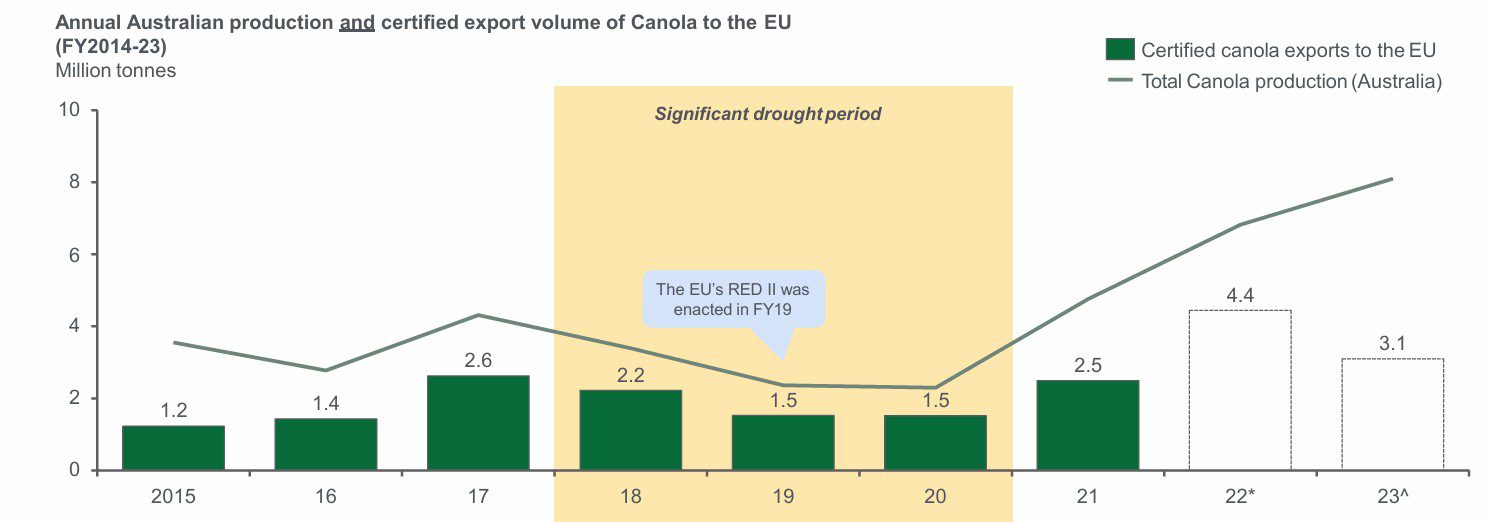
Australian production and certified export volume of Canola to the EU (FY2014-23). Source: L.E.K. Consulting
ISSC background in Australia
The report said the ISCC had “performed well for the Australian oilseeds industry” and enabled growers to access “a broad range of benefits”.
It said growers could achieve “a $5-$25 per tonne higher canola price for ISCC certification”, which gave them access to the important EU canola market and incentivised them to “adopt best farm operational and management practices”.
The report also pointed to several exemptions achieved under the program as evidence that it was possible to adapt the scheme to Australian conditions.
These exemptions include one granted to CBH in April 2024, allowing WA growers to carry out aerial spraying within 500m of dams and salt lakes.
Introduced in 2022, the requirement has been cited as a major factor behind falling compliance rates in WA.
Australian growers have also received two concessions: allowing the use of omethoate for barrier spraying against red-legged earth mite, and permitting the use of zinc phosphide to control mice infestations.
GRDC paid L.E.K. Consulting $260,000 to develop the 123-page report, under a contract titled: Quantifying the current and future costs of adherence to the International Sustainability and Carbon Certification scheme and alternative national certification programs to meet market requirements but deliver additional grower and industry benefit.
The final report, titled Australian grain and oilseed sustainability certification assessment, was completed in July 2024.
In the report, L.E.K. Consulting stated that it had not been asked to independently verify or audit the information or material provided to it.
The company said the report was intended to supplement a discussion with L.E.K. Consulting.
HAVE YOUR SAY