
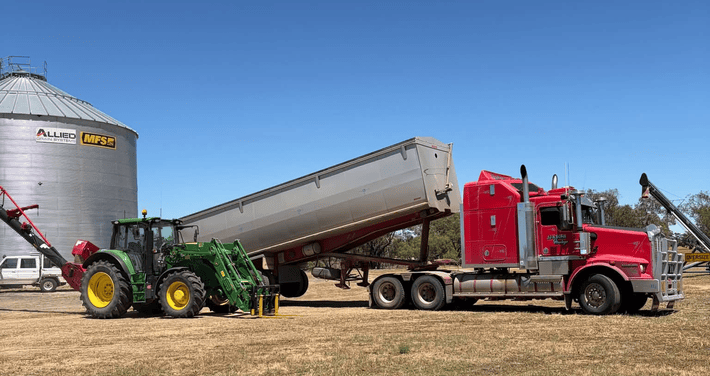
The first load of wheat for the season goes into on-farm storage this week on a farm at Coonamble, NSW. Subsequent deliveries have headed to Qube. Photo: JJ & Sons Haulage
OCTOBER is nearly over and, in contrast to convention, only one of Australia’s three leading bulk handlers has started issuing harvest reports.
That is Bunge, which received its first delivery for the 2026-27 harvest on September 24 at its Thevenard terminal, and said so in a statement the next day, then issued its first weekly harvest report on October 13.
Bunge’s most recent harvest report released on Tuesday reveals 290,855 tonnes had been delivered into its South Australian and western Victorian storage network.
CBH Group’s first delivery for the current harvest came through the gate at its Geraldton terminal on September 22, and the Western Australian bulk handler has advised its first harvest report for the year is due out on Monday, a week later than last year’s which came out 27 October 2025.
A harvest report from eastern Australia’s biggest bulk handler, GrainCorp, is yet to be seen.
GrainCorp posted news of its first 2026-27 harvest delivery coming into Mt McLaren in Central Queensland on September 15.
While the CQ harvest is over for most growers, and GrainCorp is believed to have received solid amounts of wheat and chickpeas, harvest in southern Qld and northern New South Wales is yet to build momentum amid rain and humid conditions.
GrainCorp issued its first Harvest Update for 2025-26 on 20 October 2025, detailing Queensland receivals of 537,000 tonnes, and 46,700t in New South Wales, with activity “expected to progress steadily over the coming week, supported by a favourable weather outlook”.
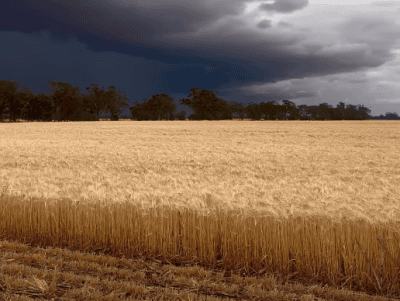
A barley crop ahead of rain last week in the Gulargambone district of NSW. Photo: Farmer From Down Under
October 202 is a vastly different story.
What has come in the gate at GrainCorp to date in the current harvest is anyone’s guess, but in southern Qld and northern NSW,where plenty of roads are boggy or closed because of the rain, word is that bulk-handler intake is limited to date.
That reflects a relatively small winter-crop planting, ample on-farm storage with drying and aeration options, a local feed market on the hunt for wheat and barley direct from farm, and a buoyant chickpea market where growers who can out-turn are trucking straight to port.
With fingers crossed for dry weather for the rest of the nation’s harvest, including potentially record crops in SA and Vic, Grain Producers Australia northern region director, AgForce’s grains president and Warra, Qld, grower Brendan Taylor, outlines in the following what rain has meant for those who summer and winter crop:
Rain stops harvest, but it shouldn’t stop us checking in
Anyone who has farmed the Downs or the north-west plains knows the feeling.
You’re standing at the kitchen window, watching rain fall on a crop you’ve been willing across the line for months.
That’s where a lot of us are this week.
It was a hard road to get here. The country was extremely dry until mid-May.
Around the border, some districts got only about four in every ten intended hectares planted.
We cut our cloth, ran lean and hoped.
Then spring delivered just enough.
The early barley came off better than anyone expected, and for a few weeks it looked like we’d scraped through.
Then the heavens opened.
In one week Mitchell had around 140mm, Hannaford over 150mm, and Roma, Moree and Narrabri between 60 and 75mm.
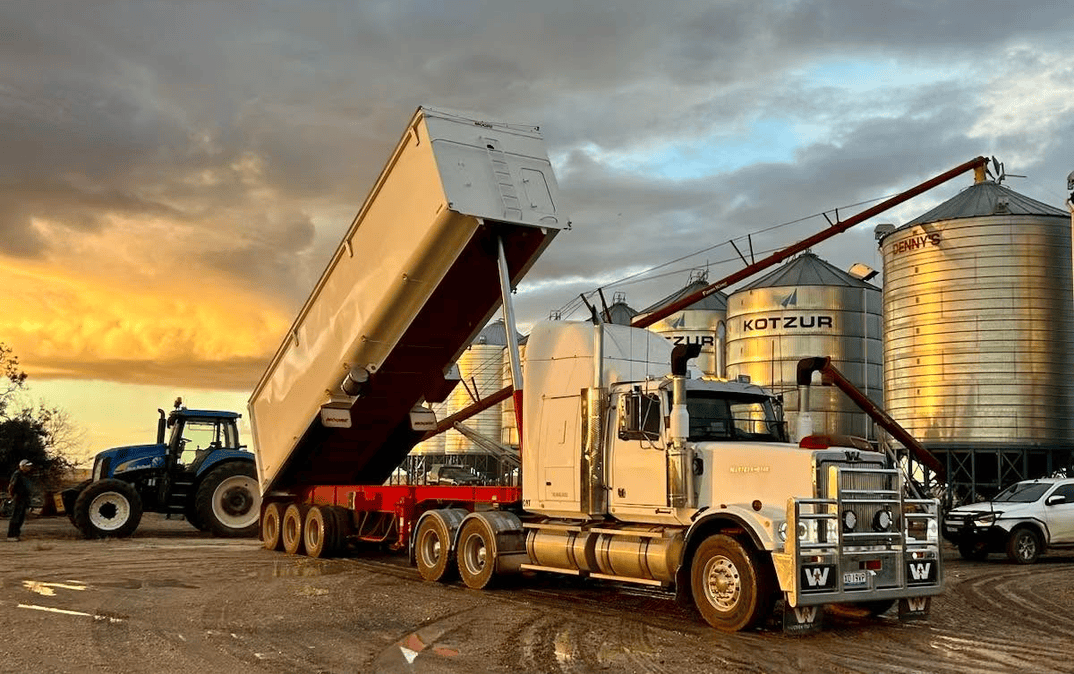
Barley goes into an aerated silo after being harvested in damp conditions south-east of Moree last week. Photo: The Jackson Brothers
Headers are parked right across the region.
Barley and wheat still standing are facing sprouting, mould and grain on the ground.
Plenty of chickpea crops have had somewhere between 100 and 200mm in a fortnight, and the pods are starting to show it.
The cruel part is that we can’t even be properly angry at it; we were praying for this rain four months ago.
The graziers are cheering and the pastures will boom; the sorghum will love it.
Good on them, but it’s hard to feel the joy when your own crop is the one taking the beating.
Farming can be the greatest life going; it can also be the cruellest, sometimes within the same fortnight.
We came so close, and being flat about it isn’t weakness; it’s a fair reaction to a hard deal.
We’ve been here before; the wet harvests of 2010, 2021 and 2023 all brought downgraded wheat and weeks of idle machinery.

Warra grower Brendan Taylor.
We got through each one.
The thing that helped most wasn’t a forecast or a price rise; it was the people around us.
Researchers who have asked rural NSW communities how they coped with flood and drought keep landing on the same answer: staying connected to other people cushions the blow.
Right now, though, we’re all stuck at home.
The paddocks are too wet to work and the roads aren’t always great.
It’s easy to spend the day with the forecast, the phone and your own thoughts, and those thoughts rarely improve when you’re on your own.
So here’s the suggestion: When the road is passable, ring the bloke down the road and meet him in town for a coffee. No agenda needed. Talk about the footy, the price of diesel, the forecast, anything. Bring the family.
Our towns are feeling this wet as well, and the café, the pub and the mechanic will be glad to see us.
A few things that help:
- Ring instead of texting.
- Go looking for the neighbour who’s gone quiet.
- Take smoko to the gate if you can’t get further.
- Include the young ones, the contractors and the employees who are just as stuck as you are.
- Don’t compare losses, because nobody wins that contest.
- Let people grumble without trying to fix it, then lend a hand when the paddocks dry out.
Most of us will be fine with a coffee and a yarn, and that’s the point. It’s easier to turn up early than to wish you had.
The sun will come out. The headers will roll and we’ll be run off our feet. Until then, ring a neighbour.
Grain Central: Get our free news straight to your inbox – Click here
HAVE YOUR SAY