
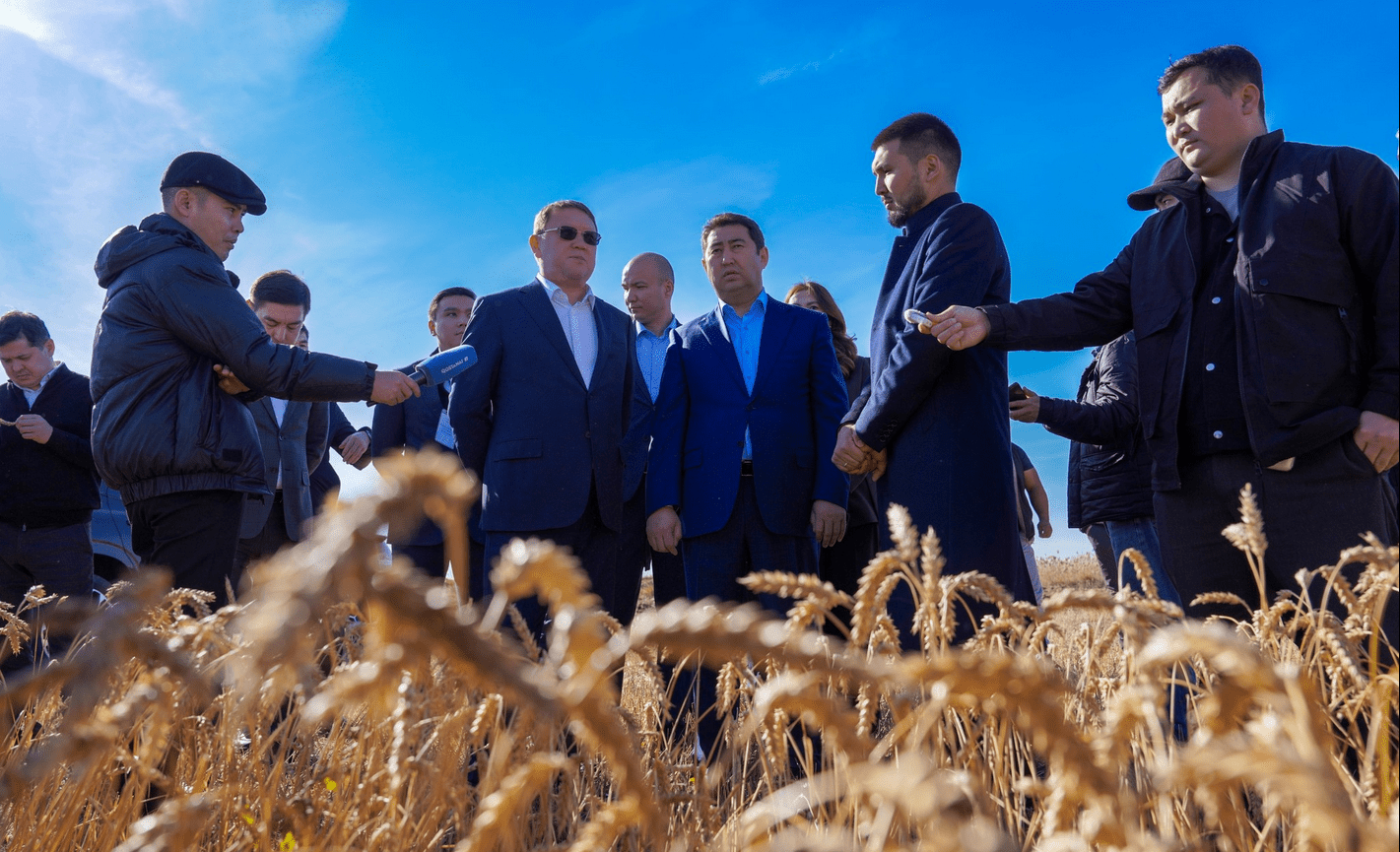
Kazakhstan’s Minister of Agriculture Aidarbek Saparov (centre in blue shirt) makes an address during his tour last month of the Kostanay region. Photo: Aidarbek Saparov
CROP diversification and the increased adoption of modern agricultural technologies, in conjunction with favourable weather throughout the growing season, have seen Kazakhstan’s farmers harvest a record quantity of grain and oilseeds for the second consecutive year.
The use of advanced agricultural technologies has had a direct and positive impact on yields in Kazakhstan in recent years, the Minister of Agriculture Aidarbek Saparov reported at a government meeting earlier this month. An analysis of the major cropping regions revealed that farmers who had more actively introduced new equipment and expertise, such as precision agriculture, digital farming, and climate-smart practices, were consistently achieving higher yields.
The Ministry of Agriculture reported that the delivered weight of this year’s cereal and legume harvest had reached a record 27.1 million tonnes (Mt), from a harvested area of 16 million hectares (Mha), for an average yield of 1.7 tonnes per hectare. This is up from 26.7Mt off 16.5Mha and an average yield of 1.62t/ha in 2024.
The 2025 grain harvest includes a record 20.3Mt of wheat, a year-on-year increase of 500,000t, despite a decrease in the harvested area of almost 900,000ha to 12.2Mha. This put the average yield at 1.66t/ha, 10pc higher than the 1.51t/ha achieved last year.
Of the soft wheat delivered to the country’s elevators, 53 percent has been classified into Classes 1, 2 or 3, slightly lower than the 56pc recorded in 2024. Class 4 wheat accounted for 35pc, up from 28pc a year earlier. “More than half of this volume has a gluten content above 20pc, which allows this wheat to be used for food purposes,” Deputy Minister of Agriculture Azat Sultanov said. Approximately 12pc of the wheat crop has been classified as non-milling and will be used for stockfeed or the production of feed flour.
Under Kazakhstan’s wheat-grading system, Class 3 is the standard benchmark for milling wheat. It is considered high-quality, food-grade milling wheat and is the primary export grade. Gluten content is typically high, often in the 23-28pc range, with Classes 1 and 2 being higher in protein, gluten, and other milling attributes. Class 4 wheat also meets food-grade requirements, but has lower gluten and protein than Class 3, while Class 5 is the lowest food-grade milling category.
Pulses, oilseeds expand
According to the ministry, barley production increased by 200,000t to 4.0Mt with quality similar to the 2024 harvest, while legume output reached a record 1Mt for the first time. Farmers in Kazakhstan are actively expanding the area planted to legume crops, especially lentils and peas. This has been facilitated by superior profitability compared to cereals, stable export demand, and the desire to incorporate them into crop rotations to enhance soil quality and fertility. Lentil production in 2025 is pegged at 800,000t, 75pc higher than in 2024, while pea output is estimated to be around 5pc higher at 155,000t.
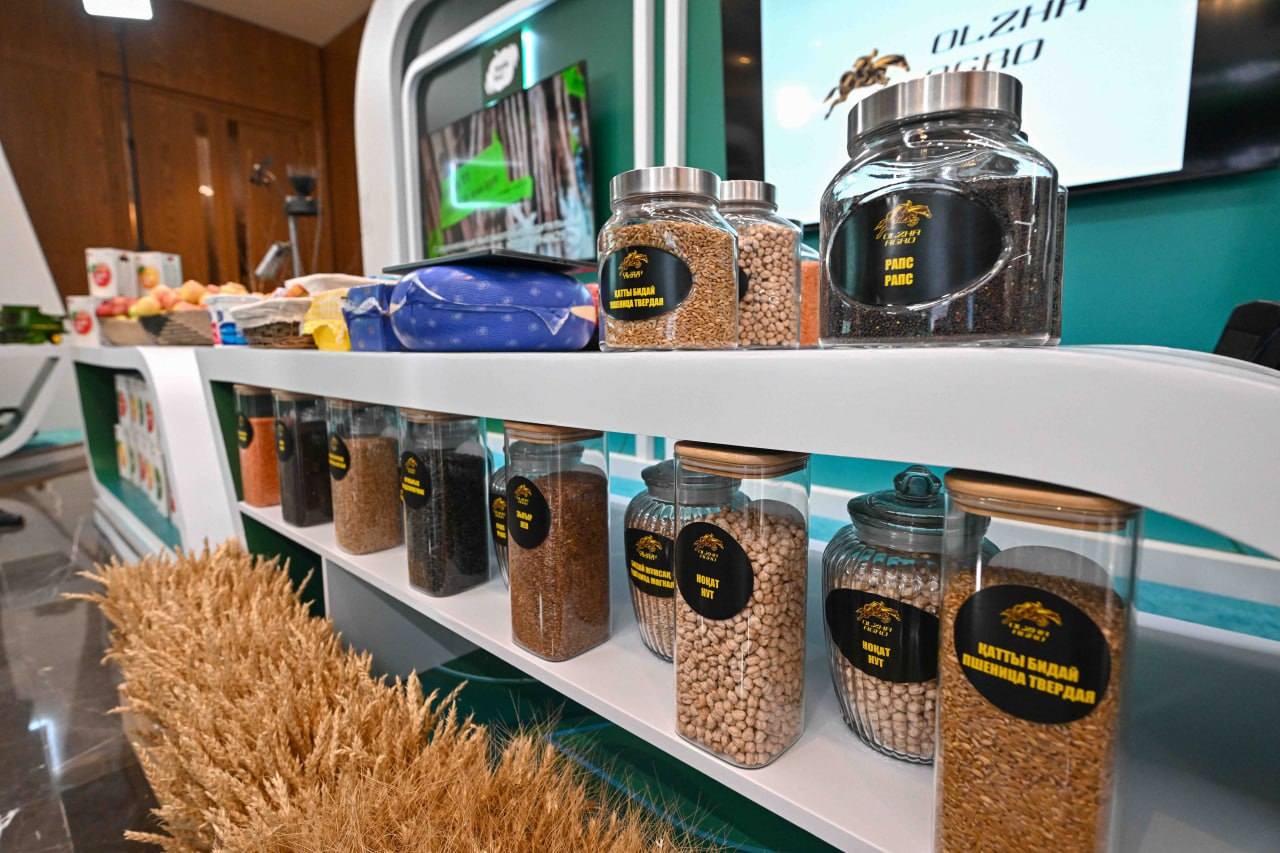
Samples showing the diversified crops now grown in Kazakhstan at the country’s National Forum of Agricultural Workers held in Astana last week. Photo: Minister of Agriculture Aidarbek Saparov
In addition, oilseed production set a new record of 4.5Mt, with harvesting still underway in several later-planted cropping regions. Oilseed crops are gaining increased importance in Kazakhstan’s crop rotations, with around 4Mha planted this year. This is up from 2.9Mha a season earlier and pushed the oilseed share of the national crop rotation, including the area allocated to annual fruit and vegetable production, four percentage points higher to 17pc. Sunflowers are the dominant oilseed with 1.8Mha planted in 2025, up from 1.3Mha in 2024 and 1.15Mha in 2023.
Exports diversify
Meanwhile, on the back of the record harvest, the government has announced plans to maintain new season grain exports at the same level as that achieved in the 2024-25 marketing year to August. The nation’s exports last season amounted to a record 13.4Mt, an increase of 47pc compared to the previous corresponding period. The Ministry of Agriculture believes that transport subsidies contributed significantly to this growth.
Total wheat exports in 2025-26, including processed products (wheat and feed flour), in grain equivalent, are forecast at 10.4Mt, including 6Mt of whole wheat. Uzbekistan is expected to remain the primary destination, with around one-third of the total, followed by Afghanistan, predominantly for flour, Tajikistan and Azerbaijan.
International sales of barley are forecast to dip from a record 1.9Mt in 2024-25 to 1.5Mt this season, despite the rise in output. Iran emerged as the nation’s largest barley customer in 2024-25, purchasing almost 1.1Mt. China was the second-largest destination with 414,000t, followed by Uzbekistan with 125,000t.
The Grain Union of Kazakhstan is forecasting lentil exports of 500,000t in the current marketing year, with Turkiye remaining the key destination. The pea export forecast is 106,000t with China, Afghanistan and Uzbekistan being the main buyers. The export of oilseeds and processed products, such as protein meals, is expected to be 2.4Mt, on par with the 2024-25 level, but 41pc higher than in 2023-24.
Grain exports in the first two months of 2025-26 marketing year totalled 2.2Mt, marking a 21pc year-on-year increase. According to Sultanov, Kazakhstan has actively explored new export directions in 2025-26, supplying grain, predominantly wheat, to Belgium, Portugal, Poland, Norway, Vietnam, the UAE, Morocco, Algeria, and Egypt for the first time. Meanwhile, exports to markets such as Iran, Azerbaijan, Armenia, and Georgia have resumed.
Earlier this month, Kazakhstan’s national grain operator, Food Contract Corporation, sent its first batch of wheat to Armenia via Azerbaijan in 30 years, with the train passing through Russia, Azerbaijan, and Georgia. The shipment became possible after agreements were reached between the heads of state of Kazakhstan and Azerbaijan, which enabled the resumption of transit through Azerbaijani territory. Kazakhstan dispatched 15 rail cars carrying 1000t wheat as a pilot shipment to test the efficiency of the new logistics route.
In the first 10 months of 2025, grain exports from Kazakhstan that transited Russian territory totalled 1.9Mt, a fivefold increase compared to the same period in 2024. This includes 500,000t that was shipped to international customers through Russian ports, a 20pc increase on last year’s level, as well as grain that was exported via Baltic ports.
HAVE YOUR SAY