
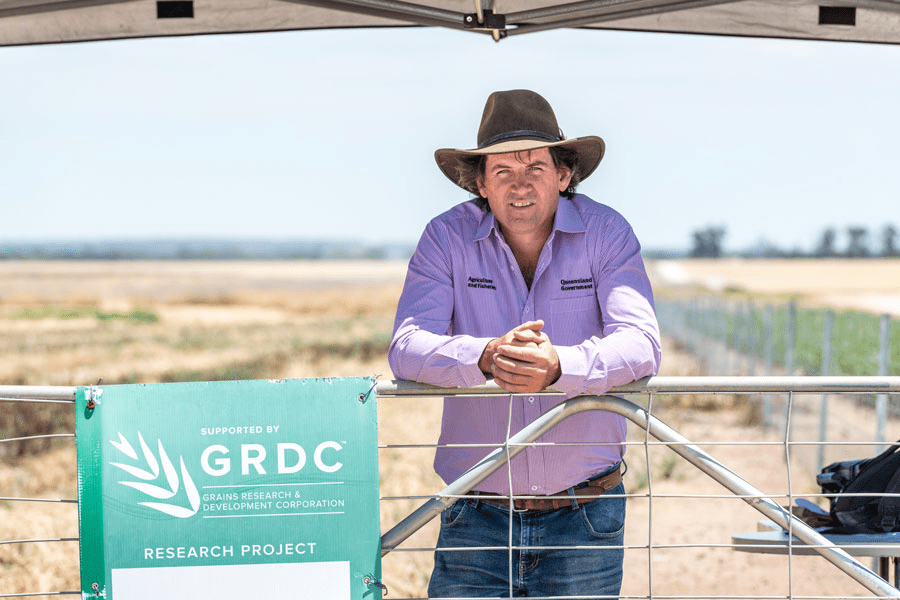
The Qld Department of Primary Industries’ Goondiwindi-based Andrew Erbacher is one of hundreds of researchers working on GRDC-supported projects across Australia. Photo: GRDC
A REVIEW of GRDC’s funding and investment has confirmed the corporation is financially secure for the long term but recommends making modest increases to R&D spending as the best way to deliver more value to the industry.
The report stopped short of recommending a cut to grower levies, warning such a move could undermine the organisation’s long-term viability.
Authored by consultancy ACIL Allen, the report Right-sizing GRDC RD&E Investment was finalised earlier this year, though only a summary was released by GRDC in July.
Alongside the release, the organisation announced a $60 million per year increase in strategic research and capacity building.
The investment would see GRDC’s total annual RD&E investment rise from a forecast of around $275M to $335M by 2028–29.
In the full 80-page report, obtained by Grain Central, consultants outlined ten options for GRDC, later narrowed into six scenarios covering possible increases in investment and services.
Using that framework, ACIL Allen found a “sweet spot” where GRDC could target investing up to $66.4M per annum and “expect to maintain its liquid reserve within its policy target”.
The proposed increase represented the most modest of the scenarios examined, with the largest considering an annual uplift of $150M.
Four of the six financial models ended with a liquid reserve below the target range, namely 45 percent of the following year’s total expenditure.
High excess reserves
Before modelling future spending scenarios, the report examined GRDC’s financial position as it stood prior to last month’s announcement.
It stated that GRDC was in a “strong financial position due market conditions generating a significant levy revenue uplift and a Reserve Policy which is designed to optimise its RD&E expenditure through prudent and efficient management of its liquid reserves”.
“GRDC’s reserve position is forecast to remain historically high,” the report said.
According to ACIL Allen’s modelling, if there was no change in spending, GRDC’s liquid financial reserves would continue to grow “reaching $849.1M by 2033-34”.
This estimate is based on “a conservative outlook for industry activity” and wouldn’t consider bumper grain harvests like those between 2021 and 2024.
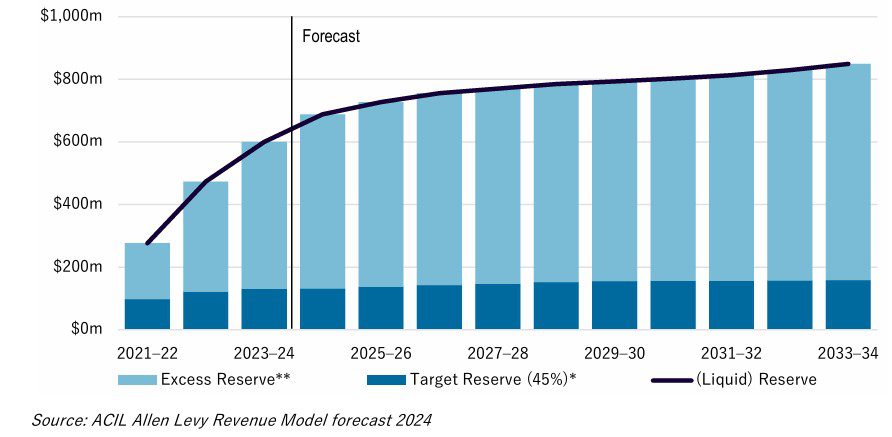
GRDC Financial Reserve Forecast
Drought resilience
The consultants also modelled GRDC’s financial position if the industry was hit with a “severe, prolonged drought” that resulted in significant drops to planted area and yields.
In this case there would be a “catastrophic decline” in GRDC levy and Government co-contribution revenue with a hit of $772.7M over ten years.
“However, even with this magnitude of shock, and without any change to expenditure, GRDC’s financial position remains sound.
“This demonstrates that even in a significant financial shock…GRDC has the capacity to absorb and continue to deliver value.
“The modelling demonstrates GRDC would have sufficient time to respond to a significant revenue shock, with financial reserves remaining above the target level until 2030-31 – some six budgets away.”
Opportunity costs
ACIL Allen ultimately concluded it was in GRDC’s best interests to lift expenditure, arguing that leaving funds in reserve risked missing out on future value that could be generated through projects and services.
This was despite the “reserve balance generat[ing] a significant financial return” to the organisation.
“In the 2023-24 financial year, GRDC generated $30.6M in interest, dividends and capital growth in its portfolio of reserves, with a return on financial assets of 4.3pc over the year.
“This revenue becomes available to GRDC to fund future research or cover other costs.”
The consultants found that the benefits from this additional revenue was lower than the potential value gained by investing the funds.
“The opportunity cost of holding additional reserves which could be invested in RD&E is significantly greater than the financial return on investment…”
Changing levy rates
The report briefly discussed the possibility of reducing GRDC revenue through changes to the levy system as an alternative to increasing expenditure.
The authors noted that as it was “not GRDC’s role to influence or set the levy”, it was not properly modelled as part of the study.
However, ACIL Allen did state that “any significant reduction in levy could see a long-term reduction in R&D investment by GRDC which would reduce R&D intensity and associated capacity and ability to respond”.
The report commented that any case for changing the levy system would need the backing of industry representative bodies – Grain Producers Australia and GrainGrowers – as well as levy payers.
“The practical implications are that industry and/or government need to propose levy amendments and work with the relevant recipient bodies…to develop a supported business case.”
ACIL Allen’s modelling included one option of “a material reduction in grower levies, returning funds to industry which it can put to use for non-research purposes”.
As the scenario was included only “for comparative purposes”, the report did not spell out what it would mean in dollar or percentage terms.
The analysis concluded that a significant drop in levies would result in “in an increase in financial risks for GRDC and reduces its future financial capacity across the board”.
It was also “assessed as having no impact on research outcomes”.
Current levy system
Under Commonwealth legislation the grains industry is levied for R&D, marketing, biosecurity, market access (residue testing) purposes.
The government matches the R&D proportion of each commodity levy up to 0.5pc of the three-year rolling average of the gross value of production across the 25 leviable crops.
The R&D levy paid by growers is calculated as 1.02pc of the farm gate value of the crop, of which 0.99pc goes to GRDC, 0.01pc to Plant Health Australia, 0.015pc to National Residue Survey and the emergency plant protection response the remaining 0.005pc.
Grain Central: Get our free news straight to your inbox – Click here
Paul McKenzie’s comments from Western Australia were spot on.
This review commissioned by GRDC is self serving, and not a surprise. The GRDC overall does excellent work with great results.
However, forced more rapid expenditure of the reserves earnings, levies and prrhaps even some of the reserves will not necessarily lead to better outcomes.