
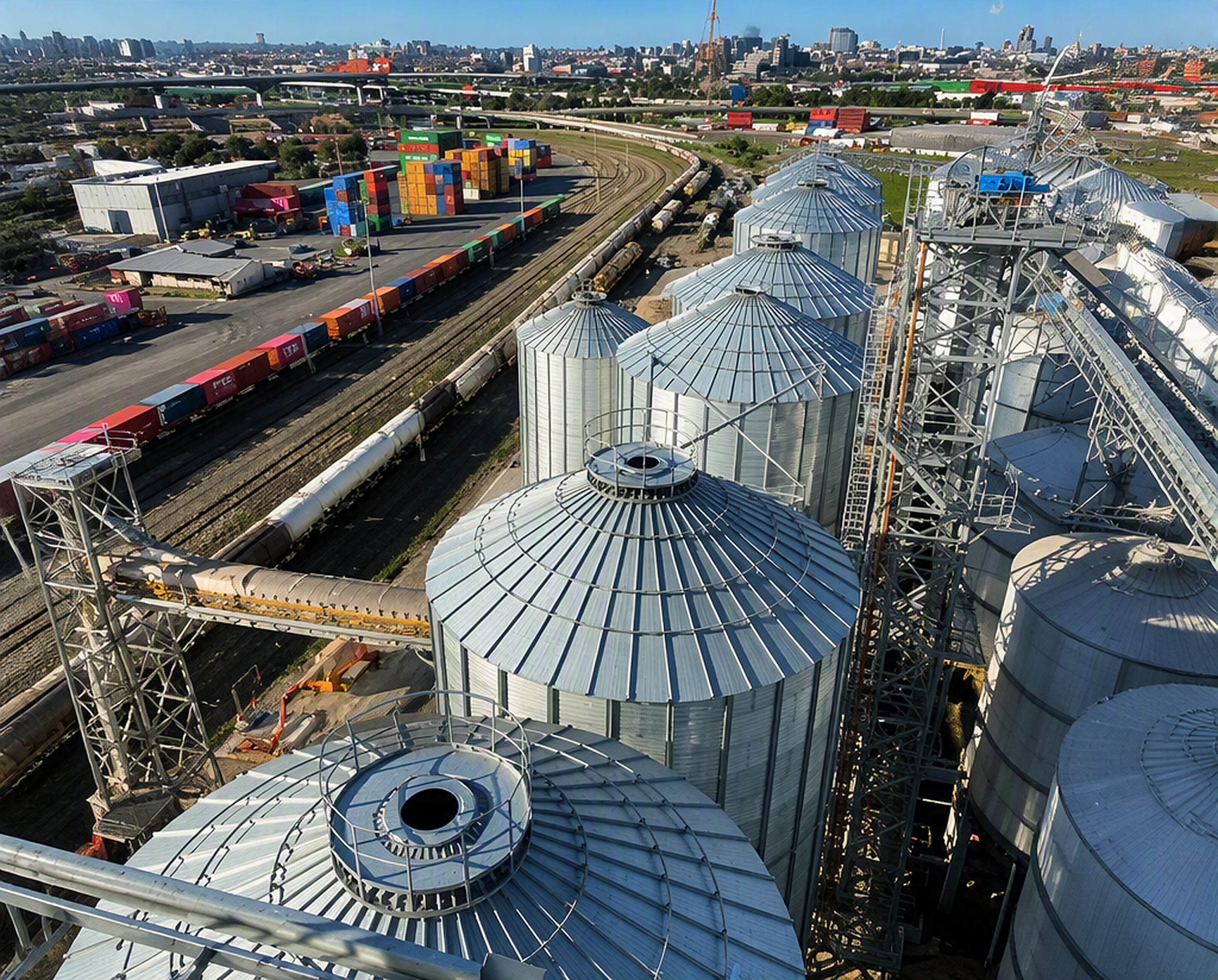
Work under way at LDC’s Melbourne terminal is adding an extra road pit and elevation plus 17,000t of storage to take its total capacity to 65,000t. Photo: LDC
EASTERN Australia’s winter-crop harvest has started, and recent upgrades and developments at Louis Dreyfus Company sites are ready to help handle and export the crop.
LDC’s evolving capacity in Queensland will see it export bulk chickpeas from Townsville in coming weeks, and its storage capacity and efficiency in the south is climbing.
Including upgrades soon to come on stream at its Melbourne terminal, LDC is heading for a combined storage capacity of around 1.6 million tonnes (Mt) across New South Wales and Victoria, and will play a vital role in shifting the region’s bumper crop.
Based on current markets, LDC Australia’s chief executive officer and head of grains and oilseeds David Johnson said wheat, barley and lentils are set to take top priority in Melbourne’s 2026-27 shipping program, which kicks off October 1.
Wheat tipped to leapfrog barley
Going on the normal order of crop ripening, canola and barley will be harvested ahead of wheat and lentils in Vic and southern NSW.
However, wheat is expected to leap-frog barley for early slots on the stem.
“In our mind, wheat is potentially the most bullish item because of the lack of shipping out of the Black Sea,” Mr Johnson said.
“If we’re sitting here in two months’ time and things haven’t changed, buyers are going to have to come to Australia and Argentina for wheat.
“You can point to an argument where wheat will be the most profitable crop to export, then lentils.”
With Houthi militants threatening safe shipping through the Bab al-Mandeb strait linking the Red Sea and the Gulf of Aden, the shortest route for Australian canola to Europe, its major market, cannot be assured.
Houthi activity also means Australian wheat cargoes bound for Asia and east Africa could populate even more of the stem if vessels from Europe and the Black Sea cannot pass through the Suez Canal leading into the Red Sea.
China remains Australia’s major market by far for barley, and a straightforward destination to target in these troubled times for shipping to or via the Middle East.
“When it comes to accessing throughput of the port, we need to look at what’s got the best margin.
“The Saudi barley market is at a premium, but you can’t get barley through the Red Sea today, so for Australian barley, it will be all about China and the rest of Asia.”
According to ABARES’ latest estimates released September 1 in its quarterly Australian Crop Report, Vic is forecast to harvest 3.4Mt of barley this season to break the 3.1Mt record set last harvest.
Vic’s wheat forecast at 4.9Mt is behind the 5.4Mt and 5.2Mt crops of 2022-23 and 2023-24 respectively, but well up from the 4.25Mt harvested last season.
The canola harvest in Vic is forecast to yield 1.42Mt, up from 1.25Mt last season, but below the record 1.55Mt of 2022-23, while lentils seen at 933,000t are tipped to nudge out last year’s record 925,000t.
Dockside
Mr Johnson said LDC already has stem booked out of T-Ports’ terminals in South Australia, and plans to maximise its only Australian terminal at Melbourne’s Appleton Dock, which will hit an increased storage capacity of 65,000t this season.
“Our development at Melbourne will add 17,000 tonnes of storage and an extra road pit and elevation.
“This will debottleneck the terminal, which has had issues since it was built in 2001, and we hope to have it commissioned and ready to go by January.”
Under LDC’s ownership of the Melbourne terminal through its 2022 purchase of the Emerald Grain network, it has already seen rail and one road pit move to separate instead of shared paths.
“The changes will improve our intake capability by having separated rail and road paths, and we will have three road pits instead of the two we have now.”
LDC moved into pulse trading two years ago, and Mr Johnson said the Melbourne terminal alone will have shipped close to 200,000t of lentils, in addition to barley, wheat, and canola, in the shipping year which ends this month.
LDC’s expansion into pulses has created an extra bulk pathway for Vic lentils by supplementing capacity from other operators shipping out of Geelong and Portland.
“It’s converted what used to have to go out of Melbourne in containers into bulk business.”
Apart from a cargo or two to the United Arab Emirates, lentils shipped from LDC’s Melbourne terminal have gone to South Asian destinations.
Mr Johnson said the outbreak of hostilities between the US and Iran from early March has had little impact on LDC’s bulk exports from Australia.
“We had lots of sales on to the Persian Gulf at the time the war started…and we executed them all.”
“Since then, the impact has been limited for Australian export flows.”
Busy ahead of harvest
Prospects for above-average yields are high in Vic and southern NSW, where LDC has sites at Ardlethan, Coolamon, Goolgowi, and The Rock north of the border, and Elmore, Kyalite, Nullawil, Telford, and Woorinen to its south.
“We’re cleaning out old-season stocks and doing some works at Ardlethan and Nullawil to expand and add storage capacity.”
This follows work last year at Elmore as part of its ongoing program to upgrade facilities including stackers across the LDC network, which extends north in NSW, and into Queensland.
“It’s all going to be about how quickly we can move what comes in this harvest.”
LDC has two trains, both operated by Southern Shorthaul Railroad, one a standard-gauge set which can carry up to 3600t of wheat, and another for operation on Vic’s broad-gauge network which can carry 2200t.
LDC Melbourne terminal road paths can accommodate triples carrying up to around 70t of product, and Mr Johnson said the use of AI-assisted visual assessment of lentils will add further efficiency to the delivery process.
“It’s about getting grower deliveries in and out in 20 minutes.”
LDC’s move into pulses has also seen it become a significant exporter of chickpeas grown in Qld and NSW.
Dry conditions at planting and little in-crop rain since mean the national crop will be roughly half the size of last year’s, with ABARES forecasting 1.05Mt from the current harvest, down from 2.19Mt last year.
However, Australia’s very small domestic market means plenty will still be available for export.
Following another successful harvest of chickpeas in North Qld, Mr Johnson said Townsville is expected to load a chickpea vessel late next month to follow its first cargo from the port sent in October last year.
Grain Central: Get our free news straight to your inbox – Click here
HAVE YOUR SAY