

Aviation is expected to be a major user of LCLF produced in Australia. Photo: Qantas
THE FEDERAL Government has announced a $1.1 billion investment to accelerate Australia’s low-carbon liquid fuels sector.
It will support a new 10-year Cleaner Fuels Program to attract investment in domestic production, funding to back Australian innovations and new production-linked incentives.
These will build on government support through the Sustainable Aviation Fuel Funding Initiative and the Future Made in Australia Innovation Fund.
Federal Treasurer Jim Chalmers said an LCLF industry was an “enormous economic opportunity for Australia”.
“This is a downpayment on developing an entirely new industry in Australia,” Mr Chalmers said.
“From the farm to the refinery, from primary production to processing, this will create more jobs and more opportunities for Australian workers and businesses.”
The Clean Energy Finance Corporation (CEFC) estimates an Australian LCLF industry could be worth $36 billion by 2050, which highlights the potential of developing local refining and value-adding capability.
Australia already exports nearly $4B of suitable feedstocks like canola and tallow.
Minister for Agriculture, Fisheries and Forestry Julie Collins said a domestic LCLF industry could provide new markets and opportunities for Australian grain producers.
“We’re committed to unlocking more opportunities to harness our feedstocks, which is why this investment is great news for our farmers and our regional communities,” Ms Collins said.
“Our farmers and foresters have always been innovators and our government is putting their expertise and world-class production practices at the centre of growing Australia’s low carbon liquid fuel industry.
“This investment will complement our National Bioenergy Feedstock Strategy – which we are developing so our agricultural sector can seize the economic opportunities that come with feedstocks.”
Details about eligibility for funding will be considered through public consultation, and design work is set to take place this financial year, with grants to be awarded through a competitive process.
Government is also supporting the market by expanding the Guarantee of Origin Scheme to include LCLF, and has established a fuel quality standard for renewable diesel.
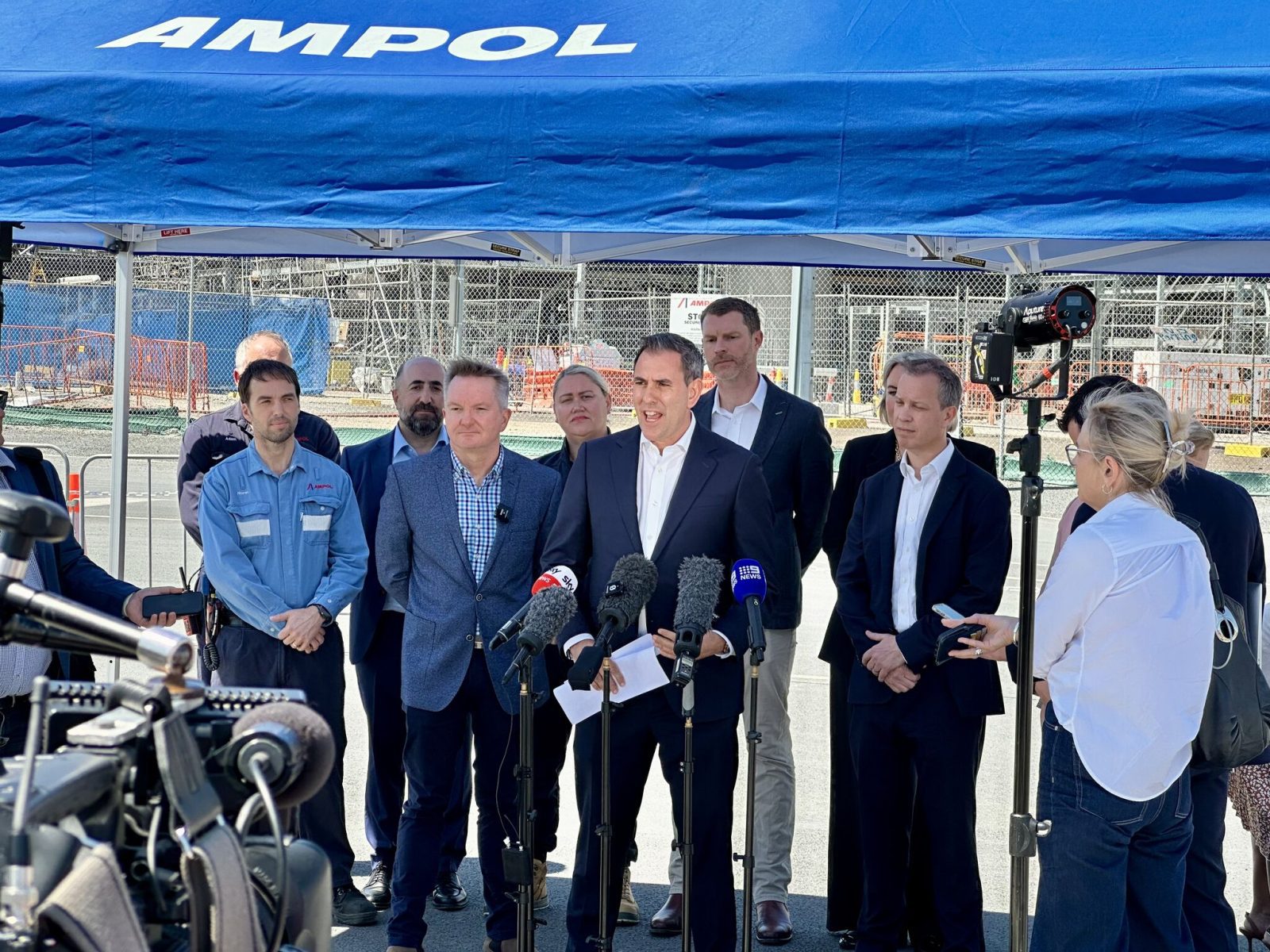
Treasurer Jim Chalmers, with Minister for Energy Chris Bowen to his left address media at this morning’s LCLF funding announcement made at Lytton in Brisbane. Photo: GrainCorp
Industry backs investment
The Low Carbon Fuels Alliance of Australia and New Zealand (LCFAANZ) represents more than 300 stakeholders across the fuel value chain, and has welcomed the announcement as a turning point for the industry and a clear signal that Australia is open for business.
LCFAANZ founder and Bioenergy Australia chief executive officer Shahana McKenzie said the announcement represented a major breakthrough in the building of Australia’s LCLF industry.
“With demand for low-carbon liquid fuels rising both at home and abroad, this investment positions Australia to play a leading role in meeting that need,” Ms McKenzie said.
“With our vast agricultural and industrial base, CSIRO reports that by 2025 Australia will have enough feedstock to replace 60 percent of local jet fuel with SAF, growing to 90 percent by 2050.
“Low carbon liquid fuels will create jobs in regional Australia, boost economic growth, strengthen energy security, and future-proof our tourism and transport industries.”
In a joint statement, IFM Investors, Ampol and GrainCorp also welcomed the Federal Government announcement.
In July last year, the companies signed an MoU to explore the establishment of an integrated renewable fuels supply chain in Australia.
This collaboration combines GrainCorp’s feedstock and supply chain capabilities, Ampol’s refining and distribution infrastructure, and IFM’s long-term investment expertise to accelerate the transition to low carbon liquid fuels.
GrainCorp head of agri-energy Jesse Scott said the funding package was an important step forward in establishing a market for Australian-produced low-carbon liquid fuels.
“Today, around 70pc of Australia’s canola is exported unprocessed, with much of it used overseas for renewable fuel production,” Mr Scott said.
“We want to bring that value-add home and turn our canola into renewable fuels, to ensure there’s a future made in Australia.”
Opportunity for grains
Industry body GrainGrowers has also welcomed the news, describing it as a golden opportunity for growers and regional communities.
GrainGrowers CEO Shona Gawel said the Cleaner Fuels Program represented the development of an important new market for Australian grain, creating additional demand, diversifying income streams, and strengthening the long-term resilience of the industry.
“Across the industry, we have the skills and experience in world-leading grain and oilseed production practices to deliver a reliable and scalable lower-carbon feedstock with established supply chains,” Ms Gawel said.
Ms Gawel said that by harnessing the nation’s abundant feedstock resources, this initiative will support a range of positive national outcomes.
“This investment not only has the potential to assist our national decarbonisation efforts, but it will also bolster Australia’s fuel security and generate new opportunities in regional communities through advanced manufacturing and market diversification.
“Right now, thousands of canola paddocks are in full flower across Australia, a striking reminder of the scale of opportunity for agriculture to underpin the nation’s low-carbon fuel future.
“As an industry, we look forward to working with the government to maximise the benefits of this investment and deliver real outcomes for grain growers and our regional communities.”
Grain Producers Australia said it looked forward to continuing positive engagement with the government and other stakeholders to further understand the specific details, and ensure good outcome are ultimately delivered from today’s announcement.
GPA Chief Executive Colin Bettles said the organisation was keen “to see the true potential benefits of these future opportunities unlocked, from Australian grains farms through to fuel tanks”.
“Given grain producers are feedstock providers, GPA supports well-designed, balanced policy which incentivises increased demand and production, in securing a local market for the supply lower carbon liquid fuels, such as biodiesel and Sustainable Aviation Fuels,” Mr Bettles said.
He said the supply-side policies and strategies currently being developed should ensure growers directly benefit from supplying these feedstocks.
“Given Australian producers are already growing high-quality grain crops, at world-leading standards to reduce emissions, we look forward to recognition of this good performance with environmental practices being included and built upon, in the policy’s ongoing development.
“In particular, in the formation and implementation of a local market that fundamentally unlocks its true potential, by incentivising local production of low carbon liquid fuels.”
Source: Federal Government, Bioenergy Australia, GrainGrowers, Grain Producers Australia, GrainCorp, Ampol, IFM Investors
HAVE YOUR SAY