
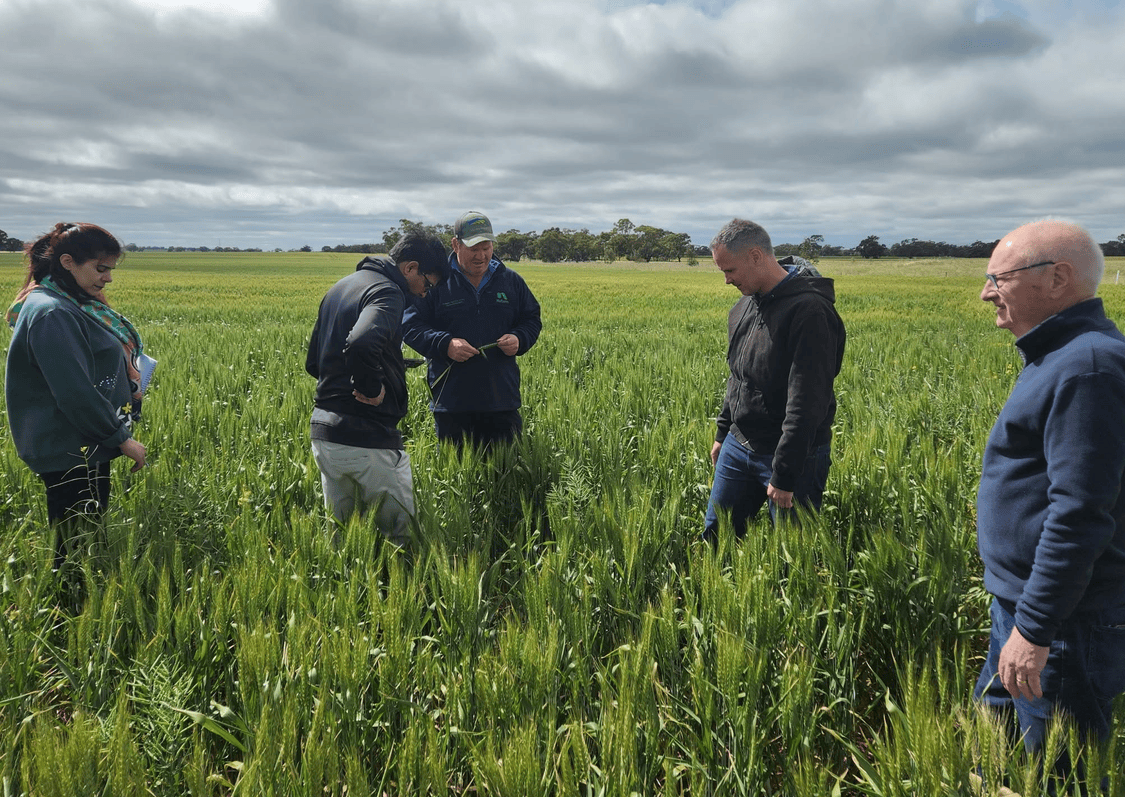
University of Melbourne and University of Agriculture Faisalabad researchers visit a paddock in Warracknabeal, Vic, as part of a knowledge exchange in January this year discussing iron and zinc biofortified wheat. Photo: The Crawford Fund
THE UNIVERSITY of Melbourne is seeking approval from two national regulators to commercially grow, sell and use genetically modified (GM) wheat lines.
The GM wheat lines, containing an event called UM-12115T-1, have been modified to feature a gene from rice which results in higher levels of nicotianamine.
Nicotianamine is a naturally occurring compound that helps plants absorb and distribute minerals such as iron and zinc.
The GM wheat is intended primarily for use as animal feed; if approved, it may also enter the human food supply through food processing and grain supply chains.
Public consultation is open on an application to Food Standards Australia New Zealand (FSANZ) to approve the sale and use of food derived from the GM wheat.
The Office of the Gene Technology Regulator (OGTR) is also considering an application from the University of Melbourne for commercial release of the same wheat lines.
The OGTR application, licence DIR 227, is yet to open for public submissions, with consultation expected to begin in early December.
The GM wheat had been previously grown in field trials in Australia under licence DIR 165.
Issued in 2019, the licence permitted researchers to grow the wheat across up to 4ha at two sites in the first year, followed by up to 10 sites a year for the next four years.
The field sites were across Victoria, New South Wales and Western Australia.
Animal feed targeted
In its application to FSANZ, the University of Melbourne said the GM wheat lines were not intended for human consumption, but approvals were being sought as a precaution because of the “realities of bulk grain supply chains”.
“UM-12115T-1 is a wheat line intended, in the first instance, to support feed-related research, market development and early commercial applications focused on high-efficiency monogastric and supplementary cattle feed,” the application said.
“However, because wheat is an established food commodity that moves through interconnected production, storage, transport and handling systems, seeking FSANZ approval is both prudent and appropriate.
“In particular, the application addresses credible pathways by which grain may enter food channels, including inadvertent co-mingling through shared infrastructure at pre-farm gate, on-farm and post farm gate stages, the blending of grain within commodity systems, and the possible redirection of surplus grain into broader market pathways during periods of structural oversupply.
“Obtaining FSANZ approval ensures that, in the unlikely event of unintended presence in food, the material would be an authorised and safety-assessed product rather than an unapproved GM presence.”
The document said the “primary reason for seeking regulatory approval at this stage is the need to cultivate UM-12115T-1 over substantially larger areas to support research, market development and pre-commercial validation activities”.
“Expanded cultivation is required to generate the grain volumes necessary to undertake efficacy, operational and value-chain studies at commercially meaningful scale, including larger animal feeding trials and broader assessment of the line’s agronomic, nutritional and market potential.”
The application noted preliminary poultry trials undertaken under the existing OGTR licence.
It said these were of a “limited scale” and that consultation with industry found that “subsequent validation will require trials involving significantly more birds to assess performance under conditions more representative of commercial production”.
“Increased grain production will also be necessary to support robust feeding studies in swine and to evaluate potential nutritional and operational benefits in ruminant systems.”
Positive safety assessment
FSANZ has assessed the genes introduced into the bread wheat line, Triticum aestivum L., and deemed them safe for human consumption.
The regulator assessed the OsNAS2 protein, which is derived from rice, while the other protein added to the wheat, hygromycin phosphotransferase (HPT), had been assessed previously.
The assessment found the OsNAS2 protein was “rapidly digested” and did not “not share any meaningful homology with known allergens, coeliac disease-associated proteins, or toxins”.
“No potential public health and safety concerns have been identified in the assessment of increased nicotianamine wheat lines containing event UM-12115T-1,” the document said.
“Based on data provided in the present application and other available information, food derived from these wheat lines is as safe for human consumption as food derived from conventional non-GM wheat varieties.”
Public submissions on the FSANZ GM wheat application will close at 11.59pm Canberra time on 1 December.
It is anticipated that the FSANZ board will consider approval in February 2027 with notification to Food Ministers’ Meeting later that month.
If no review is requested, a decision is expected to be gazetted in May next year.
Source: FSANZ, OGTR
HAVE YOUR SAY