
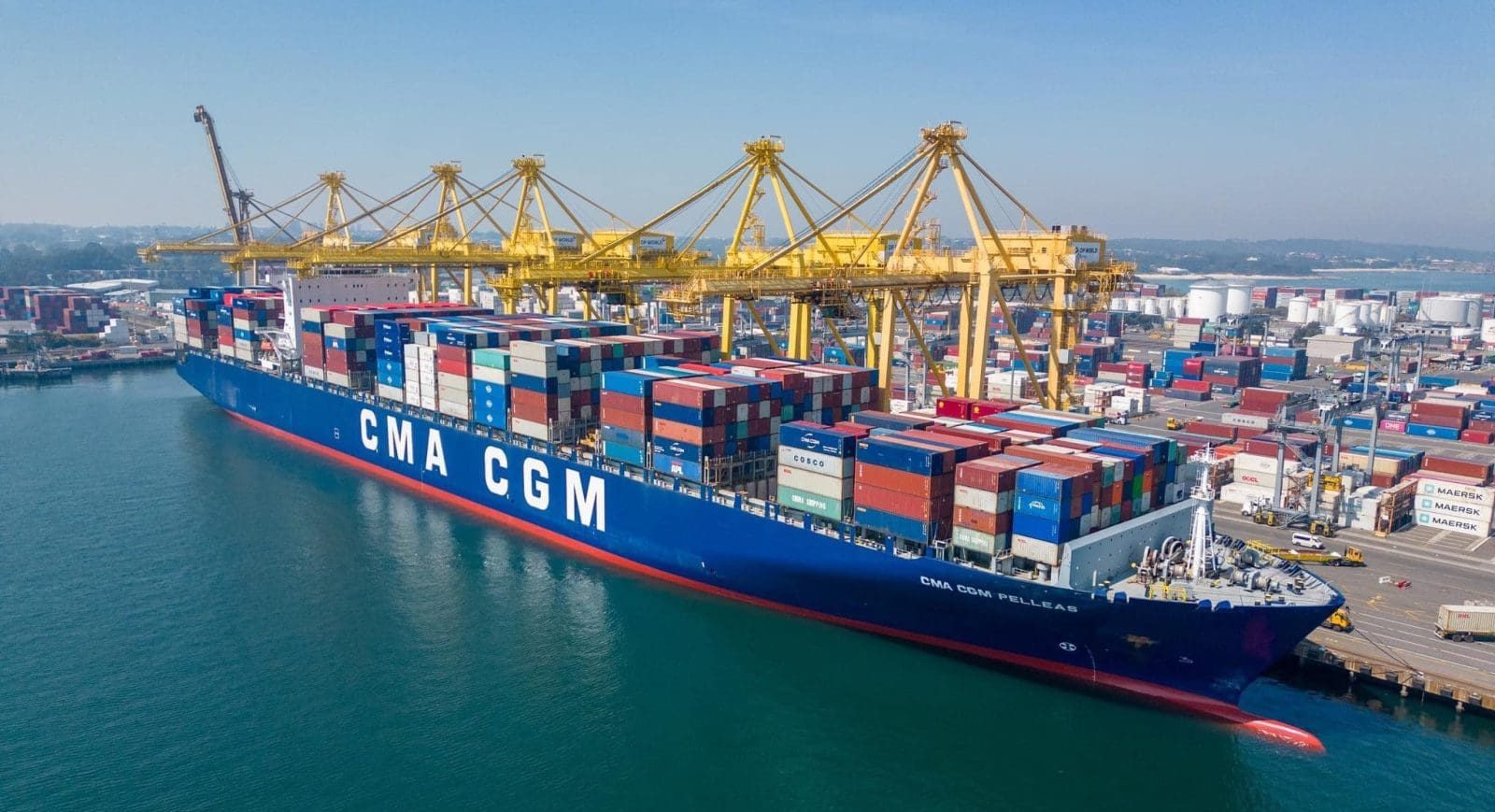
The CMA CGM Pelleas at the DP World terminal at Sydney’s Port Botany in September 2023. At 350m, the vessel was the longest to visit Sydney’s container port. Photo: NSW Ports
SHIPPING diversions and new surcharges are already generating additional costs for Australian exporters as shipping companies react to heightened conflict in the Middle East, according to Australia’s Freight & Trade Alliance (FTA) and the Australian Peak Shippers Association (APSA).
“The situation is already having direct and measurable impacts on Australian supply chains, with disruptions to…container shipping schedules, and the rapid imposition of significant conflict‑related surcharges by major international carriers,” they said jointly today.
Australia is hugely dependent on imported fuel and fertiliser, with the Middle East a major source of both.
Fertilizer Australia chief executive officer Stephen Annells said the situation in the Middle East is developing, but early indications were that requirements for seeding, which will start in earnest next month, would be covered.
“Most of the fertiliser required for seeding is either in Australia or safely on its way,” Mr Annells said.
The joint FTA-APSA statement said the Middle East remains an important trade and logistics partner, with the United Arab Emirates Australia’s largest trade partner in the region, and a critical logistics hub for Australian cargo moving onward to Europe, Africa and South Asia.
On the agricultural front, Australia regularly exports wheat, canola and feed barley in bulk to the Middle East, as well containerised pulses, while Europe is the key destination for Australia’s bulk canola, and Egypt is the sole destination for its bulk faba beans.
Surcharges hit sea freight
Heightened security risk across key maritime corridors including the Strait of Hormuz and Red Sea/Suez Canal has triggered emergency responses by container shipping lines.
Carrier actions reported to FTA/APSA members include:
- MSC instructing vessels in the Gulf region and those en route to proceed to designated shelter areas, while suspending new bookings to the Middle East region until further notice;
- CMA CGM instructing vessels inside or bound for the Gulf to proceed to shelter and suspending Suez Canal transits, with affected services rerouted via the Cape of Good Hope;
- Maersk diverting impacted services away from the Suez Canal and around Africa on affected trade lanes.
These measures are extending transit times, increasing fuel and operating costs, and adding further volatility to already strained global shipping schedules.
FTA/APSA has been concerned by the speed, scale and timing of new carrier surcharges now being imposed on affected trade lanes.
Leading container line CMA CGM has announced an Emergency Conflict Surcharge effective on containers loaded from today, and in place until further notice, and applying to affected Middle East scope cargo:
The CMA CGM surcharge equates to US$2000 per 20-foot dry container, $3000 for 40-footers, and $4000 per reefer or special-equipment container.
HapagLloyd has imposed a War Risk Surcharge, also effective from today, for cargo to and from the Upper Gulf, Arabian Gulf, and Persian Gulf of $1500 per 20′ equivalent unit on standard containers, and $3500 per reefer containers and special equipment.
HapagLloyd’s published notice states the surcharge applies excluding cargo subject to FMC (US Federal Maritime Commission) regulated scopes, and may apply to certain cargo already on the water, but not yet discharged or loaded to/from affected Gulf areas.
Maersk is imposing an Emergency Contingency Surcharge on impacted corridors, with revised amounts and effective dates varying by trade lane.
FTA/APSA members are reporting immediate commercial impacts, including increased transit times and schedule unreliability for sea freight, and substantial unplanned costs arising from new conflict and war-risk surcharges.
“Surcharges of this magnitude…represent a material cost increase for Australian importers and exporters and have the potential to compound broader inflationary pressures where costs are passed through supply chains.
FTA/APSA is concerned by the growing use of extraordinary surcharges imposed at short notice, including in circumstances where cargo may already be in transit.
The explicit reference in some carrier notices to FMC and Shanghai Shipping Exchange-regulated scope exclusions highlights that certain jurisdictions apply regulatory frameworks governing how surcharges may be imposed.
FTA/APSA believes this warrants consideration in the Australian context, particularly around transparency, notice expectations, and commercial certainty for cargo owners when extraordinary charges are applied.
“The operational impacts are clear — reduced air cargo capacity through hub closures, extended sea-freight routings and increased schedule volatility,” FTA general manager freight policy and operations and representative of the APSA Tom Jensen said.
“What is hitting Australian importers and exporters immediately is cost.
“Carrier surcharges already announced since the major escalation over recent days run into the thousands of US dollars per container and, in some cases, may apply to cargo already committed.
“For high-volume traders, these are significant, unplanned costs.”
“Where surcharge notices reference exclusions tied to regulated frameworks overseas, it reinforces the question of whether Australia’s current settings provide adequate transparency and commercial certainty for cargo owners.”
Grain Central: Get our free news straight to your inbox – Click here
HAVE YOUR SAY