
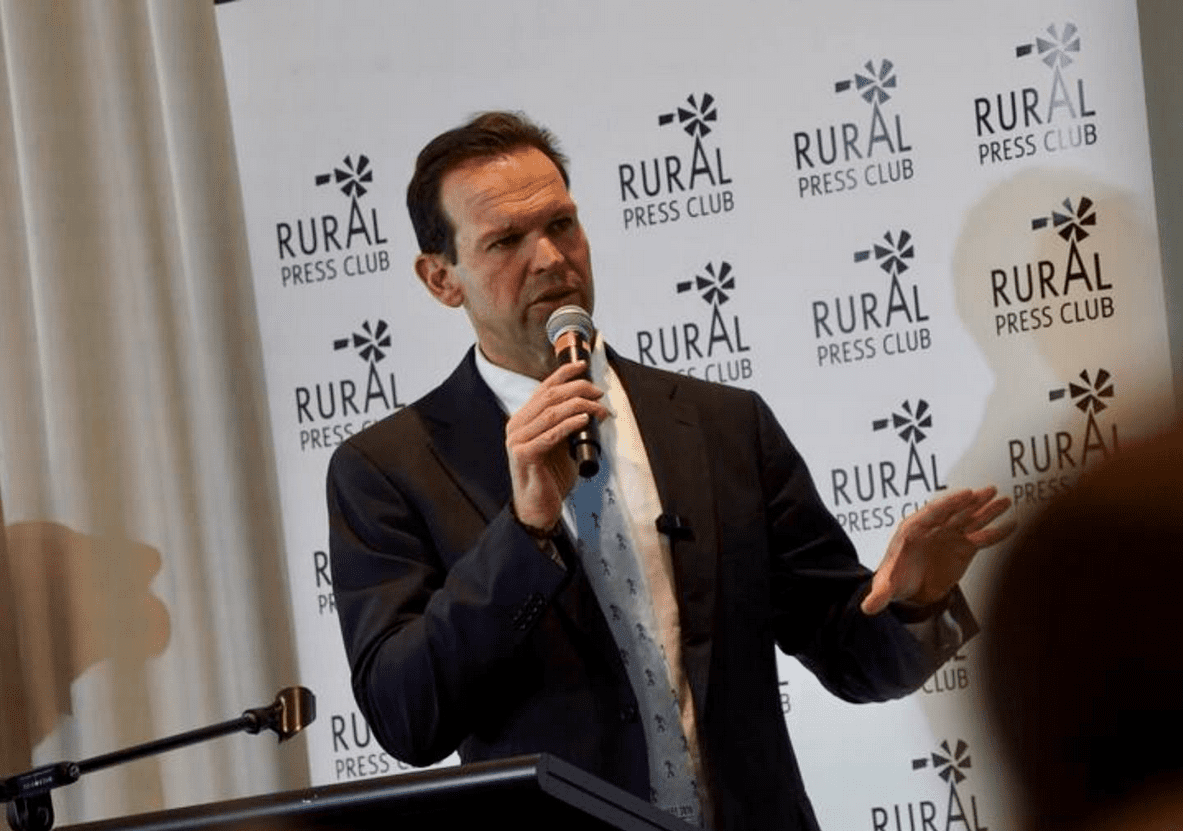
Senator Matt Canavan delivers his post-Budget address to the Rural Press Club of Queensland in Brisbane on May 20. Photo: Senator Matthew Canavan
TAX reform in the wake of the Federal Budget was front and centre for the nation’s agricultural leaders at a meeting of the National Farmers’ Federation’s Members’ Council in Canberra last week.
Bringing together state farming organisations and commodity groups from across Australia, the council passed a resolution calling on the Australian Government to safeguard farm businesses from unintended consequences arising from proposed changes to capital gains tax and their potential impact on intergenerational farm succession.
Concerns have been growing about the changes to the taxes on small business, particularly highlighting the thresholds that define small business as outdated.
Earlier this week, Nationals leader Senator Matt Canavan told the Queensland Rural Press Club that the taxes will disproportionately impact family farmers, with large multi-national corporations potentially being able to escape the tax changes, while family farmers with skinny margins were in the firing line.
In the week of this month’s Federal Budget, the Victorian Farmers Federation has proposed three changes to the thresholds:
- Increasing the maximum net asset value test from $6 million to $20M;
- Increasing the aggregated turnover test from $2M to $5M; and,
- Increasing the retirement exemption lifetime cap from $500,000 to $2M.
NFF president Hamish McIntyre said while the government’s decision to retain small business CGT concessions was important, more work was needed to ensure those settings remained fit for purpose.
“The current thresholds are badly outdated and no longer reflect the reality of family farming today, so our immediate focus is ensuring those settings are reviewed to protect farm succession and prevent unintended consequences for the next generation of farmers,” Mr McIntyre said.
“Family farms often represent farmers’ life savings, carefully invested in over decades to support their retirement and to provide a succession pathway for their children to enter the sector.”
“We need to ensure changes to CGT don’t unintentionally compromise the future of Australian farmers – something that has been positively recognised through the primary production income exemption in the proposed tax on discretionary trusts.
“We welcome the constructive engagement we’ve had with government so far and look forward to continuing this work to deliver practical solutions that allow the next generation of farmers take on the family business.”
Coalition vows to scrap tax changes
The Coalition last week said it will scrap Labor’s CGT changes to protect farmers if it wins the next federal election.
Mr Canavan said a future Coalition Government would immediately stop all of Labor’s “bad taxes”, including changes made to the CGT, which will also impact farmers who were not made exempt.
Under the Federal Budget, from mid-2026 onwards, negative gearing is restricted to new builds, and the 50-percent CGT discount is replaced by inflation indexation, and discretionary trusts face a minimum 30pc tax from 1 July 2028. A three-year rollover relief, available from 1 July 2027, is being introduced to allow taxpayers to restructure their affairs without triggering immediate CGT consequences.
Mr Canavan said returns for Australian farmers are skewed towards capital gain, not income, and so any increase in the taxation of capital gains is going to hit Australian farmers the hardest.
“Given that Australian farmers make most of their returns via capital gains, Labor’s broken promises Budget would be the biggest tax grab launched on Australian farming in history,” Mr Canavan said.
“It means Australian farmers would face one of the highest taxes in capital gains in the world, only beaten by Denmark and Chile.”
“That’s why a Coalition Government will scrap all of Labor’s planned taxes, including discretionary trusts, as well as capital gains tax, which will also impact farmers who were not made exempt, and negative gearing.”
Knights Norfolk accountant Peter Knights described the CGT changes to bring pre-1985 assets in as subject to CGT as “underhanded”.
“These assets were previously exempted for good reason, with many farm families suffering the impacts of the probate regime in the 1960s and 1970s on the same assets,” Mr Knights said.
“CGT has a death-tax effect as often beneficiaries receive assets when someone dies, invariably sell or transfer, triggering CGT, so the capital gains tax is without a doubt a death tax.
“With generational farms there has always been the need to maintain the working asset in the most productive hands, yet no proceeds are generated on transfer of land internally to pay any tax.
“We cannot see the return of similar circumstance the disastrous effects that probate had on farming business a generation ago.
“Whilst small business CGT concessions remain unchanged in this Budget, the eligibility rules are also unchanged for 20 years and fast losing relevance and effect to ensure families stay farming. If nothing else these concessions need modernizing.
“From a farming industry point of view, we have to make sure we can take assets through to the next generation, to those most capable of enterprising, leveraging assets and hard work, producing for the benefit of everyone else.
“When times are tough, traditionally, family farms still show up, but corporate farming must answer to shareholders.
“This is a productivity issue.
“If we increase tax barriers to transfer of farmland, it puts that business at risk and stability of food production at risk.”
Source: NFF, VFF and Coalition
HAVE YOUR SAY