
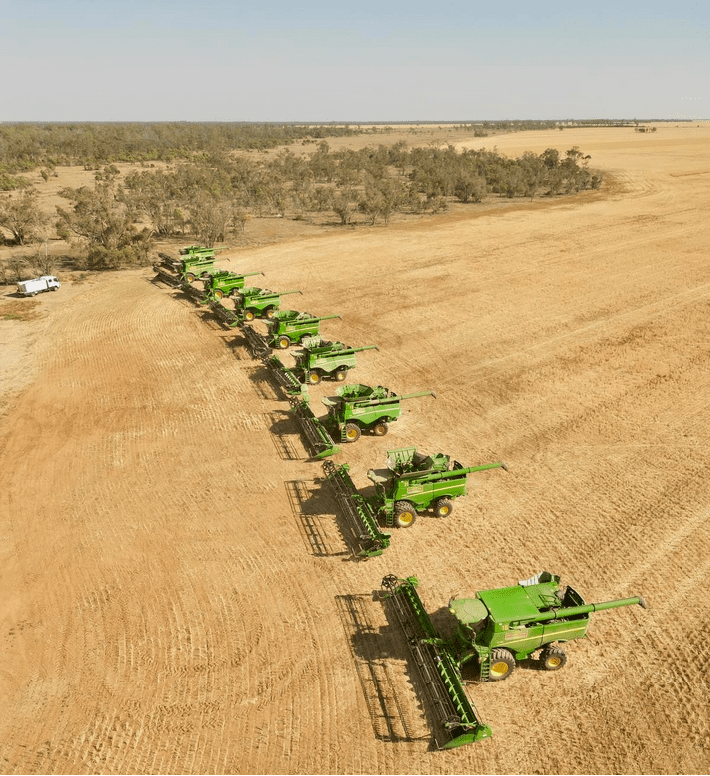
Harvesting wheat in south-west Qld’s Mungindi region, where yields have been above average . Photo: BB Harvesting
HARVEST is rapidly accelerating across the Australian grainbelt, with only Victorian growers yet to start in earnest.
In Queensland and northern New South Wales, cereal yields are above average, and close to three-quarters of the total barley crop has been harvested as growers move into wheat and chickpeas.
Early crops are being harvested in central and southern NSW and parts of South Australia, while the bumper Western Australian harvest is in full swing in the Esperance zone, and just starting in the Geraldton and Kwinana zones.
ABARES on September 2 released its forecast for Australia’s three biggest crops at 33.77 million tonnes (Mt) for wheat, 14.55Mt for barley and 6.45Mt for canola.
Despite challenging conditions for much of Vic, SA, and southern NSW, some upside for wheat and barley is seen due to largely favourable conditions in Qld and northern NSW, and WA.
Lachstock Consulting’s latest estimates put the national wheat crop at 36.6Mt and barley at 14.99Mt, while its canola estimate has dropped to 6.1Mt.
Queensland
In Central Qld, the cereal harvest is close to over and growers are making good progress on chickpeas as the harvest peak rolls south to the Darling Downs.
Nutrien Ag Dalby agronomist Ross Pomroy estimated the Downs’ barley harvest to be 75-80 percent complete, with some bumper yields recorded.
“Generally, our barley yields have been fantastic, and 20pc higher than average, with good grain quality,” Mr Pomroy said.
While yields in the occasional part paddock have eclipsed 8 tonnes per hectare, Mr Pomroy said the average so far had a seven in front of it.
“A good average is 5t/ha; 8t/ha is phenomenal.
“I’ve got guys on better country that have got 6-7t/ha from barley double cropped after high-yielding sorghum.”
Mr Pomroy said barley varieties of recent years have greatly improved standability over their predecessors, which would often top out at 5t/ha before running into yield losses tied to lodging.
Early plantings have enjoyed the best of the season, and some lower yields are expected in later crops, particularly those in more marginal country.
On the Downs, wheat crops have been yielding more than 5t/ha, well up on the average of 3.5t/ha, and Mr Pomroy has estimated the region’s wheat harvest to be around 30pc through.
“We’re getting fairly good protein and grain size, and quite a bit of AUH2 coming in.”
Mr Pomroy said on its first commercial outing this season, the Victrato seed treatment, appears to have helped wheat ward off crown rot and retain yield potential and grain quality in the dry finish.
He said the Downs chickpea harvest was just starting, with crops sown after a summer fallow yielding up to 3.5-3.6t/ha, and down to 2t/ha if double cropped.
Weekend storms brought a little rain and hail to isolated crops on the eastern Darling Downs, but harvest pace is only accelerating across the state.
“By mid-November, we’ll be nearly finished.”
New South Wales
Recent days have delivered up to 20mm of rain to crops in southern NSW, enough to build yield in wheat and pulses, but too late to add much to canola and barley.
As outlined in GrainCorp’s weekly Harvest Update out today, harvest activity remains centred in the state’s north.
Poole Ag Consulting Moree-based director and consultant Tim Poole said with rain forecast for tomorrow, growers are pulling out all stops to get as much in the bin as possible.
“We’ve cracked into it in the past week, and barley is all but done,” Mr Poole said.
Mr Poole said barley yields have been outstanding at 5-6t/ha, and more in places, and he estimated the region’s wheat harvest could be as much as one-third through.
“Yields for wheat have been 4.5-5.5t/ha, when the long-term average is more like 3t.”
Victoria
October has reversed its dry start by delivering yield-building rain in the past week.
Mallee rainfall registrations in the week to 9am today include: Murrayville 23mm; Walpeup, and Woomelang 15mm.
Ahead of the normal harvest start time in the first week of November, Sparke Ag director and senior consultant Matthew Sparke said some Mallee growers got started last week.
Rain was more widespread and heavier in the Wimmera, where the start of harvest looks like being four weeds away.
Higher Wimmera rainfall registrations in the past week include: Dimboola, Rupanyup and St Arnaud 51mm; Horsham 40mm; Nhill 34mm, and Warracknabeal 33mm.
“We’ve had a bit of rain in past week or 10 days and that’s going to fill wheat, canola, and lentils, and will top up barley.”
Mr Sparke said the rain can be expected to see some cereals throw up late tillers, which will add green heads to otherwise ripe crops, and spark a germination of weeds after limited opportunities in the past two seasons to apply knockdown herbicides.
“With the rain will come summer weeds, and some will need a herbicide over the top.
“Some guys have had 50mm over the past 10 days, so there are bits of rust popping up too.”
South Australia
Bunge issued its first harvest report for SA last week as pace picks up on the Upper Eyre and Yorke peninsulas, and the Upper North.
As with Vic, SA has had rain in time to help later crops, with registrations in the week to 9am today including: Balaklava 34mm; Cleve 25mm; Karoonda 31mm; Kimba 24mm; Paskeville 28mm; and Port Germain 22mm.
Platinum Ag agronomist Phil Holmes said harvest in the Mid North and surrounds is yet to start in earnest, and the recent rain should add around 250kg/ha to later cereals, canola and pulses.
“Where there’s hay on the ground in windrows, quality will be reduced,” Mr Holmes said.
The downgrade will come because of reduced protein and digestability, and could knock $50-$80/t off the value of discounted cereal hay.
Mr Holmes said cereal, pulse and canola yields for the Mid North and surrounds were expected to be below average.
“Crops didn’t get that early October rain, but this late rain will help test-weights.”
Western Australia
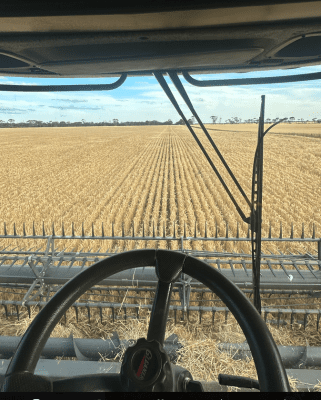
Harvesting barley in the Salmon Gums region north-east of Esperance in WA. Photo: Tim Starcevich
CBH Group’s first Harvest Report for the season is expected within 24 hours, and the co-operative last Wednesday said it expected the WA harvest now gathering pace to yield around 23Mt.
This compares with the Grain Industry Association of WA’s latest estimate for the state’s harvest, which forecasts production at 25.46Mt.
Industry sources report some internal forecasts of more than 26Mt, to challenge the state’s production record set in 2022-23.
Many growers in the Esperance zone have started harvesting barley and canola, and CBH Group received its first load for the season, barley into Chadwick adjacent to Esperance, on October 12.
Grain Central: Get our free news straight to your inbox – Click here
HAVE YOUR SAY