
THREE varieties of genetically modified canola are under scrutiny for returning what some growers have found to be surprisingly low yields.
The varieties, Nufarm’s Emu TF and Hunter TF, and BASF’s InVigor LR 4540P, all contain TruFlex trait technology, marketed as enabling canola to be sprayed with glyphosate into early flowering.
Anecdotes from WAFarmers members and others point to a serious yield deterioration for those varieties sprayed in the latest window.
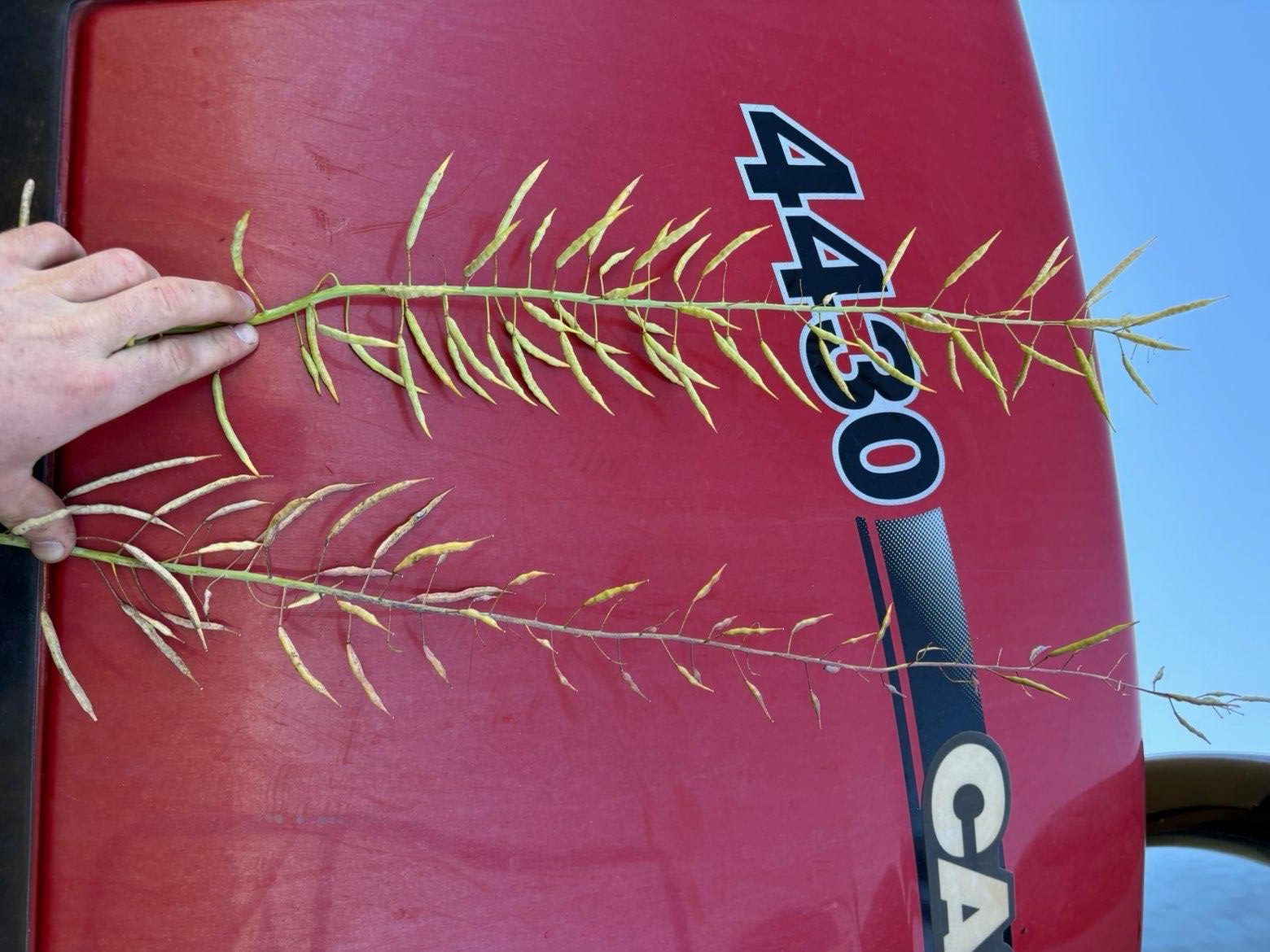
A marked difference in yield potential can be seen between InVigor 4540P at top and Hunter TF at bottom photographed on 23 October 2025 after spraying with glyphosate at the same time. Photo: Courtney Piesse, grower and agronomist, Kojonup
In response, WAFarmers has launched a survey into the perceived failure of genetic traits in TruFlex canola, possibly because of environmental stressors.
To capture results from the current harvest, the survey opened October 22 and will close at the end of this month.
The survey has so far attracted around 80 grower responses, including some from eastern and South Australia, and more than 70 from WA.
Based on information provided through the WAFarmers survey and other sources, and participant appetite for seeking recompense, WA firm Bailiwick Legal may look to engage a barrister to pursue a class action against the seed companies.
If it proceeds, civil action is expected to be pursuant to the Federal Competition and Consumer Act.
Severe yield losses feared
The WAFarmers’ survey includes an introduction which states that growers across WA have found certain TruFlex canola varieties to have lost their glyphosate tolerance when sprayed between budding and 50pc first flower, a period known as the TruFlex window.
“This is thought to be caused by environmental stresses such as moisture deficit or frost,” the survey introduction says.
“It has caused severe adverse crop effects including pod abortion, reduced crop branching and reduced plant vigour generally.
“It is anticipated that this will lead to significant crop yield reductions of 60-70 percent which growers can ill-afford in year of extreme input costs and, in many cases, decile-one rainfall.”
The survey asks respondents with canola crops they see as being affected by a failure in the TruFlex window to name the impacted variety and year it was grown, and quantify the area and estimated yield loss.
Problem acknowledged, cause unknown
Reseller Nutrien is also canvassing issues with certain canola varieties; neither Nutrien, nor BASF and Nufarm named any varieties in responses provided to Grain Central with regard to the WAFarmers TruFlex survey.
“Nutrien has received reports from its customers that certain canola varieties may not have performed to the expected level,” a Nutrien spokesperson said.
“We have communicated with all growers who purchased the reported varieties, and we have invited affected growers to meetings in Western Australia to discuss the issue.
“We are working with the seed suppliers to investigate the issue and identify the cause, however, at this stage, the cause of this performance issue is still being determined.
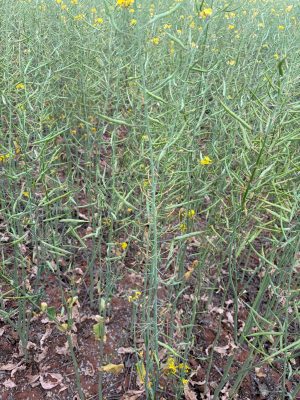
Emu TF in the eastern wheatbelt 18th Sep 2026 after having two glyphosate applications with significant pod abortion. It has yielded around 750-900kg/ha, disappointing given the season. Photo: Courtney Piesse
Nutrien said discussions with its customers remain ongoing, and it will continue to keep growers updated as the investigation progresses.
BASF said it was aware of reports relating to the performance of some canola crops across parts of WA, and observations have been reported across “multiple seed providers and varieties”.
“BASF is working directly with affected growers and agronomists to better understand the circumstances associated with individual cases,” a BASF spokesperson said.
“The cause has not been determined and our technical team is out on the ground investigating.
“BASF will continue to work closely with affected growers and agronomists as further information becomes available.”
Nufarm is also looking into the issue.
“We are aware of reports of variable canola crop performance impacting varieties in parts of Western Australia,” a Nufarm spokesperson said.
“A number of agronomic and seasonal factors may be relevant.
“We are working directly with growers, agronomists, and industry partners to better understand the facts associated with individual cases as the season progresses.”
Favoured varieties
WA has planted a record area of canola this year, seen at around 2.3 million hectares, above the ABARES-estimated 2.2Mha that produced WA’s record canola crop of 4.5 million tonnes (Mt) in 2022-23, and last year’s 4.25Mt from 1.95Mha.
Sources say the abovementioned varieties feature heavily in making canola such an important crop in WA, and have been chosen for their high yield potential, and ability to perform well in a range of environments and seasons.
According to WA DPIRD data, Hunter TF accounted for 18.5 percent of WA’s canola area last year, making it the state’s most popular variety.
Hunter TF was followed by Emu TF at 12.4pc, and after Pacific Seeds’ Hyola Regiment XC at 9.3pc, InVigor LR4540P came in at fourth with 8.9pc of area.
“They represent very significant areas in WA,” WAFarmers Grains Section president Mark Fowler said of the TruFlex varieties in question.
That rings true for Mr Fowler’s Wickepin farm, where Hunter TF sprayed in the TruFlex window is one of the main varieties grown.
“I’m just about to harvest my Hunter; I’d be surprised if it does 0.5t/ha.”
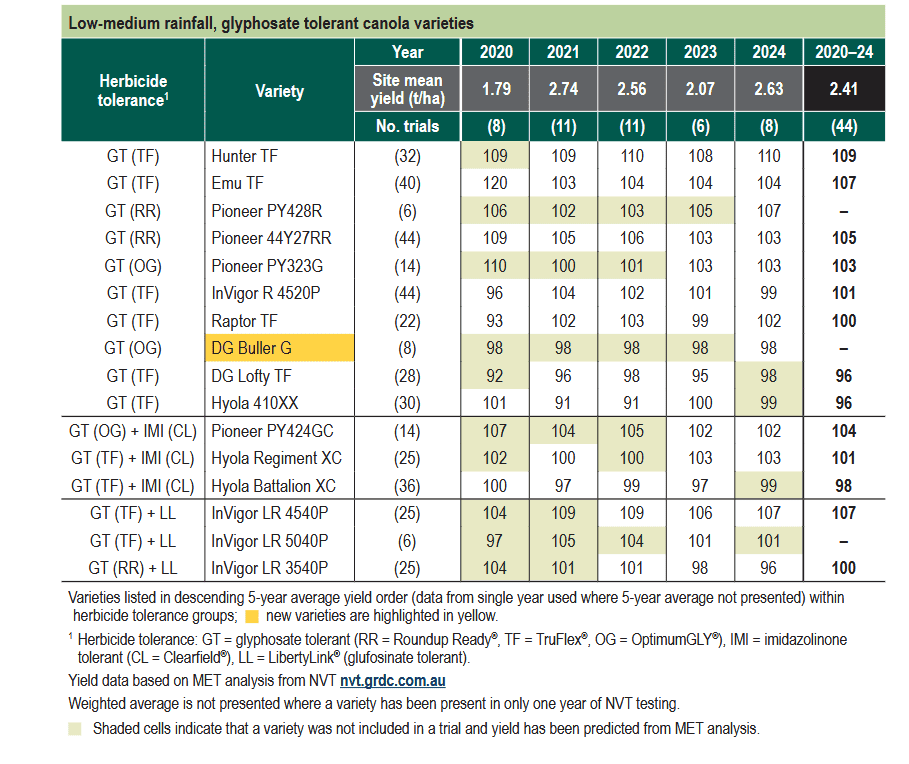
Table 1: Grain yield of glyphosate-tolerant canola varieties at WA’s low to medium-rainfall NVT sites expressed as a percentage of site mean yield for each trial year from 2020 to 2024, and the weighted average over the five-year period, and showing Hunter TF, Emu TF, and InVigor LR 4540P to be among the top performers. Source: WA DPIRD
Mr Fowler expects other varieties planted nearby will yield around 1.8-1.9t/ha, meaning Hunter TF could deliver him a yield penalty of around $1000/ha.
Mr Fowler said issues with Emu TF, Hunter TF, and InVigor 4540P are not universal.
“There are lots of people that have grown [them] without problems.”
Mr Fowler said this may be because they did not spray them in the TruFlex window, or because a soft season masked impact of a vulnerability.
He said information coming into WAFarmers points to the final glyphosate spray impacting the yield potential in varieties in question, and said growers may opt to keep growing them, but avoid the final spray in the TruFlex window.
TruFlex traits allow canola to be sprayed with glyphosate beyond the Roundup Ready window which closes at the sixth true leaf stage, prior to bud formation.
Roundup Ready varieties of canola have been grown commercially in WA since 2010, and TruFlex varieties followed, with Emu TF released in 2021, and Hunter TF and InVigor 4540P in 2023.
Mr Fowler said the TruFlex trait has been valuable for WA growers in allowing weed control into early flowering, and he planted Hunter TF on his farm this year after its strong results last year.
Canola seed containing TruFlex technology is priced at around $55-$60/kg, compared with Roundup Ready varieties at roughly $40/kg, and Triazine Tolerant ones at $20-$30/kg.
“The time has come for growers to speak out; we pay a premium for these traits,” Mr Fowler said.
Click here to access the WAFarmers survey.
Grain Central: Get our free news straight to your inbox – Click here
HAVE YOUR SAY