
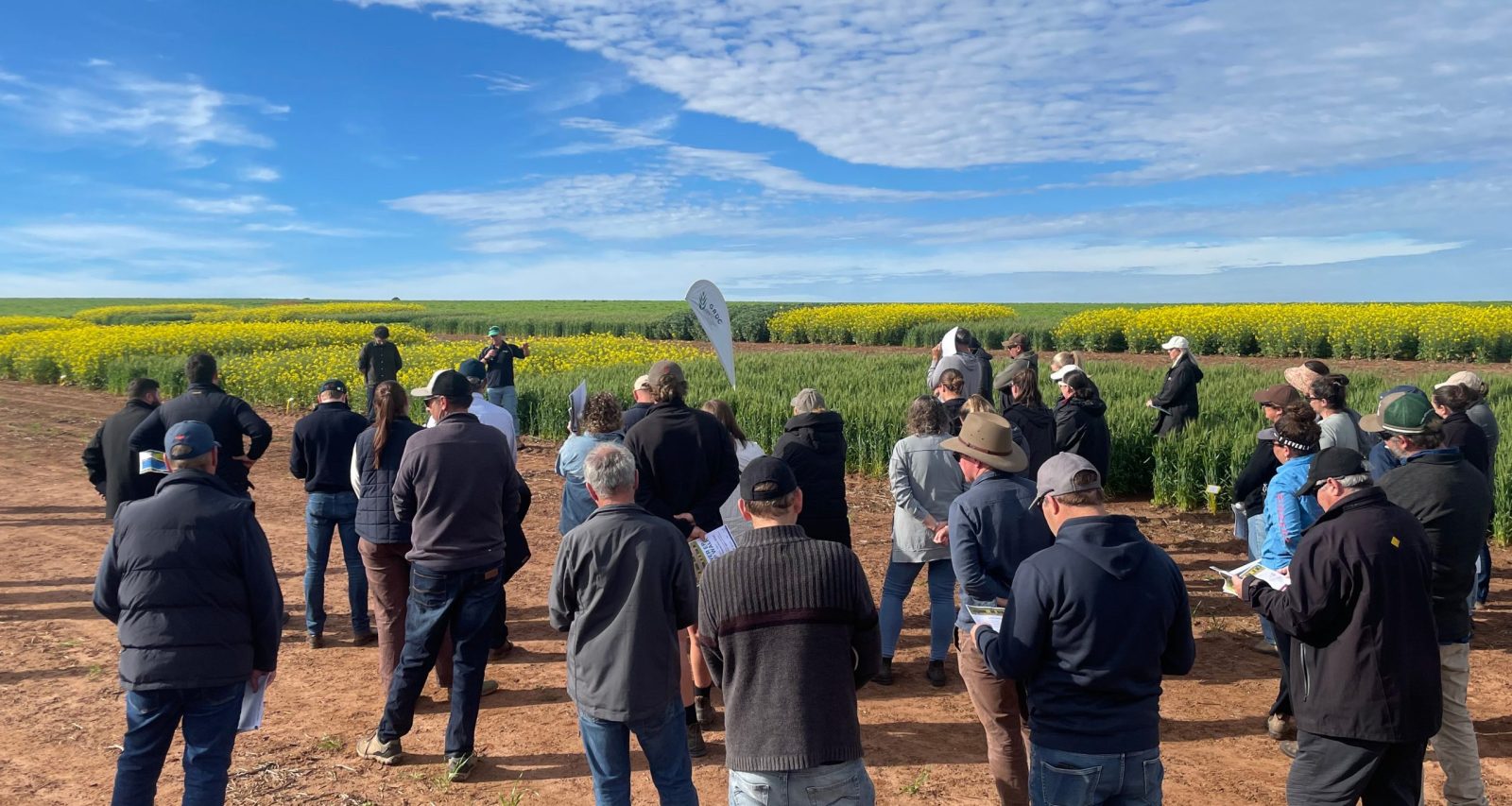
Ag Innovation & Research Eyre Peninsula’s September 8 Lower EP Crop Walk included talks from a range of experts and a look at trials thriving in a stellar season. Photo: Mark Modra
GRAIN production in South Australia is continuing to exceed expectations, with the SA Department of Primary Industries and Regions (PIRSA) estimate for the 2026-27 winter crop lifting to 11.6 million tonnes (Mt).
The figure has come in PIRSA’s latest Crop and Pasture Report – Winter Crop Performance, and shows a major jump from the 9.8Mt estimate in the previous report released in July to site behind only the record crop of 12.79Mt 2022-23.
The forecast is also 2.6 percent higher than the estimate of 11.3Mt delivered by ABARES earlier this month to reflect a season shaping up to be one of the best SA farmers have ever experienced, with PIRSA’s latest forecast sitting 32pc above the five-year average.
Forecasts by both PIRSA and ABARES have consistently increased since the start of the season, reflecting the favourable conditions and a growth in confidence that is matched only by the crop growth farmers are seeing across much of the state.
PIRSA now sees SA’s crop at 6.38Mt, up from 5.25Mt seen in July, and barley at 2.63Mt, up from 2.3Mt.
The report puts lentil production at 1.12Mt, up from 937,610t in July and breaking the 1Mt barrier for the first time to extend the production record set last year.
Above-average rainfall
The report said the strong crop growth this season had been supported by above-average rainfall and significantly improved soil-moisture levels across most parts of the state.
“Average to above-average rainfall fell through winter for all regions of South Australia, with August being the fourth wettest on record,” the report said.
“Root-zone soil moisture is above to well above average for most of South Australia’s agricultural regions, an exception being isolated pockets of average to below-average soil moisture in some south-eastern and coastal districts.”
The wet seasonal conditions had increased the disease pressures, with rusts, powdery mildew, net blotch, blackleg and sclerotinia reported by growers.
“However, proactive monitoring and preventative fungicide programs have generally kept disease levels manageable, and significant impacts on yield potential are expected to be limited.
“While seasonal conditions remain highly favourable, wet paddocks, limited spraying opportunities, fungicide shortages and lodging in oat hay and some barley crops have created localised management challenges.
“Growers also remain alert to frost and heat risks as crops move through critical spring growth stages.”
Climate models are also showing that El Niño is “well established and continuing to strengthen”, with its peak likely to be during late spring or summer.
This could bring an elevated chance of warmer and drier conditions across southern Australia.
A warmer and generally drier outlook is predicted during the October to December period.
Advanced crop progression
PIRSA has crop development “generally more advanced compared to an average season” driven by the early break, soil moisture, and favourable growing conditions.
“Cereals are progressing through flag-leaf emergence and into heading, pulse crops are flowering strongly, and canola crops are at or nearing the end of flowering, with yield potential considered the best seen in several years across many regions.
“High biomass production underpins the best hay and pasture yield potential seen in several years.”
Strong pasture conditions
Abundant feed availability and secure water supplies have made for strong pasture and livestock conditions across most regions.
“Feed availability is above average, and water supplies are secure, with producers reporting full dams and excellent soil moisture reserves.
“With pasture bulk significantly higher than normal, widespread spring feed surpluses provide a strong foundation for livestock production heading into summer.
“Livestock condition is reported to be very good, supporting optimism for livestock production, with many producers focused on conserving excess feed and making hay ahead of summer.”
Cautious optimism
Grain Producers SA chief executive officer Brad Perry said the crop across much of SA looks phenomenal” and the PIRSA report confirms the “enormous potential” this season holders for SA grain growers.
“There is still a considerable distance to go before the grain is safely in the silos,” Mr Perry said.
“If crops can avoid damaging frost and other late-season setbacks, we believe South Australia is on track to challenge the state’s grain production record.”
“One major concern emerging at exactly the wrong time is the sharp increase in diesel prices.
“Harvest requires enormous volumes of fuel for headers, chaser bins, trucks and other machinery, so any sustained price spike will add significantly to growers’ costs and erode the value of what should otherwise be an outstanding season.”
“Growers are optimistic, but they are not taking anything for granted.
“The focus now is on protecting crops from frost, disease, locusts and other seasonal risks, while ensuring the workforce, fuel and supply-chain capacity are available to bring what could be a record crop safely and efficiently into storage.”
SA Minister for Primary Industries and Regions Clare Scriven said the report delivered good news for growers who were on track to deliver “one of the state’s strongest-ever seasons”.
“Forecast production reflects the innovation and skill of our farmers as much as it reflects the favourable growing conditions, as grain producers have seized opportunities even in the face of global pressures such as the cost and availability of fuel and fertiliser supplies,” Ms Scriven said.
“While our farmers are alert to emerging challenges such as locusts and El Niño, this report highlights the resilience, preparedness and optimism of many of our farmers this season.”
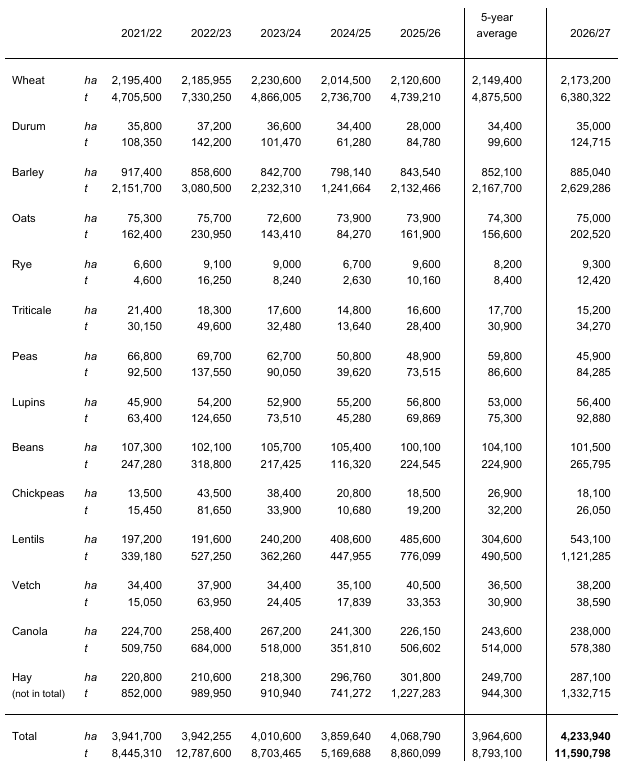
Area and production estimates for major SA crops based on conditions as at 14 September 2026 against the five-year average to 2025-26. Source: PIRSA
Source: PIRSA, GPSA
HAVE YOUR SAY