
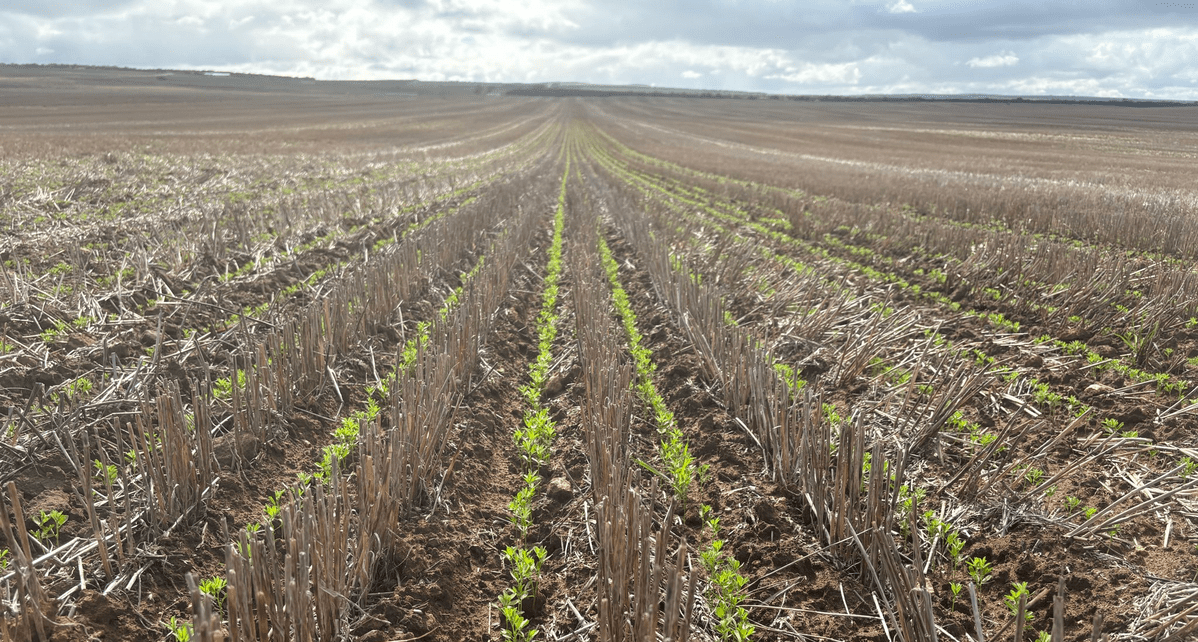
Lentils off to a good start at Strathalbyn in South Australia. Photo: James Stacey
CHICKPEA prices have rallied in recent weeks on some short covering, and as prospects for a widespread plant in southern Queensland and northern New South Wales look limited based on lack of soil moisture.
In contrast, the season in South Australian and Victoria is off to a flying start, with faba bean and lentil crops up and away after an early opening rain and follow-up falls.
ABARES will release its initial forecast for Australia’s 2026-27 winter pulses in its quarterly Australian Crop Report.
The Bendigo Bank Agribusiness (BBA) May Crop Status Report issued May 21 puts the national chickpea crop at 1.3 million tonnes (Mt), down from 1.9Mt last year, with faba bean and lentil production steady on last year at 900,000t and 1.6Mt respectively.
On area BBA’s estimates are for a 900,000ha chickpea crop, down 100,000ha from last year, with faba bean and lentil areas tipped as unchanged from last year at 400,000ha and 900,000ha respectively.
All prices quoted are in Australian dollars per tonne unless stated otherwise.
Chickpeas
Chickpeas delivered Brisbane have traded to a high of $700/t this month, up around $70 from mid-April.
Demand is coming from Bangladesh, India, and Pakistan, some of it for combination cargoes incorporating lentils loaded in South Australia and Victoria.
“Exporters are looking for bulk through July-August,” Sunrise Commodities managing director Scott Merson said.
Rather than reflecting a lift in global pricing, the rally reflects the difficulty traders have had in prising chickpeas out of on-farm storage.
“Farmers aren’t that enthusiastic to sell,” Shepherd Grain trader and director Todd Jorgensen said.
“It could have something to do with the end of financial year.”
While some paddocks in northern NSW have had soaking rain in the past week, it will by and large not be enough to enable a full-scale chickpea planting without a widespread rain of at least 50mm by early July.
At Walgett in the state’s north-west, grower and Outlook Ag director and agronomist Greg Rummery said much more rain would be needed before growers would consider expending around $200/ha on planting chickpeas.
“Around here, most places got 5mm to 40mm; that needs a one in front of it to really make a difference,” Mr Rummery said.
With zero subsoil moisture, planting at depth is not an option for the Walgett district’s growers, who add considerable weight to the NSW crop in favourable years.
The dryness extends to the Goondiwindi, Moree, and Mungindi districts, where Bureau of Meteorology gauges registered zero, 5mm, and 2mm respectively for the week to 9am today.
This is in contrast to higher registrations further south and west, including: Coonamble and Walgett 27mm; Narrabri 30mm, and Pilliga 26mm.
Pulse Australia agronomist Paul McIntosh said conditions are brighter in Central Queensland, where up to half the crop could be planted.
“In CQ, they’ve had a lot more rain than we have here in southern Queensland, so chickpeas are either in or going in,” Mr McIntosh said.
North Qld is also expected to plant an increased area after a wet season that delivered.
Mr McIntosh said southern Qld was “a mixed bag”, with some growers in the Maranoa going big on chickpeas in a planting window which extends into July.
Faba beans
Planting of faba beans in SA and Vic started and finished early, thanks to soaking rain in late February and early March with follow-ups.
Industry sources indicate a bigger plant in the south made possible by the early break may have offset a reduced area in northern NSW and southern Qld, where conditions in April and May were too dry to allow planting.
Domestic demand for fabas has fallen away now that pastures, dual-purpose and fodder crops are up and away in SA, Vic and southern NSW, and are set to provide winter grazing after an unusually mild autumn post germination.
A small amount of faba beans is being accumulated for export at around $400/t delivered Wimmera packer, with the strongest bids coming from domestic splitting for the human-consumption market.
Unsold faba beans are mostly being held on farm for in-house livestock feed, or to sell into the domestic stockfeed market should the season fall over.
In the northern NSW and southern Qld market, domestic demand is coming mostly from graziers looking for a cheaper alternative to cottonseed.
Lentils
Lentils have traded steady to $30/t below last month’s figures for smaller Nipper types, with some short covering bumping up prices to fill what looks like the last of the season’s hatches.
The highest delivered port price was around $670/t delivered port earlier this month.
“Lentils are getting difficult to sell overseas,” Arya Pulses trader Michelle Penrose said.
“Canada’s apparently having a good year again, and their crop will come off in the next couple of months.”
ETG Horsham-based trader Todd Krahe described the lentil market as “fairly flat” at present.
“There’s been a little bit of a spike for June shipments, which is probably a few exporters that thought growers would come to market,” Mr Krahe said.
“The Vic grower has been extremely stubborn.”
Larger Jumbo-type lentils are still commanding a $50/t premium over Nipper types, but Mr Krahe said the spread has narrowed to reflect the well-supplied Sri Lankan market.
On containers, business is still being written and executed into South Asia as trade flows reshuffle around the shuttered Persian Gulf.
“Anything going into the gulf…is still impossible.”
With urea’s expense and the early break, the intended area of new-crop lentils has been planted on or ahead of schedule, and crops are well established.
“Crops have come up quickly; they’ve bounced out of the ground.”
Grain Central: Get our free news straight to your inbox – Click here
HAVE YOUR SAY