
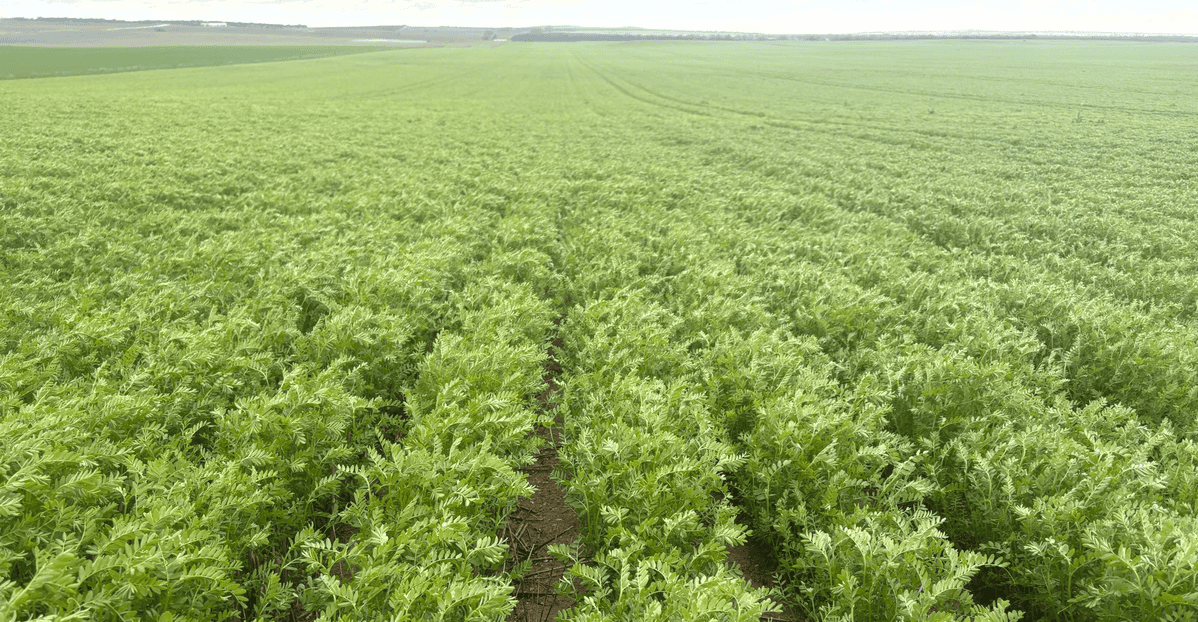
Australian lentil crops including this one at Strathalbyn, south-east of Adelaide, are showing bumper yield potential thanks to an early start, consecutive rain events, and unusually mild temperatures in winter to date. Photo: James Stacey
SOUTHERN Australia’s pulse crops are enjoying ideal growing conditions, and heading towards an early finish which looks likely to set a new record for national lentil production.
However, the global market remains depressed under the weight of big consecutive crops from Australia and Canada.
Faba bean demand is very thin in the export and domestic markets, with chickpeas the bright spot in volume global pulse demand.
Chickpeas, as grown predominantly in Queensland and northern New South Wales, have mostly had limited in-crop rain.
Growers of all three pulses are yet to engage in new-crop trading, with depressed prices the reason on faba beans and lentils, and uncertainty about yields deterring forward sales of chickpeas.
All prices quoted are in Australian dollars per tonne unless stated otherwise.
Chickpeas
Chickpea prices are trading at around $720/t delivered Downs packer, up $30/t since late June.
Mandala Trading director Umang Bagaria said current crop was trading in reasonable volume, with the recent rally in prices reflecting demand from India, Pakistan and Bangladesh.
India has led the charge, with demand receiving a boost from upcoming festivals including Diwali in the year’s final quarter.
“Now the rally has kind of stagnated,” Mr Bagaria said.
“Markets have come to a bit of a standstill at the moment.”
Australian chickpeas incur a 10-percent tariff in India, but demand has looked beyond that to bolster domestic supplies ahead of some uncertainty around the harvest of India’s rabi crop.
Mr Bagaria said Indian buying has been responsible for the market’s recent rise, and competitors Bangladesh and Pakistan have not been prepared to follow it up.
“The rally has caused them to miss out.”
Mr Bagaria said markets were waiting to see if the Indian Government will reduce its duty on yellow peas from Canada and the Black Sea to bolster domestic pulse stocks.
This could send chickpea prices south and spark the next round of buying from Bangladesh and Pakistan.
With their feet in subsoil moisture, chickpea crops in Qld and northern NSW are looking at average or better yield prospects, but are susceptible to August-September frosts, when many crops will be flowering.
Concerns about the strengthening El Niño, which has a habit of turning off the tap in Qld and northern NSW before it impacts other regions, are also looming large.
“New-crop is not trading, only because there’s no rain in Australia’s chickpea-growing areas.
“There is a little bit of that El Niño effect in the market.”
Containerised chickpeas are trading at $790/t DCT as the bulk program pauses ahead of new-crop becoming available out of Central Qld ports in October-November.
Faba beans
Very few faba beans were planted in northern NSW and southern Qld this season because general rain did not fall until after the northern planting window closed in mid-May.
However, a reasonable area has been planted across southern Australia, where demand from the stockfeed industry is minimal thanks to plenty of paddock feed for sheep and cattle.
Australian Grain Export pulse trader Mitchell Olive said demand signals were weak from Egypt, which typically buys up to 70pc of its imported faba beans from Australia.
“We’re seeing an oversupply in the Egyptian market,” Mr Olive said.
“We’re not seeing demand.”
In his report last Friday on the 2026-27 faba bean market, GrainSource trader Simon Hutt said buyers were bidding deliver port zones at $400/t, well below offers at $440-$450/t.
The bid is nominally down around $20/t on late June values, while offers have not budged.
Australian growers holding faba beans are believed to be happy to do so as long as this El Niño develops, and brings with it the threat of reduced livestock feed.
Mr Hutt’s report said some upside can be seen for new-crop Australian beans if either the quality of European faba beans fails, or the Australian dollar weakens, while the downside risks include “a clean French export program landing on a stronger Australian dollar”.
“If France delivers volume and quality, Egypt covers its early window cheaply and Australian bids stay defended at current levels for longer.
“If UK and Baltic quality disappoint — and the disease and heat evidence points that way — Egyptian demand arrives in our window earlier and with more urgency than current bids assume.”
Lentils
Current-crop lentils have traded sideways in the past month at around $630/t delivered port, while the new-crop market is developing around a $600/t maximum level.
Unenthused by new-crop prices, growers are showing little engagement, despite bumper or even record yields looking likely.
AGE’s Mr Olive said Canada’s new-crop lentils will start to appear next month, and volume will build in September.
“There’s plenty of supply both in Canada from their old crop and their upcoming crop, and we’re expecting to have a record crop here,” he said.
Ahead of that, Mr Olive said the market was seeing “a little bit of spot demand in India”.
Across developing lentil areas in Western Australia and NSW, and in their heartland states of South Australia and Victoria, yield prospects are universally stellar.
That includes Vic’s northern Mallee, which like other growing areas got off to a strong and early start, and has not looked back.
“If marginal country is having a good year, you can imagine how good the good areas are.”
Grain Central understand the last few bulk cargoes for the season have shipped out of southern Australian ports this month, with SA largely sold out.
WA pulse events scheduled
The Grain Industry Association of WA is holding its first Power of the Pulse agronomy workshop on August 17 at Tompkins on Swan in the Perth suburb of Alfred Cove.
Over a half day, the event will bring together experts able to speak directly to the agronomic and economic barriers that limit pulse adoption, giving insights to strengthen advice participants provide to clients.
The program features WA grower and agronomist Erin Cahill and researcher Audrey Delahunty from Agriculture Victoria.
On the following day, a field day is being held at Piawaning to showcase trial sites covering weed control, nutrition and disease management in lentils, field peas, chickpeas, and lupins.
It will also include presentations from WA growers who have integrated pulses into their farming systems.
Agronomists, farm business advisers, grain marketers and other subject experts will cover everything from choosing, sowing, managing, harvesting, storing and marketing pulses.
Both events are supported by the Grains Research and Development Corporation, and are now taking registrations.
Grain Central: Get our free news straight to your inbox – Click here
HAVE YOUR SAY