
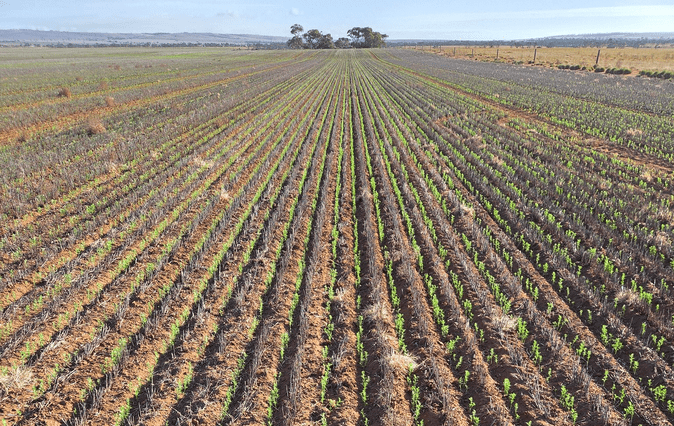
Lentils planted mid-March in SA’s Port Wakefield district are off to a strong and early start. Photo: Leighton Wilksch, Agbyte
GROWER selling of chickpeas, faba beans and lentils has slowed as dry conditions in the north intensify and export pricing remains flat.
Limited subsoil moisture in northern New South Wales and south-west Queensland is pointing to a much-reduced chickpea and northern faba bean area this year.
In contrast, Victorian and South Australian lentil and faba bean area could be up after rain since late February which has filled many subsoil-moisture profiles.
All prices quoted are in Australian dollars unless stated otherwise.
Chickpeas
The bulk chickpea market delivered Brisbane is trading at around $630 per tonne, steady to $5/t up on mid-March values.
Sunrise Commodities managing director Scott Merson said prompt pricing sends no incentive to growers to sell stock on hand, or plant new crop.
This is despite chickpeas requiring no planting or in-crop nitrogen in this period of inflated and hard-to-source urea, and expensive diesel, all functions of the Iran-US conflict which has effectively closed the Strait of Hormuz.
Chickpeas are planted at depth, which consumes more fuel than shallower-planted cereals.
“At $600 a tonne [on farm], no-one is that interested in planting chickpeas deep,” Mr Merson.
“We don’t have the pricing signals to justify planting them.”
However, the main planting window for chickpeas stretches from late May to early July, so significant rain between now and then could lift area, and Central Qld is expected to have a regular-sized plant based on its higher levels of subsoil moisture.
Wheat prices in the north have rallied as consumers in northern NSW and southern Qld start pulling cereals from further afield.
It means growers with chickpeas and wheat stored on farm are choosing to sell wheat into the bullish domestic market, and hold the chickpeas.
The potential for al El Niño to develop has made northern growers, who can crop over both summer and winter, lean towards fallowing over winter in the hope that good rain falls by September, and diesel and urea prices drop.
“It’s quite dry, and the outlook for rain is not great.”
“What the growers have in storage could well be their production for the next 12 months.
Faba beans
The focus of the faba bean market is switching from export to domestic as dry conditions in the north lift its inclusion in poultry and other rations.
The Brisbane poultry market is currently paying around $450/t delivered for faba beans, $20/t above where No. 2 beans delivered southern ports were trading last month.
“If they turn into a domestic drought-type feed, it’ll start to creep up,” Mr Merson said of the faba bean market.
Along with cereal hay and barley, faba beans are being held by mixed farms in NSW, Vic, and SA with sheep and cattle to feed.
Just as northern feed demand is lifting NSW and southern Qld prices for wheat and barley, it may well lift the northern market for faba beans, which are looking at a much-reduced planted area this season because of dry conditions.
The faba bean planting window is the first of the major pulses to close, with mid-May generally the cut-off in the northern and southern regions.
ETG pulse trader Todd Krahe said last month’s rain is expected to prompt an early run on faba beans in higher-rainfall areas.
“I assume we’ll see a good faba planting for southern Vic and the South East of South Australia.”
Lentils
Australia’s bulk exports of lentils have slowed to a trickle to reflect the rundown on stocks left in SA, and limited stocks in traders’ hands in Vic.
Containerised business is still ticking along and bound for ports as far west as Pakistan, with Nipper types trading at $630-$660/t, and $720-$750/t for Jumbo types.
“There’s a good premium for larger varieties,” Mr Krahe said.
One bulk cargo, and one or two combination ones, are expected to wind up the bulk program for the foreseeable future.
“Things have definitely slowed right down.”
New-crop prospects for lentils are bright, based on recent rain which has allowed growers in SA and Vic to spray out recently germinated weeds, and some growers in SA’s northern regions like Upper Eyre Peninsula are into planting.
“We should expect nice clean crops this year after having a pre-season knockdown.”
However, dryness in topsoil could well pull up the early start to germination, and a switch to dry sowing from Anzac Day onward, as is usual for the Vic Mallee and Wimmera, and much of SA.
Grain Central: Get our free news straight to your inbox – Click here
HAVE YOUR SAY